How to Stay Connected in Marriage During Hard Times
Four months into their marriage, Sarah-Gayle got a phone call that changed everything. Her brother died. She cried every day for over a year. And Chad, not wanting to add to her burden, quietly shut down his own needs and emotions.
That's how emotional drift starts. Not with a blowup. With silence.
In this episode of the Hope Relentless podcast, Chad and Sarah-Gayle open up about how to stay connected in marriage during hard times: grief, business failure, and the seasons where they kept missing each other. Here's what helped, what didn't, and four anchors that held their marriage together when life fell apart.
Prefer to watch instead of read? Here is the full episode.
Key Takeaways
- Comparison quietly disconnects couples. Both spouses' needs matter, even in a season of grief.
- A faith crisis is often just as disruptive to a marriage as the loss itself. Name it, don't avoid it.
- Staying connected during hard times starts with asking how you're contributing to the solution, not just what your spouse is getting wrong.
- Forgiveness isn't optional in hard seasons. It's what prevents resentment from becoming a permanent wall.
- Community, personal faith, forgiveness, and service are the four anchors that hold a marriage together when life falls apart.
In this episode, we cover
- Why suppressing your own needs to 'protect' your spouse quietly disconnects you both
- How three family losses in five years tested Sarah-Gayle's faith and their marriage
- What happened when the business failed, and they had to start over in a new city
- The 'both and' mindset that creates space for both spouses in hard seasons
- Four anchors that held their marriage together: community, personal faith, forgiveness, and service
The Comparison Trap: When One Person's Pain Silences the Other
When Sarah-Gayle lost her brother four months into their marriage, Chad made a quiet decision. His frustrations didn't seem to matter compared to what she was navigating. So he stopped bringing them up. Stopped sharing. Started suppressing.
It felt like a sacrifice. Over time, it became drift.
Chad and Sarah-Gayle call this the comparison trap. It's the moment one spouse decides their needs aren't worth mentioning because the other person's pain seems bigger. The problem is that comparison doesn't protect the grieving spouse. It just silences the other one. Two people can share a home for years while slowly losing each other emotionally.
The phrase they use now with couples is the 'both and.' Both spouses matter. Both experiences deserve space. You don't have to wait for the grief to lift before your voice gets to exist in the marriage.
If your spouse is going through something heavy right now, ask yourself: Am I still fully in this marriage, or have I quietly become support staff?
The comparison trap doesn't only show up in grief. It shows up in financial hardship, when one spouse decides their stress about money doesn't count compared to how hard the other is working. It shows up in parenting seasons, when one person is running on empty but decides their exhaustion doesn't matter because the other one looks more tired. It shows up after a health crisis, a career loss, a miscarriage, a prodigal child.
The form changes. The dynamic is the same. One person goes quiet to make room for the other, and slowly, both people end up alone. What makes the comparison trap stubborn is that it doesn't feel like a mistake when you're in it. It feels like love. Choosing not to burden your spouse with your needs, in a season when they're already carrying so much, feels like the kind thing to do.
A marriage where one person has no voice isn't a protected marriage. It's an unbalanced one. And unbalanced things eventually fall.
The "both and" isn't a technique. It's a posture. It's deciding together that this marriage has room for two people, even in the seasons when one person's pain takes up more space. It doesn't mean forcing equal airtime. It means neither spouse disappears.
In practice it often starts with one question, asked genuinely: "How are you doing in all of this?" Not as a formality. As a real invitation for the spouse who has gone quiet to come back.
When Life Hits One of You Harder
goes deeper on what to do when one spouse carries more weight than the other.
When Grief Stacks: The Faith Crisis That Comes With It
Sarah-Gayle didn't lose one person. Within five to seven years, she lost her brother, her mother, and her sister. Each loss arrived before the last one was fully processed.
And in the middle of all of it, she was wrestling with a harder question than most couples ever talk about: Is God still good?
She had been believing for her brother's healing. She had a picture of his future in her mind. When he died, it wasn't just grief. It was a faith crisis. And that kind of crisis doesn't just affect the grieving spouse. It ripples through the entire marriage.
What pulled her through wasn't a perfect theological answer. It was a decision. She raised her hands in worship after her brother died, choosing to hold God at his word: 'give thanks in all things,' not because circumstances proved his goodness, but because she resolved to anchor her faith there. That conviction carried her through the next two losses as well.
If your marriage looks fine on the outside but feels stuck on the inside, Christian Marriage Communication: Why Hiding Your Struggles Is Costing You speaks directly to that.
How to Stay Connected in Marriage When You Keep Missing Each Other
Around years 10 to 12, Chad and Sarah-Gayle closed a business they had poured everything into and moved from Los Angeles to Arizona to start over. New city. New jobs. No roadmap.
That's when they kept missing each other. Sarah-Gayle needed encouragement and emotional presence. Chad needed her to lock in and push forward with him. She wanted him to solve the problem. He wanted her to meet him in the resolve. Neither of them was wrong. But they kept showing up to the same marriage expecting completely different things.
Chad remembers praying during that season and feeling a very clear challenge from God: You'll find a way to justify whatever you want to justify. So which direction do you want to look?
That shift, from blame to asking 'how am I contributing to the solution?' is where things began to change. Not overnight. There were hurtful words along the way. But forgiveness created a clean slate, and a clean slate made it possible to start rebuilding.
One pattern they see consistently in the couples they work with: resentment that builds when spouses feel unseen in a hard season. Forgiveness isn't passive. It's a decision to trust God with the healing and refuse to let the pile keep stacking.
Not sure how far the drift has gone?
Hard seasons hide the distance. Take the free Marriage Assessment to see where your marriage is still strong and where it has quietly pulled apart, so you know what actually needs attention.
Take the Free Marriage AssessmentFour Anchors That Hold a Marriage Together in Hard Seasons
Chad and Sarah-Gayle close the episode with four things that sustained their marriage across grief, business failure, and the weight of starting over. These aren't theories. They're the things that actually worked.
1. Community / Local Church
They were already planted in a local church in LA, not as spectators, but as people who had served and built real relationships. When the losses came, people brought food, prayed with them, and showed up. Community didn't replace God in their story, but it was the hands and feet of his grace in tangible form.
The keyword is planted. Not attending. Not visiting. Planted, with roots deep enough that when the storm hit, the community was already there. Most couples we work with who feel alone in a hard season have the same story underneath: they had been circling the church rather than actually connecting in it.
Showing up on Sundays but never joining a small group, never serving, never letting anyone in close enough to know what was actually happening at home. Community only shows up for you when it knows you. That kind of belonging gets built slowly, in the ordinary seasons, so it's there when the hard ones arrive.
If your marriage is struggling right now and you feel isolated, ask yourself honestly: have we actually let anyone in, or have we been protecting an image? Real community requires real vulnerability. And real vulnerability is exactly what most couples avoid until they're desperate. Stop performing for your church community and start building within it. The roots you put down today are what hold you when the ground shifts.
2. Personal Relationship with God
Separate from church attendance, both Chad and Sarah-Gayle had individual faith lives that continued to grow even during the hard seasons. That's where the 'both and' insight came from. That's where the conviction about God's goodness took hold. Individual faith sustained the marriage even when the marriage was struggling.
There's a difference between going to church and actually walking with God. Both matter, but they're not the same thing. Community can carry you through a hard season. Personal faith is what grows you through it. For Chad and Sarah-Gayle, the "both and" insight didn't come from a counseling session or a conversation with a friend. It came from time alone with God. So did the conviction that he was still good even when the outcomes didn't match the prayers.
What this looks like in practice varies from person to person. For some, it's daily Scripture. For others, it's journaling, prayer walks, or worship. The format matters less than the consistency. A marriage under pressure needs two people who are each drawing from something deeper than the relationship itself. If you're leaning entirely on your spouse to be your spiritual anchor, that's too much weight for one person to carry. Your personal relationship with God is not a supplement to your marriage. It's a foundation under it.
For us, praying together through hard seasons became the anchor that held everything else.
3. Forgiveness
Hurt people hurt people. They say it plainly. In survival mode, couples wound each other. Forgiveness wasn't the absence of pain. It was the decision not to let resentment stack. It's difficult to forgive a spouse when you don't first recognize how much you've already been forgiven yourself.
Survival mode has a cost. When couples are under enough pressure, they say things that land hard. They withdraw at the wrong moment. They push when their spouse needs space, or disappear when their spouse needs presence. Nobody is at their best in a crisis. Most couples acknowledge the wounding. What trips them up is what they do with it afterward. Every unaddressed offense gets filed away. And over time, that pile becomes the lens through which your spouse sees everything you do.
Forgiveness doesn't mean pretending the hurt didn't happen. It means deciding not to keep adding it to the case against your spouse. It means trusting God with the healing rather than keeping score yourself. The hardest part for most people isn't forgiving. It's feeling justified in not forgiving. The offense was real. The pain is real. But resentment held onto long enough becomes a wall, and walls don't just keep your spouse out. They keep you in.
If forgiveness feels impossible right now, start here: you have been forgiven more than you have been hurt. Let that be the ground you stand on.
4. Serving Each Other
Even in the hardest seasons, choosing to serve the other person created the bridge back to connection. Service is what turns individual faith into relational repair. It's the move that says 'I still choose you' even when the feelings aren't there yet.
Most couples wait to feel connected before they start acting like it. Service flips that. You act your way into a feeling, not feel your way into an action. In the hard seasons, serving your spouse rarely looks dramatic. It's making the coffee before they ask. It's taking something off their plate without being told. It's sitting with them in a hard moment instead of trying to fix it. Small, deliberate choices that say "I still see you" when everything else is loud.
The hard part is that difficult seasons are usually when both spouses feel the most depleted. You're running low yourself. Serving when you have nothing left feels impossible, or at best, unfair. Chad and Sarah-Gayle didn't serve each other because they had plenty to give. They served each other as a decision, before the feelings caught up. The connection didn't come first and produce the service. The service came first and eventually rebuilt the connection.
You don't wait until you feel close to start choosing your spouse. You choose your spouse until you feel close again.
What Scripture Says About Marriage in Hard Seasons
Your Next Step
If any part of this resonated, pay attention to that. Drift doesn't announce itself. It gets quieter until the distance starts to feel normal. If the two of you keep circling the same distance without closing it, that is the point where marriage counseling
is worth a look. The free consultation is one honest conversation, 30 minutes to get clear on where you are and what your marriage actually needs right now. No commitment required.
Reflection Questions for Couples Going Through Hard Times
- Is there something one of us has been holding back to protect the other? Is there space for both of us to be honest right now?
- In our current hard season, are we fighting against each other or alongside each other?
- Which of the four anchors (community, personal faith, forgiveness, or serving each other) feels weakest in our marriage right now?
Keep Building Connection
Connection is built in a hundred small moments. These go deeper on the ones that matter most.
- how curiosity saves your marriage
- getting on the same team as your spouse
- cultivating emotional connection
- conquering loneliness together
- daily deposits that fill your spouse's cup
- when your marriage is getting the leftovers
- the intentional marriage
- why love and respect is oxygen to a marriage
- when we commit to connect, we stay connected
You do not have to navigate this season alone
If this episode hit close to home, you don't have to navigate this season alone. Chad and Sarah-Gayle work with couples facing grief, disconnection, and the weight of starting over.
Schedule a Free ConsultationCheering you on,
- Chad & Sarah-Gayle
There's always, always hope.
Sarah-Gayle Galbreath, MSMFT Sarah-Gayle holds a Master's in Marriage & Family Therapy from Azusa Pacific University and has 15+ years of experience helping Christian couples build stronger, more connected marriages. She and her husband Chad have been married 20+ years and co-host the Hope Relentless podcast together.
Chad Galbreath, Ordained Minister Chad is an ordained minister with a Bachelor's in Sociology from UCLA and 15+ years of experience helping married couples find practical, lasting breakthrough. Together with Sarah-Gayle, he leads marriage workshops, teaches at local churches, and co-hosts the Hope Relentless Christian Marriage Podcast.
Read the full episode transcript
Chad (00:00)
in today's podcast, we're gonna jump right in and we're gonna talk about something, whether you've been married for a couple minutes or a couple decades, you've likely experienced, and that is difficult seasons. It's easy for relationships to thrive when everything's going well. The reality is the longer our relationship, the higher likelihood that we face grief, loss.
challenge obstacles and so the purpose of today's podcast is to highlight some of the challenges that Sarah-Gayle and I have faced and be transparent the things that maybe didn't serve us well
But also highlight what are some things that got us through those seasons or as we look back with more wisdom, with more context, we recognize, wow, these are some things that would have continued to encourage and equip us. And that's our heart. Our heart here isn't to compare our difficult seasons against your difficult seasons. Our heart here is to encourage and equip you. One, we all face difficult seasons. So it doesn't necessarily mean you did something wrong. Now, there are moments where we've created our own obstacles as well.
But that's not the purpose or the focus. It's highlighting different dynamics that in difficult seasons, what can we do as individuals and what can we do as a couple to navigate through that season?
Sarah-Gayle (01:16)
Yeah, and it's so important and I know for us as we were younger in marriage it would have been so helpful for us to have more resources that talked about the hard when it comes to marriage because there are a lot of hard painful moments and a lot of times we highlight you know what the fairy tale what it should be or or the fantasy but I think the real conversations need to be had because we could use support in those seasons. I know Chad and I got married pretty young. He had just turned 21. I was 23. So yes, I am a cougar.
and it's so we could die at the same time. So this was very strategic. But anyways, like I said, it would have been nice to have more resource in the midst of those seasons, but we're gonna tell you about some of the areas that were helpful for us as we go through this podcast. And the first thing I wanna bring up is
four months after we got married, my brother passed and that was devastating for me. I remember crying every day, literally, this is not an exaggeration, right? Like every day for at least a year. And it was so painful and heart wrenching for me because I was really believing God for my brother. I was believing that he would be restored, that some of the habits and hangups that he was dealing with, he would be healed in Jesus name from them.
I saw him with a family and so I saw this image of him by faith that I was really holding on to so when he died it not only broke me as far as just created a lot of sadness in me but it impacted my faith as well because I was asking the question is God good? this was a lot to deal with four months after we had just gotten married and I want to hand it off to you before I continue because what I went through was my experience.
And I want to hear about what you went through.
Chad (02:59)
Yeah, I mean, think you talked a little bit about the context, but it's, you know, 21 and 23. I was actually still a senior in college, so I was finishing my degree and working. Sarah-Gayle had just graduated, was working, and those first four months were almost like honeymoon. Yeah. Right. Like we're living together as Christians. We waited until marriage, so we're enjoying the fruit of newlyweds and some of the fun that comes with that. Yeah. And then it just felt like in one moment, one phone call changed it all. And so now there's
There's there's loss, there's confusion, there's disruption of faith. And as Sarah-Gayle said, she cried like most nights for over a year. And I'm thankful that at least part of her memory is that I showed up in a meaningful way of support. But there were also some unhealthy patterns that we created or that we built in that season of trying to survive and trying to navigate. And so one of the unhealthy patterns was I didn't know
how to take other frustrations unrelated to Sarah-Gayle. So if I was disappointed or frustrated or hurt, ⁓ the wrong story that I told myself was my wife was already overwhelmed, appropriately so. She's grieving the loss of her brother, but I didn't wanna put other things. But the reality is other areas of life were still moving on, right? And so I started to shut down.
Started to kind of suppress my own thoughts and my own emotions and as we look back we can see that there were seasons where We were showing up maybe physically for each other, but we were drifting we were experiencing emotional connection drift and so one of the things that as I look back or that I would encourage you is ⁓ Recognize comparison comparison right rarely produces fruit and so
I was comparing my concerns to what Sarah-Gayle was navigating. And then I decided, well, these don't matter in comparison. But this wasn't even something she ever said to me. Like, I just made this assumption or judgment on my own. And so part of it, it's like, well, why? It's like, well, I didn't want to be a burden. But even that viewpoint was just off. It wasn't healthy, as opposed to understanding. ⁓
Sarah-Gayle (05:02)
That's good.
Chad (05:19)
One of the phrases I love sharing with couples today and we talk about at times is this idea of the both and. So what does it look like to create space for both Sarah-Gayle and Chad? Right, and so it's okay to experience different things and just giving them space to exist on their own. ⁓ Now one of the good things that really I think
sustained us in that season was I'm so thankful we were already part of a local church. And so right from dating in one of the other podcasts which I was like my pick-up line and so we had a deep community in the local church. So this is we are in LA at the time. Sarah Gail and I aren't from LA so we didn't have family in the area that we were leaning on. It was friends that acted like family but that was a blessing that God provided because we were a part of a local church and had served
and been a part and built community. And so there was people bringing us food. There's people praying for us. There's people showing up in so many meaningful ways that like in many ways, yes, we built some unhealthy patterns, but also we were sustained in many ways by the grace and mercy of God during that time.
Sarah-Gayle (06:30)
Exactly. Yeah, I was just going to say there's grace for this season. Whatever season you might be in listening, God is in the midst of it. He hasn't left you. He hasn't forsaken you. just want to encourage you in that. as Chad was mentioning, yeah, when he kind of pulled away regarding his desires and the things that he was going through, that was foundational for us because here I am and yeah, I'm experiencing the pain. So I'm kind of blindsided. I'm not really thinking about how he's doing for the most
part because I'm really navigating a faith crisis. I'm navigating the grief of loss, all of that. And so it's understandable, right? But it still doesn't help this connection grow. And we're going to talk about some things that you can do to help your connection grow in the midst of hard seasons. But it was foundational in the sense that I'm like, like, Chad doesn't, he doesn't really have a lot of feelings. He just goes with the flow. He doesn't need me to check in. He just is independent. He just does what he wants to do.
So then we're living life with me thinking this outside of that moment and we had to do a lot of work when it came to kind of breaking that down and starting afresh as far as wait a minute in the midst of all that's gone on because what we didn't say yet is after my brother passed, my mom passed as well and then later my sister passed as well all within a matter of maybe like five.
Seven years. So it was boom boom boom and one of the things that was incredibly helpful for me when it came to all of all of that loss was to go back to God because I had to reconcile is God still good because like I said I was believing him big time from my brother and I was upset I was disappointed I was let down I was mad at God and so not only was there a disruption in our connection in our marriage because it just became
To be honest, I became self-centered in just my pain and my grief, and I was thankful for the blessing of my amazing robotic, if you will, husband who just did what I needed, and I didn't see the humanity in him in that regard. But still, when it came to the faith crisis, I had to resolve, or I chose to resolve that God was good. And that was everything. And I remember, you know, after my brother died, getting to a point where I just raised my hands and worshiped.
and I was giving thanks to the Lord even in that because I was trying to hold God at his word that says give thanks in all things. And that conviction stayed with me through the deaths of my mother and my sister as well and really shaped my faith. And so this is what I mean when I tell couples even in the midst of our pain, God is doing a new thing. He's on the move. Look for the good because God works all things for the good of those who love him.
that was foundational for my faith that I never would have got to in the sense of that maturity without the grief, without the pain. And then like I said, with us, God's grace was in the midst of all of it. You know, fast forward to now where we're able to navigate or we're able to process things and stay connected because we've had the conversations and we've gone through the healing.
Chad (09:37)
Yeah, and so I think maybe just takeaways on that first element for us was ⁓ recognize and avoid comparison. Yeah. Comparison is going to elevate one person and push somebody else down. we don't need to do that. We both matter. Our voices, our experiences, finding that both and. And I would say the more impactful thing for us was the presence and grace and mercy of God in our life. And for us, that came through the local church. So if we want to give ourselves credit for something,
It's being planted in a local church and creating the opportunity to build community. We've had different seasons where, like a lot of people, we've been hurt or discouraged or disappointed, but by and large, the local church has been such a refreshing and healing place that God has used to develop our skills and our talents, allow us to be there for people when they're in difficult seasons, but also to have people that can be there for us. And I think just that element that when you kind of decide
that God is good.
That that became a foundational dynamic as we faced other struggles. It's like we're not going back on this idea of the faithfulness and the goodness of God. And so another challenge that we faced was ⁓ kind of in the 10 to 12 years of marriage. And so now another decade of life, right? Sarah-Gayle talked about other loss of loved ones that we experienced on her side of the family, on my side of the family. It felt like unfortunately this routine that we are running into consistently
learning how to navigate. But then professionally and personally for me there were some opportunities around building a business and I really felt like God created some incredible doors that it just felt like the hand and the favor of God and just they're different stories for different podcasts but just his provision of only God creating doors. And so it felt like the fairy tale ending, like it was already pre-written, right? ⁓
certainly it's going to end a certain way. And it didn't.
And was another one of those moments where it felt almost like a gut punch again, where what we were praying for, what we were believing for, what we were seeing, even in the practical take place, very quickly was gone. And so we went from a place of building and growing a business with some best friends, one of them I consider like a brother to me still this day, to basically having to close the business. And we moved. We moved from LA out to Arizona.
kind of to start over. But it was another one of those seasons where it was like a dream. It felt like a dream died and it was like, wait a minute, now what?
Sarah-Gayle (12:24)
Yeah, yeah and that season was very difficult because like Chad said we had to start over and go from just these hopes and just a faith journey to did we miss it? Like what what happened? And I remember we were looking for new jobs and I took on some different jobs and I hated them to be honest. And I remember we'd be at the at the table with the boys and I think honestly like I would have my head on
the table sometimes, right? Like I can be dramatic a little bit.
Chad (12:59)
She said it.
Sarah-Gayle (13:02)
And I felt like I was dying because I'm all about purpose and fashion and I understand sometimes you just got to do what you got to do to provide. so I had to grow up. I had to grow up and recognize, okay, know, lock in Sarah-Gayle. This is the season you're in. But there were some... ⁓
interactions between the two of us that were not life-giving. And you know some words were said and I think one of the things that served us the most in that season that I can remember is really forgiveness because we weren't at our best. We were scrambling, right? things would happen but then it was our job to be obedient to Christ in the sense of we're gonna forgive just as He has forgiven us because that helped us to start with
clean slate and not to stack stack stack stack. We talked to a lot of couples and one thing we actually were just talking about yesterday was resentment. when we are going through these hard seasons especially a lot of times there's space to feel misunderstood, there's space to feel not seen and then what comes from that is resentment. If we're holding it in and especially if we're not going to God to cleanse us because we're making that decision we're gonna forgive, we're gonna trust God with the healing process and what the
looks like inner personally. And so for us, I think that was a lifeline in that forgiveness because it allowed us to start fresh and to see each other with a lens of still life and hope.
Chad (14:28)
Yeah, I...
I don't know if it one moment or multiple moments, but I remember in that season, like not wanting a divorce, ⁓ but understanding why or how people got there. Because it just felt like we were constantly missing each other. ⁓ Sarah-Gayle's looking for support and encouragement, and I'm looking for her to like, put on your big boy pants and let's go. I'm looking for encouragement and support, and she's looking for me to solve the problem.
We just kept missing each other, but in that season of feeling overwhelmed and confused and discouraged, we'd hurt each other. It's that basic saying of like, hurt people, hurt people. And so we were in that cycle. ⁓ And as Saragale talked about, forgiveness was part of what broke that cycle. I remember one day just like in my prayer complaining about this wife God gave me. ⁓
And there's just this element of like, man, like I get this, you know, God fixer changer. And I just felt in my spirit that it was just like, hey.
you'll find a way to justify whatever happens. So if you keep thinking about divorce and justify that, you'll find that way. You'll find the proof there. Or you can find the proof and the resolve to rebuild and to restore and to strengthen. And I just felt like challenged ⁓ in my faith and in my prayer in that season. And so then it shifted my mindset of like, well,
how am I contributing to the solution instead of blaming Sarah-Gayle? And I think that's the challenge. We can blame each other. In marriage, we have such proximity and access to each other. We can find things to be critical and to blame and be right. We just, in our humanity, we come up short over and over.
for me, it was just this decision of what am I going to focus on and what am I going to create and what am I going to try and celebrate? And as we started to do that, we were able to over time rebuild. And I think what's interesting is like through all of our journey, we've been a part of local churches that have played such a crucial role, whether it's an opportunity to worship, right? Where it's just like, I don't even remember the message, but I needed to just surrender fresh in that moment of worship.
of a church service or maybe it was a line from a pastor that's like enough food, enough nourishment that sustained me in that season to continue coming back to God and coming back to my wife in a way where we're wanting to actually rebuild and reconnect and hey, we're starting over but in the midst of all of that.
We built an experience and we built a wisdom and we built an understanding that now God uses regularly. Both to encourage and strengthen others and also to bring him glory. And I think that's what's exciting is when we get through these difficult seasons.
They make us a better version of ourself. And like rarely do we encourage people out of our strengths. Like we're able to connect with couples or people out of our stories. Now I'm not here, know, longing for more difficult seasons just as a way to connect, but it is amazing to see how God uses those to reconnect with people in those hard seasons.
Sarah-Gayle (17:53)
Yeah.
Yeah, it's interesting to look back on these things because I also recognize our personal relationships that we have with God, with the Father, have been so significant as well, whether it's me concluding that God is good in the midst of... It doesn't matter what I see, right? I might see one thing happen, you know, there's different stories in the Bible where it's like, but even if he doesn't, like even if God doesn't, he is still Lord, he's able, but even if he doesn't do what I'm believing,
still Lord, He is still able. And so to see that and even with you when God was telling you that conviction of, you're going to justify whatever you want to justify. Those inclinations, those words come from a personal relationship with Christ. And so I think it is so important to really abide in His word as individuals because that literally is what gives us that strength in the midst of our relationship in those hard times because we're on the same
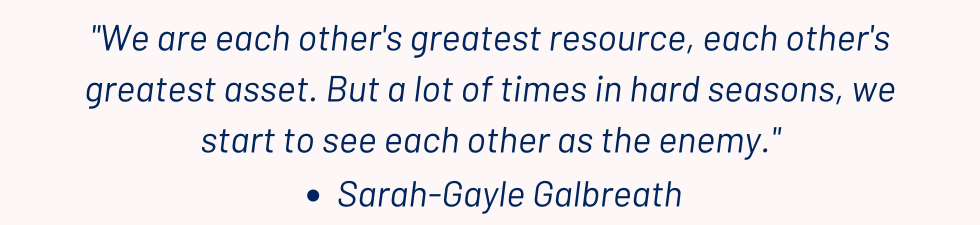
And a lot of times we start to see each other as the enemy and really the battle is not against flesh and blood, right? It's against the powers and principalities. And so when we can recognize, hey, this is not who I'm fighting against. This is who I'm fighting with in the sense of together, whatever we're approaching, whatever we're looking at, we're heading at that or we're looking at that together. Then I think that's where the strength comes from because we are each other's greatest resource, each other's greatest asset. And I think when we can
recognize that in these challenging seasons where we're not comparing and we're not creating these unhealthy foundational structures based off of fear, based off of lack, then I think that's where we can grow and we can learn how to navigate even those tough seasons in a way where there's still connection. you know, throughout the different sessions that we have with different clients, we see a lot of couples that are having a hard time. They're going through a hard season, whether one of them's dealing with cancer, whether there's been a diagnosis.
on one of their children. There's a lot of hard things that you listening go through. so I just want to encourage you to know that you're better together and that you too can navigate these seasons together and that God is right in the middle of it.
Speaker 2 (20:07)
We want to reiterate the four areas that have been helpful for us throughout our journey. And the first one is community getting plugged in to a local church. It has been pivotal. It has been crucial for us and a constant. And we know that, you know, the church is, us, is you and me, the church, we go to a building, sure, but the church is the people and the people of God have been incredible for us. And obviously God is the source. He is constant. He's the one who never changes. But when we have a line.
when we have been in community with God's people, then they have seen us in ways and they have carried us in ways that we could not do on our own and we are made for community.
Speaker 1 (20:48)
And so I think the second thing that I think is so supported out of a local church or out of community is our personal relationship with God. In the midst of those difficult seasons and disconnect between Sarah Gayle and I, we were still growing in our faith as individuals. And I think that is one of the ways that God was able to deposit the different things that we needed in the long term. while there was pain, while there was disconnect, while there was frustration in the moment,
it didn't become our new norm. one of those things with God was our ability to serve each other. And so even in the midst of that, instead of becoming selfish, God is able to rework our heart and create grace and mercy for each other so that we can serve. And so out of that service, we create the bridge to come back together, to reconnect to one another.
Speaker 2 (21:40)
Yeah, and it's all connected because the other thing that was helpful that we mentioned was forgiveness. It's difficult to forgive our spouse when we first of all don't recognize how much we have been forgiven. And also when we're not being led by Holy Spirit who's giving us the strength to serve, to forgive, to do all those things that are honoring to him. So those are the four areas that we just want you guys to think about if you're in a season that is difficult. Is there one of those four areas that we talked about that can serve you that
You guys can start to implement right away
Speaker 1 (22:11)
And so some practical takeaways for you is I want to encourage you, check in with yourself. Take those four things, right? So local church, personal relationship with God, forgiveness, and serving, right? Is there something there? Check in, do a heart check, and then check in with your spouse. Have a conversation. How are we doing in these areas? And that can start to create opportunities to take steps towards each other and to allow difficult seasons not to disrupt the purpose and plan that God has.
for your life as a marriage or as individuals, but to be something that he uses to strengthen and to encourage and honestly to equip you to reach other people who down the road are going through a difficult season that you've navigated together.
Speaker 2 (22:55)
Yeah, and we will have in the show notes a document that can help you to connect with your spouse just under the surface and to ask the real questions that even in those hard seasons where we're like, I don't know if there's space for me. Yes, there's space for both of you in those hard seasons. It's actually very important that we, you know, receive the grace of God for that season. And we recognize, okay, it might be a bit messy, but at the same time know that there still can be connection in those seasons. And it's actually so refreshing when we can find
a way to do that. So make sure you look at those show notes and we are excited for what's to come out of this because we know that God works all things for the good of those who love him and that he can take a hard situation, a painful situation, and show us his goodness and his purpose in the midst of it because that's just who God is. That's just what he does. So we're believing with you for what's to come, you know, the good that's to come. And also our hearts go out to you if you might be in one of those hard seasons. We know it's hard.
but just know that God is with you. He never leaves you or forsakes you. He's with you.