Can You Fall Out of Love? Why Love Is a Choice, Not a Feeling You Lose
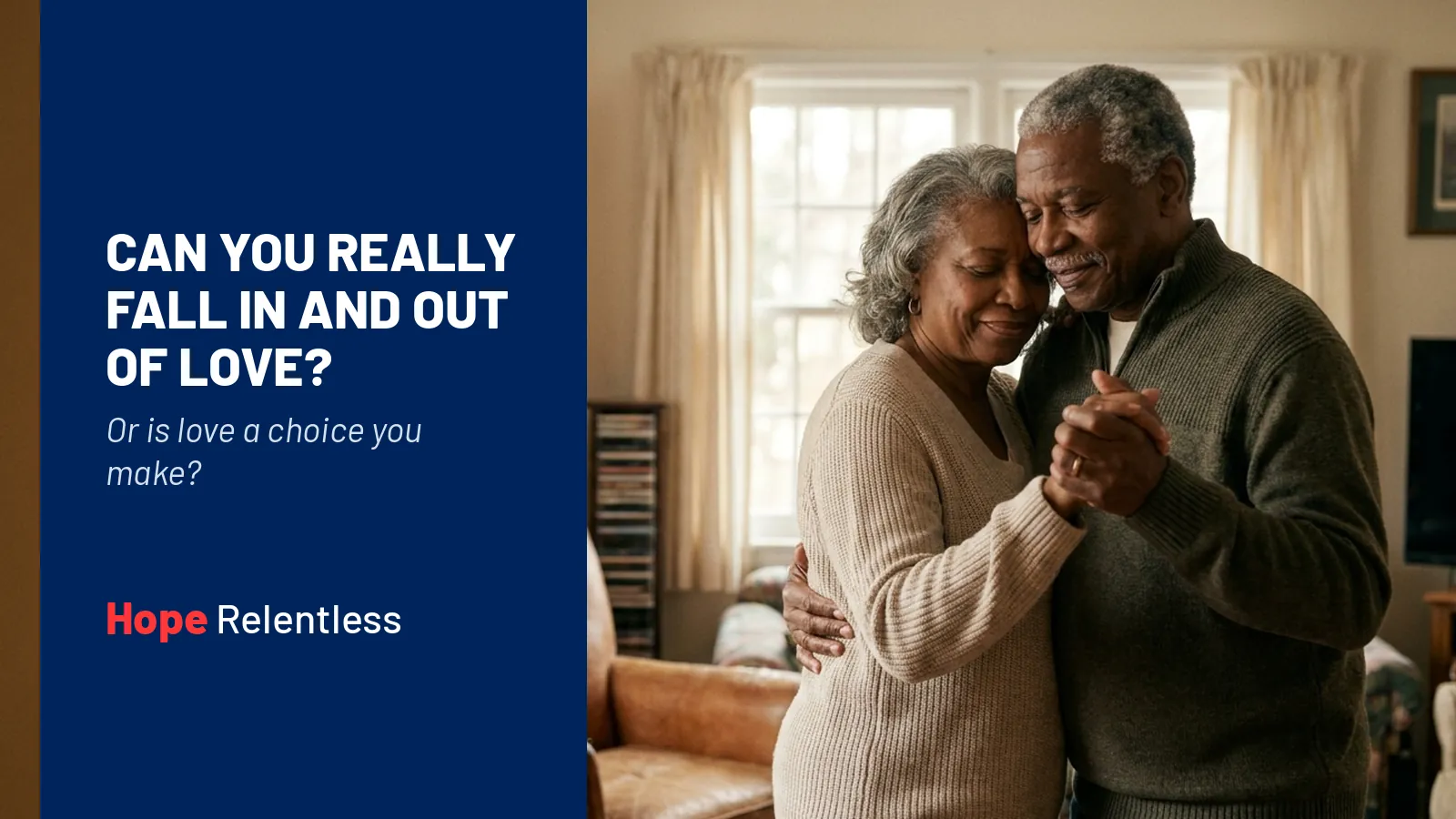
We talk about love like it's weather. You fall into it. You fall out of it. It sweeps over you, and one day it's just gone, like a fog that lifted while you weren't looking.
It's the language couples reach for when a marriage is ending. We just fell out of love. We grew apart. And it sounds so final, so out of anyone's hands.
Here's the question we kept coming back to on the podcast: is that actually true? Can you fall out of love? And maybe more importantly, is that what you want to believe?
Prefer to listen? This episode is on the Hope Relentless podcast wherever you get your shows. Podcast player to be embedded below the video.
The Problem With "Falling"
Listen to the word itself. To fall into something. You fall into a puddle. It's an accident, something that just happens to you, no decision required. And if you can fall in by accident, the language tells you that you can fall out the same way. It's precarious. It's passive. It treats the most important relationship in your life like something happening to you instead of something you're building.
And here's the trap. If you believe you can fall out of love, that belief tends to come true. If you're a passive observer in your marriage, swept up in the romance early and then disappointed as the butterflies fade, then yes, you will probably fall in and then fall out. That will be your experience, because you were never actually steering.
Love Is a Choice You Make, Then Manage
We believe love is a choice. A decision. And once you make the decision that you're going to love this person, your job is to manage that decision, to keep making it, to invest in it. The couples who are still together and still thriving twenty, thirty, fifty years down the road didn't just get lucky with a feeling that never faded. They made choices. They intentionally sowed into the relationship year after year, and those choices are what let the marriage not just survive time but keep growing.
This is the same truth underneath the question of whether true love takes work. Being swept away by love-gravity is not what we see in the marriages that last. What we see is intentionality and action.
"Let us not love with words or speech but with actions and in truth."
1 John 3:18
Even Scripture defines love as something you do, not just something you feel. Love that lasts has hands and feet.
What About the Dry Seasons?
Let's be honest, because this is where it gets real. When you've been married a long time, you don't always feel loving. You don't always feel the butterflies. There are stretches that feel flat, even distant.
If you believe love is a feeling you can lose, those dry seasons become dangerous, because they hand you a reason to disengage. You start to think, well, maybe we've just grown apart. Maybe we're not in love anymore. And your mind is powerful. Whatever you decide to look for, you'll find. You'll collect evidence for it in the words you say and the moments you notice.
But if you decided from the start that love is a commitment you made, then a dry season reads completely differently. It's not proof the love is gone. It's just a season. And you can say, I can still have the marriage I want. It just takes intentionality right now.
I'll say something that sounds almost too simple. There are times I can honestly say, I love you, and I don't like you right now. Sarah-Gayle has those moments too. I love Chad, I'm choosing to build my life with him, and I didn't love how he just talked to me. That's not a failure of love. That's being human. The love holds because it's a choice, not because the feeling never dips.
Want to see where your marriage is strong and where it's drifting?
Take the free Connection Pulse assessment. In about ten minutes you'll see the areas where your marriage is thriving and the areas quietly asking for attention, with one next step for each. It's not a test you pass or fail. It's a clear, encouraging snapshot, perfect for a season when you're choosing to be intentional again.
Take the Free Marriage AssessmentSave this for later
Perspective and Ownership Change Everything
This really comes down to ownership. If you see love as a whimsical thing you can't control, then when your marriage starts to drift, you just accept it. There's nothing to do. It's happening to you.
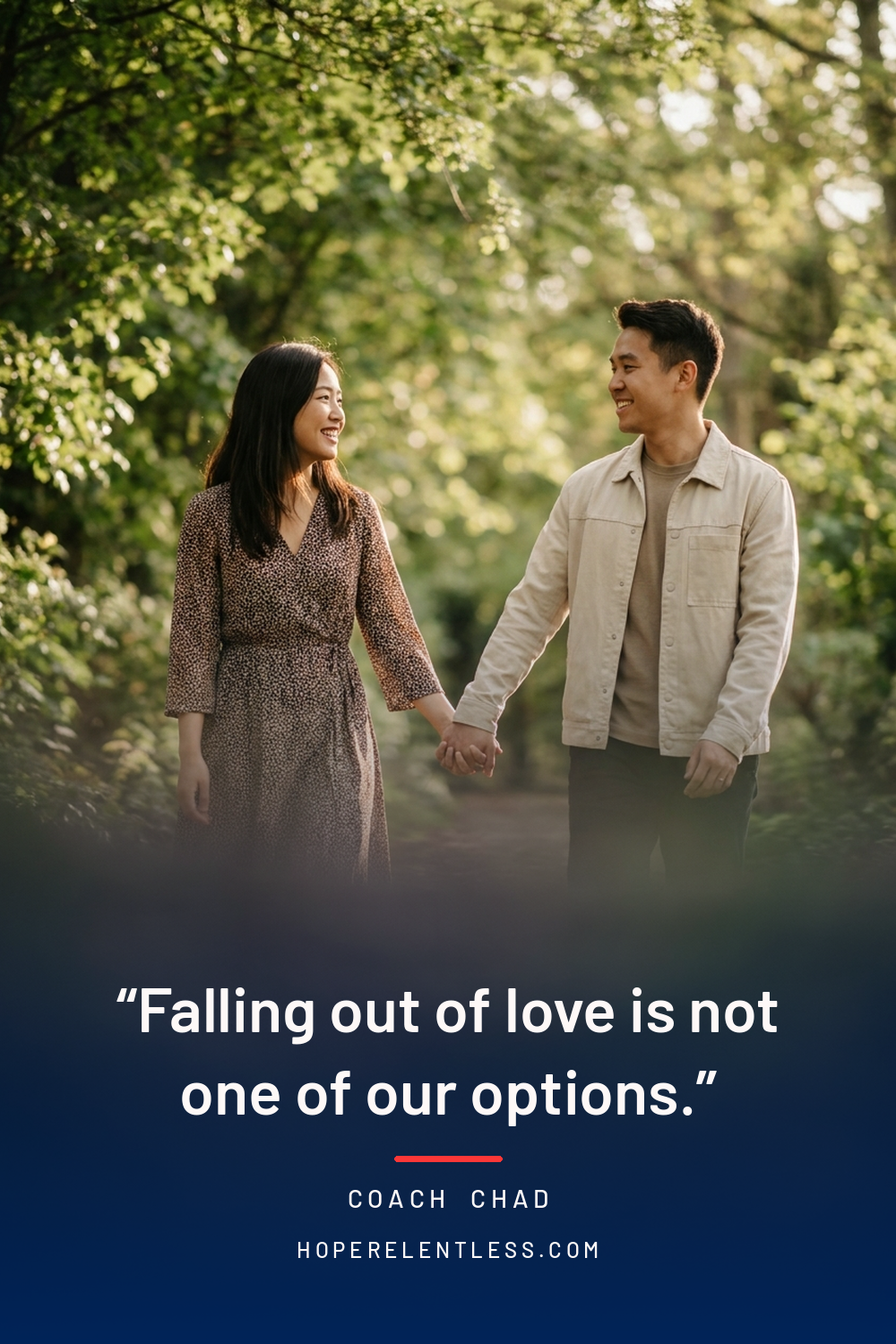
But when you see love as a choice, as actions, as something you can actually influence, then drifting becomes a signal, not a verdict. You take different action. Maybe that's personal growth. Maybe it's taking personal responsibility in your marriage for your own part. Maybe it's finally learning to communicate. The point is you do something, because falling out of love isn't on the list of options.
When we don't take ownership, we go looking for excuses to let ourselves off the hook. And honestly, that's often what falling out of love really is. It's looking for a reason to bail that isn't anyone's fault, just some mysterious force that drifted in and out. Taking ownership is harder, but it's the doorway to growth that actually lasts.
"Many waters cannot quench love, neither can floods drown it."
Song of Solomon 8:7
So, Can You Fall Out of Love?
If that's what you want to believe, then sure, you can. You'll find the evidence. But if you want a marriage that lasts and keeps growing, the better question is the one underneath it: what are you choosing, and what are you doing about it?
Love that lasts was never an accident. It's a decision, made once and then kept, backed by real actions, especially in the seasons when the feeling is quiet. That's not less romantic. It's the most romantic thing there is: being chosen on purpose, again and again.
"Love never fails."
1 Corinthians 13:8
Your Next Step This Week
If you've been waiting to feel in love before you act loving, flip the order this week. Choose one action and do it before the feeling shows up: a real compliment, a phone put away, a hard thing owned and apologized for, a date actually scheduled. Watch what happens. Action tends to wake the feeling back up, not the other way around. And keep an eye on your self-talk, because your mind will hunt for whatever story you hand it.
Reflection Questions For You And Your Spouse
- Where have we treated love like something that happens to us instead of something we choose?
- What story have we been telling ourselves in the dry seasons, and is it helping or hurting us?
- What does choosing love look like in action for us this season, not just as a feeling?
- When we drift, do we tend to take ownership and act, or look for a reason to disengage?
- What is one loving action I could take this week before I feel like it?
Save this for later
Want help choosing each other again?
If you're in a dry season and not sure what to do next, let's talk. One conversation. 30 minutes. You'll know if it's a fit. No pressure, no commitment, just a real conversation about where your marriage is and where you want it to go.
Schedule a Free ConsultationCheering you on,
- Chad & Sarah-Gayle
There's always, always hope.
About Sarah-Gayle Galbreath, MSMFT. Sarah-Gayle holds a Master's in Marriage and Family Therapy and co-leads Hope Relentless with her husband, Chad. She helps Christian couples turn unhealthy communication patterns into healthy ones and rebuild connection across every area of marriage.
About Chad Galbreath, Ordained Minister. Chad is an ordained minister, marriage coach, and co-host of the Hope Relentless podcast. Married to Sarah-Gayle for over twenty years, he's passionate about equipping couples with the skills and mindset to move from tension to teamwork. Chad and Sarah-Gayle are coaches, not licensed therapists.
Read the full episode transcript
The next question is, can you fall in and out of love? That's a good question, because we use that word a lot. Oh, I fell hard, I fell in love. Or when marriages are dissolving, it's irreconcilable differences, but really, we fell out of love. From the start, the phrase to fall into something tells me you can fall out of something. If you can fall into it, it has this precarious feel, like it's just emotion, like I fell into a puddle, and it implies you can fall out of it just as easily. So when it comes to falling in and out of love, I believe love is a choice and ultimately a decision that you make. Once you make the decision that you're going to love this person, you manage the decision you've made. If you don't keep making the decision, it fades. It's something to be managed, and how we manage it is we work on it, we invest in it.
That question, can you fall in and out of love, is almost met with another question: is that what you want? If the answer is yes, then sure, you can fall in and out of love. But big picture, I don't know that that's what we want, and it goes back to does true love take work. If somebody is reactive in their relationships, almost like a passive observer, then you could fall in and then fall out of love, and likely that will be your experience, swept up in the romance and excitement early on, then disappointed as it fades. But in relationships that survive not weeks and months but decades, it's not a passive dynamic. There's a level of intentionality and action. Love in its best form is a choice followed by actions. The idea of just being swept away by love-gravity is less what we see in relationships thriving twenty, thirty, fifty years down the road. It wasn't that they never fell out of love; it's that they made choices to intentionally sow into their marriage, and those actions and choices allowed the relationship to keep growing and flourishing year after year.
When you've been married a long time, you don't always feel loving. You don't always feel in love, you don't always feel those butterflies. So when we treat this question as valid, in those dry seasons it almost gives us a reason to disengage, because we start to think, maybe we're just not in love anymore, maybe we've grown apart. That's a defeating attitude. But if we decide from the get-go, this is my decision, this is what I'm going to sow into and invest in, then in those dry seasons we can recognize, I can have the relationship I want, it just takes intentionality. Our mind is so powerful. If we think we grew apart and we're not in love anymore, we'll confirm that over and over in the things we look for and the words we say. But if we think, that's not even a real thing, this is a decision and a commitment I've made, then in the hard times we dig deep and look at options, because falling out of love is not one of them.
Perspective and ownership are so powerful. If we see love as a whimsical thing we can't control, then when our relationship drifts we just accept it. But when we take ownership and see love as a choice, as actions, as something we can positively impact, then when we start to drift we take different actions to resolve the issues, maybe personal growth, maybe communication, whatever it is. As opposed to, I don't know what happened, we just fell out of love, which often is a sign that we feel defeated and aren't willing to put in the work. This might sound simplistic, but there are times in our relationship where I could say, I love you, but I don't like you right now. And I imagine you have moments too where you're making a choice: I love Chad, I'm choosing to build my life and future with him, but right now I didn't like the way he talked to me. That's realistic. That's humanity. When we take ownership and identify what we want, we find solutions to move in that direction. When we don't take ownership, we find excuses to let ourselves off the hook. That's what falling in and out of love often is: looking for a reason to bail that isn't our fault, that's someone else's or some whimsical thing.