Is Counseling Only for Messed-Up Couples? The Myth That Keeps Good Marriages Stuck
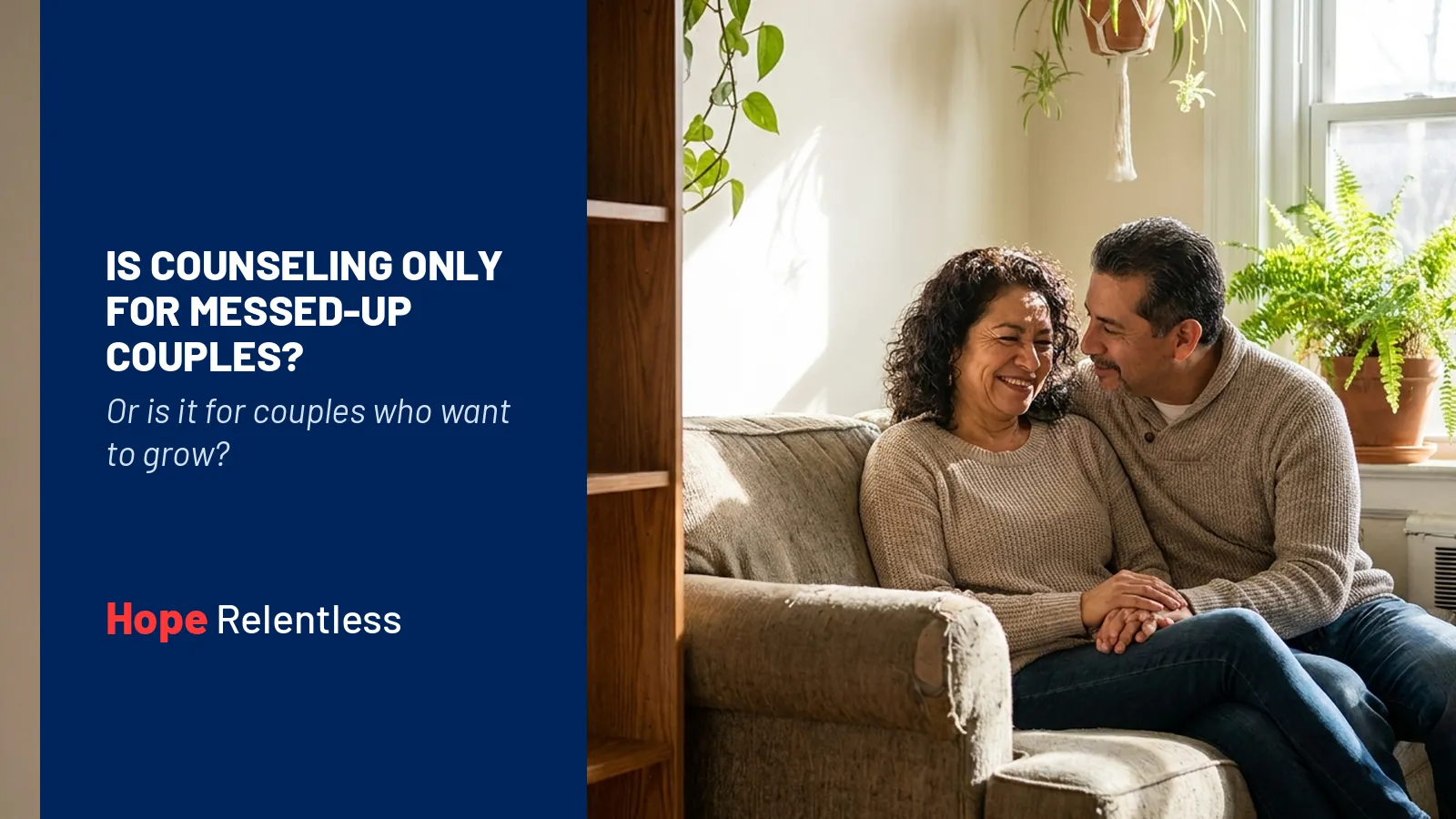
There's a quiet belief a lot of couples carry: counseling is for the couples who are falling apart. The ones who are messed up. The ones who waited too long.
So you tell yourself you're not that bad. You're not in crisis. You're managing. And you keep waiting, because in your mind, reaching out is an admission that something is broken.
Here's the reframe that changes everything. Counseling is not a verdict that your marriage failed. It's one of the smartest, most hopeful things a healthy couple can do.
We tackled this one on the Hope Relentless podcast, and Sarah-Gayle had a strong reaction to the way the question was even phrased. Let's walk through why.
Prefer to listen? This episode is on the Hope Relentless podcast wherever you get your shows. Podcast player to be embedded below the video.
The Myth: Counseling Is Only for Couples in Crisis
The phrase itself, counseling for messed up couples, tells on us. It assumes that if your marriage is in a good season, you would never need help. And that quietly traps the couples who could benefit the most.
Think about it. If counseling is only for the broken, then the moment you consider it, you've labeled yourself broken. So good couples wait. Drifting couples wait. And the data backs this up: research often cited from Dr. John Gottman found that couples wait an average of six years after problems begin before they seek help. Six years of small things hardening into big things, all because reaching out felt like an admission of failure.
It does not have to work that way.
Counseling Is More Like the Doctor Than You Think
Here's how I think about it. Do you go to the doctor when you're sick or injured? Of course. But do you also go when you're healthy? The best practice says yes. Annual physicals. Checkups. Preventative visits that catch the small thing before it becomes the big thing.
Marriage works the same way. When you're struggling, disconnected, or stuck in the same argument, getting counsel makes obvious sense. But when you're flourishing, that's actually one of the best times to get counsel, because you're building on what's already strong and adding what takes your relationship to the next level. There's always growth available, and it always helps to have another voice speaking encouragement and wisdom into your marriage.
This is exactly why seeking wise counsel in your marriage is not a last resort. It's a rhythm.
"Where there is no guidance, a people falls, but in an abundance of counselors there is safety."
Proverbs 11:14
Nobody Says Coaches Are Only for Messed-Up Athletes
I ran track at UCLA, so this one is personal for me. Think about sports or business. The best athletes in the world have coaches. The best leaders have mentors. Nobody looks at a world-class team and says, ah, coaches are only for the athletes who are failing. That would be ridiculous. Coaches are for people who want to become the best version of themselves.
Why would marriage, the most foundational relationship you have, be the one area of life where getting a coach means something is wrong with you?
Sarah-Gayle and I practice what we preach here. We have our own marriage mentors, and we meet with them in both seasons: when things are going great, and when we've hit a wall we couldn't solve on our own. Hitting a wall isn't a sign of a bad marriage. It's a sign that you're two real people doing a hard, beautiful thing, and sometimes you need an outside voice to help you over the wall.
Curious where your marriage is strong and where it's quietly drifting?
Take the free Connection Pulse assessment. In about ten minutes you'll see the areas where your marriage is thriving and the areas asking for a little attention, with one next step for each. It's not a test you pass or fail. It's a clear, encouraging snapshot, exactly the kind of preventative checkup we're talking about.
Take the Free Marriage AssessmentSave this for later
You Are Not Damaged. You Are Healing.
Sarah-Gayle kept getting caught on that word, messed up. And it matters, because the words we use over ourselves and our marriages are powerful.
She was working with a couple walking through the pain of infidelity, and at one point they'd quietly accepted that one spouse was now damaged because of what she'd been through. They didn't mean it harshly. But Sarah-Gayle stopped them. You are not damaged. You are in a season where you're healing. That's not the same thing.
The couples who reach out are not messed up. They're in a season where they could use some support. Saying that out loud isn't being inauthentic, and it isn't pretending. It's a statement of faith about where you're headed, even before you fully feel it. The way we speak about our marriage shapes the marriage we're building. So speak life.
What Actually Changes First
Here's something we see all the time. When couples first start working with us, often not much has changed yet in their actual circumstances. The bills are still the bills. The schedule is still the schedule. But something big has already shifted: their hope and their perspective.
They start to believe they're learning and growing. They start to see that the problem they've been white-knuckling for years has tools they were never handed. And that fresh hope changes how they show up long before the circumstances catch up. If you've been stuck, getting the right guidance is often what unlocks growth that actually lasts.
One quick, honest note. If reaching out in person feels like too much right now, that's okay. Even online marriage counseling can be a low-pressure first step toward getting an outside voice in your corner.
"Iron sharpens iron, and one man sharpens another."
Proverbs 27:17
That's what counsel does. It sharpens. One of the couples Sarah-Gayle works with right now is, by every outside measure, thriving. High-capacity people running businesses, deeply connected. On the surface there's nothing dramatic to fix. And yet they're growing just as much as a couple in crisis, just in a different direction. They're sharpening their communication, getting reminded of what they love about each other, and clarifying how they want to keep growing together. You never know what you don't know until you let someone speak into it.
"May the God of hope fill you with all joy and peace in believing, so that by the power of the Holy Spirit you may abound in hope."
Romans 15:13
So, Is Counseling for Messed-Up Couples?
Yes. And also no. Yes, if your marriage is hurting, counseling is absolutely for you, and there is real hope. If you get counsel and start learning and applying things differently than you did before, it is completely reasonable to expect different results moving forward.
But counseling is also for the couple who isn't messed up at all. It's for the couple who wants to stay healthy, sharpen their skills, and get ahead of the painful seasons instead of waiting six years to react to them. The best way to avoid the worst seasons is to make growth a habit.
Your Next Step This Week
Drop the word messed up. This week, reframe one sentence you tell yourself about your marriage. Instead of we're a mess, try we're in a season where we're learning. Instead of something's wrong with us, try we're a couple that's choosing to grow. Speak life over it. Then take one small step toward getting an outside voice in your corner, whether that's a mentor, a trusted couple, or a conversation with us.
Reflection Questions For You And Your Spouse
- Have we been waiting to get help until things got bad enough? What have we been telling ourselves about what reaching out would mean?
- If a coach is normal for athletes and leaders, why does getting one for our marriage feel different? Where did that come from?
- What's one area we're already strong in that we'd love to make even stronger?
- Is there a word or label we've quietly accepted over our marriage that we need to replace with words of life?
- What would it look like to make growth a habit for us, not just a rescue when we hit a wall?
Save this for later

Want an outside voice in your corner?
You don't have to be in crisis to reach out. Whether you're hurting or just want to grow, let's talk. One conversation. 30 minutes. You'll know if it's a fit. No pressure, no commitment, just a real conversation about where your marriage is and where you want it to go.
Schedule a Free ConsultationCheering you on,
- Chad & Sarah-Gayle
There's always, always hope.
About Sarah-Gayle Galbreath, MSMFT. Sarah-Gayle holds a Master's in Marriage and Family Therapy and co-leads Hope Relentless with her husband, Chad. She helps Christian couples turn unhealthy communication patterns into healthy ones and rebuild connection across every area of marriage.
About Chad Galbreath, Ordained Minister. Chad is an ordained minister, marriage coach, and co-host of the Hope Relentless podcast. A former Division I athlete at UCLA and married to Sarah-Gayle for over twenty years, he's passionate about equipping couples with the skills and mindset to move from tension to teamwork. Chad and Sarah-Gayle are coaches, not licensed therapists.
Read the full episode transcript
The last question is, is counseling for messed up couples? I love how that's worded, that phrase, because I think that's honestly what we think sometimes. Even when we ourselves are going to counseling, it's like, we're messed up, we're a mess. You know that hashtag, bless this mess? It's like, I don't want to bless this mess, I want to get healthy. And obviously healthy is not perfection, that's a different thing altogether. But counseling, yes, it's for couples who need assistance, who need help. What this phrasing implies a little bit, to me at least, is that if you're a couple in a good season, flourishing, it kind of implies you wouldn't be one to go to counseling. And I don't think that's true. A lot of times when we're flourishing, that's the best time to go, because it continues to build on what's already there. There's always growth that can occur, and it's significant to have another voice speaking into your relationship, encouraging it, and helping you do the things you want to do.
I think counseling can be a lot like the medical field. Do I go to a doctor when I'm sick or injured? Yes. But do I also go to a doctor, as best practice, when I'm healthy? Yes. Maybe not as often. Annual physicals, different checkups as you get older, preventative care. When we work with couples, you share the stat, I think it's initially from Gottman, that couples often wait about seven years before they seek counsel or get help. So is counseling for messed up couples? Absolutely. But do messed up couples still have reason to hope? Absolutely. If you get counsel and start to learn and apply things differently than you did in the past, then it's totally reasonable to anticipate different results moving forward. At Hope Relentless, every day we have tons of reviews, other counselors have tons of reviews, where relationships were causing pain, they were disconnected, there was a lack of communication, they get counsel, and they start to see growth and improvement.
But counseling is also for couples who, in this season, aren't messed up. One of the best ways to avoid the more painful seasons of relationships or life is to make it a habit to consistently learn, grow, and get counsel, get wisdom, get practical advice in every area of life, especially relationships. When our relationship is struggling, when we're disconnected or fighting, it impacts every other area. It impacts how I interact with the kids, how I show up at church or at work. So it makes sense to get counsel. This is one reason we have our own marriage mentors, and we meet with them both when things are going well and when we hit a wall. We've hit a wall we tried to solve on our own and couldn't, so we get help, we get advice. My desire is for couples to start getting guidance and counsel earlier, premarital, early in marriage, just to make it a habit and a pattern.
You think about business and sports. People have coaches, people have mentors. Nobody says, coaches are only for messed up athletes. Coaches are for teams and athletes who want to become the best version of themselves. So when you're hurt, do you need some guidance? Absolutely. But when you're healthy and you want to experience another level, that's also a time to get counsel. I have one couple right now that I'm working with, and they are phenomenal, high-capacity individuals running businesses. On the surface there's nothing deeply detrimental they're going through, but they are growing, sharpening their communication skills, being reminded of the things they love about each other, and clarifying their priorities and how they want to keep growing together. They're growing just as much as a couple in crisis, just in different ways. You never know what you don't know, and when you expose yourself to counselors and mentors, there's amazing opportunity for growth.
The last thing I want to say, because of how the question was phrased, I keep getting caught on this phrase, messed up. I was working with a couple dealing with infidelity, and they had accepted that one spouse was damaged because of what she was going through. They didn't mean it negatively, but I caught it, and I said, you're not damaged. On the contrary. These couples reaching out, the so-called messed up couples, they're not messed up. They're just in a season where they could use some help, some support. The wife is not damaged, she's in a season where she's healing. The words we say are significant, and we don't want to put ourselves in a box we don't want to be in. We want to speak life, and that's a statement of faith, even if we don't feel it yet. I just wanted to point that out, because I was caught every time we kept saying messed up.
I think it highlights the power of perspective, and once again it highlights the growth that can take place by seeking counseling. Oftentimes when we first start working with couples, not a lot has changed in their actual circumstances, but a lot has changed in their hope and their perspective. They now believe we're learning and growing, and the problems they'd been struggling with, they're now getting the tools to manage differently. That's one of the powerful things about getting counseling in our lives and our relationships, so we can have that hope and that fresh perspective of growth and progress.