
When You Feel Like You're Doing It All in Marriage (Part 1)
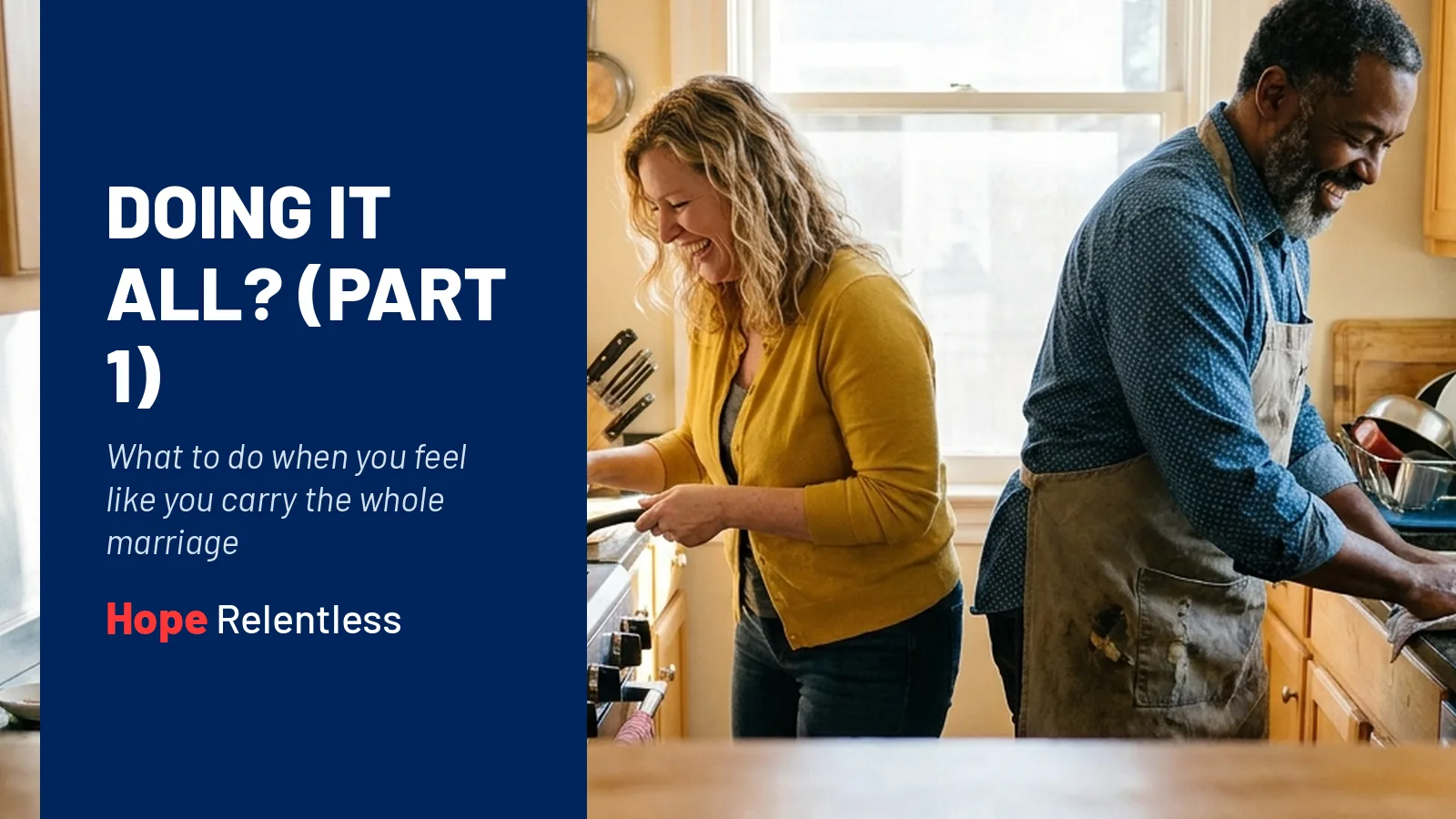
You cooked. They left the dishes in the sink. Again.
It is one of the most common feelings we hear in our office: "I feel like I'm doing it all." Carrying more than your share, running on empty, and quietly keeping score. The feeling is real and it is understandable. But how you think about it changes everything, and there are ways through it that do not require turning your spouse into the enemy.
This is Part 1, where we focus on the one thing you actually control: your attitude.
Prefer to watch or listen? Hit play above, then keep reading. This is a two-part conversation.
What this episode is about
When one spouse feels overwhelmed and under-supported, the natural instinct is to fight back, to keep a tally and demand that things even out. The problem is that marriage is not 50/50, and it is deeply vulnerable, because you cannot control what your spouse does.
In Part 1, Sarah-Gayle and Chad dig into the attitude shift that changes the whole picture: moving from keeping score to contributing, from transactional to solution-focused, and from going it alone to playing on the same team.
Key takeaways
- Marriage isn't 50/50. Some seasons you carry more, some seasons your spouse does.
- Keeping score backfires. We are biased bookkeepers who inflate our own effort and shrink our spouse's.
- Contribution beats transaction. Ask "what can I add here?" instead of "what am I getting?"
- Integrity is personal. If you know the good you ought to do, do it, regardless of what your spouse does.
- You reap what you sow. Sow generosity and trust the harvest, even when it is slow.
- Teammates expect obstacles. Hard seasons are normal. The danger is turning each other into the obstacle.
Marriage is vulnerable, and that's the hard part
Nobody wants to be taken advantage of, so when we feel like we are pulling more than our weight, our first instinct is the toddler's instinct: it's mine, it's even, if I do one you do one. But marriage does not run on a 50/50 ledger. It is vulnerable by design, because you cannot control who your spouse becomes, whether they will commit to growth, or whether they will carry their share today. The logical part of us wants a formula, do A, B, and C and get result one, two, three. Relationships do not work that way, because there is no input that guarantees your spouse's response.
Add in how busy life is now, with both spouses often working, and the vulnerability grows. You know everything that happened in your own day and almost nothing about the weight your spouse carried in theirs. It usually shows up in the evening grind, dinner, kids, pickup, cleaning. One rough night is fine. When it becomes a pattern, the feeling of doing it all sets in.
The trap of keeping score
Here is why a transactional marriage falls apart. First, we are terrible bookkeepers. You will always overinflate your own contributions and underinflate your spouse's, not out of malice, but because you cannot see everything they do when you are not in the room. So both of you sit there convinced you have already over-contributed, both waiting for the other to move. And when you finally talk, the conversation becomes a contest of listing what each of you has done, none of which gets the dishes done or moves you forward.
Second, keeping score is problem-focused instead of solution-focused. The moment you pivot to contribution, the whole interaction changes. Instead of "look at everything I do," it becomes "how can I add value here?" That question frees up creativity. Maybe it means doing the dishes, or maybe it means finding another way to help the load get lighter. Either way, you are back in the game instead of standing on the sideline with your arms crossed. This is the heart of personal responsibility in marriage.

Integrity, sowing, and grit
There is a verse that reframes all of this: if you know the good you ought to do and you do not do it, that is on you (James 4:17). It does not matter whether your spouse did their part. The question is who you are becoming. Are you a person who contributes and forgives, or only when conditions are perfect? You also reap what you sow. If you want a marriage marked by generosity and kindness, then sow those seeds, even first, and trust that the harvest comes, maybe not this afternoon, but in time.
This takes grit. Not the grit to tolerate abuse, that is a different conversation, but the grit to believe marriage is for life and to keep doing your part through hard seasons. When Peter asked how many times he had to forgive, Jesus said seventy times seven, which is to say, as many times as it takes. Real teamwork is easy when things are going well. It gets tested when they are not. Every team expects obstacles, the whole point of the other team is to make them fail. Strong couples expect obstacles too, and they refuse to turn each other into one. If you stay teammates and aim at the solution, you can face almost anything. If you divide, you have just added each other to the pile of problems, and that is where a marriage really gets in danger. Staying on the same team is what protects the relationship.
When entitlement creeps in
There is a version of keeping score that runs deeper than the dishes, and it is worth naming gently. When one spouse has been wronged, it is easy for the relationship to slip into a debtor dynamic, where one person is treated as being in debt and the other gets to keep collecting. We never want to minimize real pain or broken trust, and there is a real process for working through those things. But the big-picture goal is always the same: to move the marriage out of debtor mode and back into partnership, back to being co-laborers on the same side of the table. That road usually runs straight through forgiveness, because in the absence of forgiveness the debt only compounds. It also means watching for ultimatums. "Because you did this, you had better do that, or else" can feel justified in the moment, and we understand where it comes from, but an ultimatum has never once built the atmosphere any of us actually want. You can be right about the wrong that was done and still choose to stop collecting, because being right and building a marriage are two different projects.
There's freedom in reframing
If you take one thing from this first half, let it be this. How you think about your situation largely determines how heavy it feels. So much of the "I'm doing it all" weight is shaped by the story we are telling ourselves about it. That is not denial, and it is not pretending the load is perfectly fair. It is the freedom of reframing. When you trade "why won't they" for "how can I contribute here," and "I am carrying everything alone" for "we are in a hard season and I am still on this team," the facts may not change, but your experience of them does, and that shift is usually what unlocks a different kind of conversation. And please hear this if you are the one who feels like you do it all. You are not alone, and the feeling is understandable. We all hit seasons like this. The point of the reframe is not to dismiss what you are carrying. It is to put you back in a position to actually change it, which is exactly what we get practical about in part two.
And let's be honest about the limits here. You cannot control your spouse, and if you sit with it for a second, you would not actually want to. Control is not a characteristic of a healthy relationship. You might get a kind of compliance in the short term, but it quietly costs you the very trust and partnership you are really after. So we keep coming back to the one person you can actually lead, which is you, and to the kind of environment you want to live inside. Sow that, and give it time to grow.
Need to set up a conversation about the load you're carrying?
The Game Plan Guide walks you through the who, where, and when of a hard conversation, so it goes somewhere instead of sideways. Grab it free below.
Key scriptures
"If anyone, then, knows the good they ought to do and doesn't do it, it is sin for them."
James 4:17
This puts the focus back on you. Do the good you know your marriage needs, regardless of the scoreboard.
"Love is patient, love is kind... it keeps no record of wrongs."
1 Corinthians 13:5
The biblical picture of love is the opposite of the scorecard. It keeps no record of wrongs.
"Do not be deceived: God cannot be mocked. A man reaps what he sows."
Galatians 6:7
Sow contribution, generosity, and kindness, and trust that, in time, that is what you will reap.
"Lord, how many times shall I forgive? Up to seven times? Jesus answered, not seven times, but seventy-seven times."
Matthew 18:21-22
Marriage takes the resolve to keep showing up and forgiving, as many times as it takes.
Your next step
This week, catch yourself the next time you start tallying. Pause, and ask one different question: "What is one thing I can contribute here?" Then do it, without waiting for it to be reciprocated. That single shift, from scorekeeper to contributor, is where the freedom starts.
Questions to discuss together
- Where am I keeping a scorecard right now, even quietly?
- What might my spouse be carrying that I do not see?
- Is there a good thing I know I should do that I have been withholding because of how I feel?
- What kind of environment am I sowing with my attitude this week?
- Where have we started treating each other as the obstacle instead of facing it together?
Feeling close to burnout?
If you are carrying more than you can hold and want a way forward that keeps you on the same team, let's talk. One conversation. 30 minutes. You will know if it is a fit.
Cheering you on,
- Chad & Sarah-Gayle
There's always, always hope.
About the authors
Sarah-Gayle Galbreath, MSMFT holds a Master of Science in Marriage and Family Therapy and coaches Christian couples in communication and connection. She and Chad have been married more than 20 years and co-host the Hope Relentless podcast.
Chad Galbreath is an ordained minister and marriage coach. Alongside Sarah-Gayle, he has spent more than 15 years helping couples move from tension to teamwork through the Hope Relentless method. Chad and Sarah-Gayle are coaches, not licensed therapists.
Read the full episode transcript
Sarah-Gayle: Hello and welcome to the Hope Relentless Marriage Podcast. We are so excited you are tuning in. We are passionate about marriages because it is a ripple effect: marriages impact families, families impact communities, and communities impact the world. So you are making a difference as you listen and apply this. Well done.
Chad: That's right, world changers. Today we have a sticky topic that comes up in counseling often: what to do when you feel like you're doing it all. One spouse feels overwhelmed and like they are carrying more than their weight.
Sarah-Gayle: This is a big topic, and a lot of us can identify with it. In different seasons of our own marriage, there have been times where it is as simple as, well, I cooked but you didn't do the dishes. How we respond, and what we believe about how we should respond, makes a big impact. The challenge is, we don't want to be taken advantage of. Nobody wants to feel walked over. So our first instinct is to fight back, to go back to the toddler mindset of it's mine, or 50/50, if I'm nice to you then you have to be nice to me. But marriage is not always 50/50. We covered that in our myths episode. The biggest thing is that marriage is vulnerable, because we don't know what the other person will do, who they will become, or whether they will be committed to growth. We can't control what our spouse does or doesn't do.
Chad: Sometimes a couple wants a solution, especially a logical or math personality: tell me to do A, B, and C and I get result one, two, three. In relationships that doesn't always work, because no matter what I do, I cannot control my spouse, and there is no guarantee. That is the vulnerability. On top of that, busyness is high. A lot of families have both spouses working, and we don't know what has gone on in our significant other's day, while we are fully aware of our own. It often rears its head in the evening routine, dinner, kids, pickup, cleaning. A night or two is fine, but when it becomes a pattern, that is when feeling like you're doing it all sets in. One potential solution is examining our attitude.
Sarah-Gayle: A big thing to be aware of with attitude is whether we have an attitude of entitlement. We see it especially with betrayals, like an affair, where one spouse feels indebted because they are in the doghouse. Our expectations really shape how we approach those scenarios. Chad, do you have thoughts on how a betrayed spouse can interact in life-giving ways?
Chad: This is where faith and forgiveness matter. In the absence of forgiveness, we get a debtor relationship, where one person wronged the other and is now in debt to them. That is not a partnership. I never want to minimize the pain or broken trust, and there is a process to go through, but the big picture is to get the relationship out of debtor mode and back into partnership, co-laborers, a team. We can be hurt and disappointed and frustrated, and it doesn't change what the relationship actually needs. We can focus on what we feel we deserve, which keeps eroding the relationship, or focus on what the relationship needs and what healthy relationships have in common.
Sarah-Gayle: It can lead to ultimatums, like, because you wronged me, you better do this, or else. Anytime we are in an ultimatum relationship, it is not productive and not creating the atmosphere we want long term. When marriage is transactional and we keep track of all the wrongs, we all fall short, because we all make mistakes. The best marriages don't keep track, they contribute. It is focusing on what I can do to create an exciting atmosphere and add value, rather than what I can get. That attitude lets us be creative. If I am frustrated about the dishes and I shut down, I minimize any chance of it changing, because I took myself out of the game. But if I ask how I can contribute, maybe it is doing the dishes, or maybe it is finding another way to help the issue get solved.
Chad: Two challenges with transactional relationships. First, we are terrible bookkeepers. I will overinflate my contributions and underinflate yours, partly because we can never accurately record everything each person does, including the things done when the other isn't there. So even with an agreement, the records are flawed, and if I overinflate mine, I will assume you are overinflating yours, and now we both wait. There is a problem that needs someone to contribute to the solution, but we both feel we already over-contributed, so we sit there, and the conversation becomes me listing what I did and you listing what you did, none of which gets the dishes done. That is the debtor dynamic, not a healthy partnership. Second, it is problem-focused rather than solution-focused. When we pivot to contribution, we look at things through the eyes of how do I add value, how do I serve, and it changes the interaction.
Sarah-Gayle: To round out attitude, I want to challenge us on integrity. There are things we know grow a marriage, connection and forgiveness, and things that help us treat people well in general. If we know the good we are to do and we don't do it, it is a problem. It doesn't matter if our spouse did good or not, because we are looking at personal responsibility. James 4:17 says if we know the good we ought to do and don't do it, it is sin, because we know better. That empowers us individually to keep doing the good the marriage needs, regardless of circumstances, because we are either people who do kind things and forgive, or we are not. And if that changes with circumstances, that is something to grow in, and to ask, is that really the person I want to become?
Chad: I like that. Since I can't control you, and wouldn't want to, because control is not a characteristic of a healthy relationship, we get back to the target: a healthy, vibrant, life-giving marriage. There is a dynamic that we reap what we sow. I don't want to reap bad seeds, so I won't sow them. Even from a selfish standpoint, I want an environment of generosity, kindness, and contribution, so I will sow those actions. In different seasons it is a trust element, maybe you don't reap it back this afternoon or next week, but over time these principles play out. You also mentioned the idea of, is there a point where you won't contribute anymore, a relational ultimatum, and that is just not a characteristic of a healthy relationship. We can get short-term results that undermine what we want long term.
Sarah-Gayle: We will have to do two parts. What you are describing reminds me of grit. If there is a point where, if this doesn't happen, I'm out, then either we believe marriage is for life and we work through whatever comes, or we don't, and I am not talking about abuse. There are hard seasons. There is a verse about how many times to forgive, seventy times seven, basically as many times as it takes. In marriage we need that resolve of whatever it takes, because I am committed for my time on earth. It is vulnerable, but I am still choosing it, doing my part with what I can control, and believing my spouse will meet me closer, without withholding just because I feel like I am doing more in this season.
Chad: We talk with couples a lot about teamwork. It is easy to be on the same team when things go well. It gets tested when they don't. Teams expect obstacles, literally another team trying to make them fail. So grit, perseverance, and teamwork mean we anticipate obstacles, and it doesn't mean we become opponents or throw in the towel, or that something is wrong with us. It means we are alive and life has challenges. If we stay together as a team and work toward the solution, that is huge. If we divide, we have turned each other into obstacles on top of the external ones, and that is where the future health of the relationship is in jeopardy. Next week we will talk about part two, the now what, the solutions that don't include turning your spouse into the problem.
Sarah-Gayle: From this part, if you feel like you're doing it all, you are not alone, and it is understandable. We have those seasons. What we hope we gave you are different ways to think about it, because a lot of times how we think about it is what makes us feel like we are doing it all. There is freedom in reframing. Next week we continue. And it still doesn't make me skip appreciation time. Chad, I appreciate that you make it a priority for us to extend appreciation and fix our eyes on the good things in our life. I can be more the task and project person, and you keep it about the main thing, which is people.
Chad: I appreciate your commitment to grow in everything you do. You are always resourcing yourself and finding new ways to grow, in family and work, and it is inspiring. That also means you are committed to recognizing when you get it wrong and learning what to do differently.
Sarah-Gayle: Thank you. We hope you appreciate each other consistently, daily, so you create an atmosphere of appreciation that your kids catch and your spouse grows from. No matter where you are, in a high place or a low place, I want you to know that there is always, always hope.