For couples who are drifting, not in crisis
Marriage Workshops
Two hours, a room of couples in the same boat, and a tool you can use before the week is out. No sharing your business in front of strangers. Just the two of you at your own table, learning something that works.
$149 per couple. Seats are capped at 12 couples.
What's on this page
- Why a workshop, and who it's for
- What couples say
- The four workshop topics
- What actually happens in the room
- What one tool actually looks like
- Workshop, weekly coaching, or intensive
- When a workshop isn't the right fit
- What it costs
- Bring a workshop to your church
- Where workshops happen
- Who's teaching
- Register for our next workshop
- Frequently asked questions
Why a Workshop, and Who It's For
Most couples wait years before they get help, and the reason is almost never the money. It's that asking for help feels like an admission. Booking a program feels like saying out loud that something is wrong.
A workshop skips all of that. You aren't a case. You're two people in a room with other couples who are quietly dealing with the same thing, learning something useful for a couple of hours.
This is for you if
- You feel more like roommates than teammates, and you can't name the day that started.
- The same argument keeps coming back in different clothes.
- Things are basically fine and you'd like to keep it that way.
- You've talked about getting help for a year and never pulled the trigger.
- One of you is more ready than the other, and two hours is an easier yes than a program.
- You're in a season that's squeezing you: a new baby, a new job, a kid leaving home.
A lot of couples use the workshop as a test. Two hours to see how we teach, whether the tools make sense, and whether you want more. That's a completely reasonable way to use it, and it's part of why we run them.
What Couples Say
The line we hear most on the way out is some version of "that was easier than I thought it would be." Two hours is a small ask, and most couples are surprised how much moves inside it.
The workshop library
The Four Workshop Topics
Each workshop stands on its own. You don't need to have attended the others, and there's no order you have to follow. Come to the one that sounds like your marriage right now.
Communication and Conflict Resolution
How to have the hard but important conversations without them turning hurtful. This is where we teach the Communication Loop, our four step process, and you practice it on something real. It's the one most couples come to first.
Marriage Foundation: Biblical Mindsets
What a marriage is actually built on, before anybody hands you a tool. Tools used with the wrong heart become weapons, so this is the ground everything else stands on.
Spiritual Connection in Marriage
Growing together rather than side by side and separate. Practical, not theoretical, for couples who want their faith to be something they share instead of something they each do alone.
Sexual Intimacy: God's Design
Honest teaching on a subject most couples have never heard addressed with any candor. Emotional and physical closeness, how they feed each other, and what to do when expectations differ.
What you walk away with: one tool, not a binder. Something small and specific you can use the day you get home. Couples tell us the surprise isn't the teaching, it's the conversation they end up having in the car on the way back.
What Actually Happens in the Room
Here's the fear, and it's worth naming because it stops more couples than the price does: that you'll be asked to talk about your marriage in front of a room of strangers.
That never happens. Not once, not ever.
You sit with your spouse. We teach one idea at a time from the front. Then you turn to each other and work through it at your own table, in your own words, at whatever depth you're comfortable with. Nobody circles the room asking couples to report back. Nobody is called on.
Your business stays yours
No forced sharing, no group confession, no icebreaker where you say what you're struggling with. What you talk about at your table stays at your table.
You aren't the only ones
The quiet value of a room is realizing that ten other couples cleared their calendar and drove here for the same reason you did. That does something a private session can't.
Both of you, always
We work with couples only. You register together and you attend together. There's no version of this for one spouse showing up alone.
Rooms are capped at 12 couples on purpose. Big enough that you aren't the only ones, small enough that we can actually get to your table when you get stuck.
What One Tool Actually Looks Like
"You leave with a tool" is the kind of thing every website says, so here's the actual thing, from the Communication and Conflict workshop. This is step one of the Communication Loop, and it takes about twenty minutes to teach.
How a conversation starts largely decides where it ends up. Most hard conversations open with an accusation, and once that happens the other person is defending instead of listening. So we teach you to open a different way. Three parts.
How it usually starts
"You never help around here. I'm doing all of it and you don't even notice. It's like living with a roommate."
Three problems in one sentence: a you-statement, an absolute, and no request. Your spouse now has something to argue with instead of something to do.
A Proactive Start
"When the evenings get away from us and I'm still going at nine, I feel alone in it. Moving forward, I'd appreciate us picking one thing each night that's mine and one that's yours."
Same frustration. A context instead of an accusation, an emotion I own, and a clear positive target my spouse can actually hit.
That's it. When this happens, I feel this, moving forward I'd appreciate this. It sounds almost too simple written down, and it is genuinely awkward the first two or three times you use it. Then it starts working, and you notice the conversation ending somewhere different than it used to.
In the room you don't just hear that. You write yours down, on a real thing from your own marriage, and you say it out loud to each other while we're there to help you adjust it. That's the difference between reading about a skill and leaving with one.
Who's Teaching
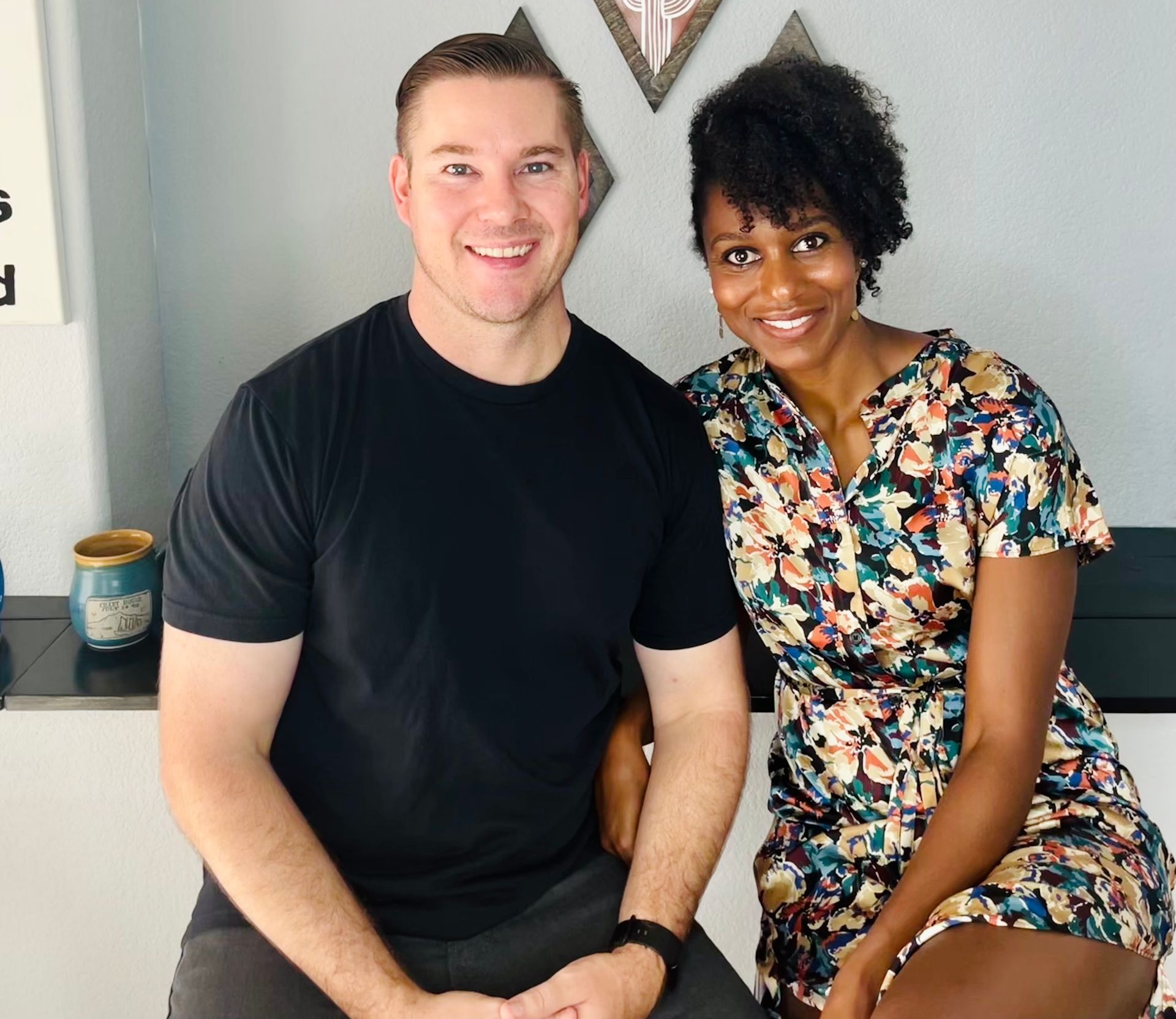
Both of us teach these together. A husband and wife team teaching a room of husbands and wives, which matters more than it sounds like it should. Nobody in the room ends up feeling like the coach is on the other spouse's side.
Chad Galbreath
Co-founder, ordained minister
I spent about ten years as an executive pastor before Sarah-Gayle and I built Hope Relentless. I used to fight to be right. My wife jokes that I should've been an attorney. I'd win the argument and lose the connection every time. The shift wasn't a better comeback. It was realizing we were on the same team.
Sarah-Gayle Galbreath
Co-founder, marriage coach
Sarah-Gayle holds a Master of Arts in Clinical Psychology with an emphasis in Marriage and Family Therapy from Azusa Pacific University, and she works here as a coach rather than a clinician. She hears what's underneath what a couple is saying, and she's the reason our frameworks are as practical as they are.
We've been married since 2005 and have coached couples since 2010. Hope Relentless is a coaching practice, not a clinical one. We are coaches, not licensed therapists, and we do not provide therapy, diagnosis, or treatment. If your situation calls for licensed clinical care, we'll tell you and help you find it.
Workshop, Weekly Coaching, or Intensive?
Three formats, same frameworks underneath. The difference is depth and how much of your calendar it asks for.
A workshop fits if
- You want the smallest possible first step
- One topic and one tool is enough for right now
- You want to see how we teach before committing to anything
- Two hours is realistic and twelve weeks is not
Something deeper fits if
- You have a specific issue you need worked, not a topic taught
- You want a coach in the room while you have the hard conversation
- Two hours won't move what you're carrying
- You've done a workshop and want to keep going
If a workshop isn't enough, the next steps are weekly marriage coaching or a two-day marriage intensive. Plenty of couples start at a workshop and move into one of those. Plenty come to a workshop, use the tool, and never need anything else. Both are fine outcomes, and we'd rather tell you which one we'd put you in than sell you the bigger thing.
When a Workshop Isn't the Right Fit
A workshop is a teaching room. It works for couples who are stable enough to learn and practice something new. It's the wrong tool, and can make things worse, when something urgent is happening.
If there's violence, intimidation, or fear for anyone's safety in your home, a group setting is not the place to start. The National Domestic Violence Hotline has guidance written for exactly that situation. If someone is in crisis or thinking about self-harm, call or text 988.
- There's violence, coercive control, or fear for safety at home.
- An affair is active or was just discovered and everything is still raw.
- Addiction is active and untreated.
- A mental health condition needs clinical care first. We are coaches, not clinicians.
- One partner is only coming to keep the peace, or has already decided to leave.
None of that means the marriage is finished. It means a room of twelve couples is the wrong room for this month. Private work first, and a workshop later once you're both learning rather than just surviving the conversation.
What It Costs
One registration covers both of you. Not per person.
That covers the two hours, the teaching, and the materials you take home. Nothing is billed separately and there's nothing to buy at the door.
We price it low on purpose. A workshop is the front door, and a front door should be easy to walk through. If two hours and $149 is what it takes to get a couple in a room who has been putting this off for two years, that's a trade we'll make every time.
Before you leave we'll walk you through what continuing with us looks like, whether that's another topic, weekly coaching, or a two-day intensive. That's information, not a pitch. You'll have what you need to decide later, on your own, without anybody working the room.
For pastors and ministry leaders
Bring a Workshop to Your Church
We travel for this, and it's some of our favorite work. If you lead a church, a small group ministry, or a marriage ministry and you'd like us to teach one of these for your couples, that's a conversation we're always glad to have.
What we bring
- Both of us, teaching together
- The full two hour session and the workbook material
- Whichever of the four topics fits your people
- A format your couples can use the same week
What you provide
- A room with tables, seating two per table
- Promotion to your couples
- Registration, however you normally handle it
- A date that works for your calendar and ours
I spent about ten years as an executive pastor, so I know what it's like on your side of this. You want something your couples will actually come to, that will not embarrass anyone, and that leaves them with something practical rather than just a nice evening. That's what we build these for.
Reach out and tell us about your church and your couples. We'll tell you honestly whether we're the right fit and which topic we'd start with.
Where Workshops Happen
Most workshops are held at our Arizona office. It's a room set for tables of two, not rows of chairs, so you're sitting with your spouse rather than facing a stage. Parking is free and steps from the door. You can find the address and directions on our locations page.
We also teach these at churches that host them, which is often how a couple ends up at their first one. If your church has brought us in, come to that. If it hasn't and you think it should, send them this page.
Seats are capped at 12 couples, so the best way to get in is to register for our next workshop as soon as you know you want to come.
How this starts
Pick your workshop
Choose the date and topic that fits where your marriage is right now.
Register as a couple
One registration covers both of you. That's the whole commitment.
You show up together
Two hours, Saturday or a weeknight depending on the date. No prep, nothing to read beforehand.
$149 per couple. Seats cap at 12 couples.
Register for Our Next Workshop
Our next workshop is Communication and Conflict Resolution, the one most couples come to first. Two hours, both of you, and one tool you can use the night you get home. Seats cap at 12 couples, so grab yours while they're open.
Frequently Asked Questions
Will we have to share our problems in front of everyone?
No. This is the question we get most and the answer is never. We teach from the front, then you turn to your spouse and work through it at your own table, in your own words. Nobody is called on, nobody reports back to the room, and there's no icebreaker where you announce what you're struggling with. What you discuss at your table stays at your table.
How long is a workshop?
Two hours, start to finish. We run them on Saturdays and on weeknights, so there's usually a version that fits your week. There's no prep and nothing to read beforehand. You show up together and leave with one tool you can use that night.
What does a workshop cost?
It's $149 per couple. One registration covers both of you, not per person, and that covers the two hours, the teaching, and the materials you take home. Nothing is billed separately and there's nothing to buy at the door. We price it low on purpose. A workshop is the front door, and a front door should be easy to walk through.
When is the next one?
Our next workshop is Communication and Conflict Resolution. You'll find the date, time, and location on the registration page. Seats are capped at 12 couples, so register early if you know you want in.
Do we both have to come?
Yes. We work with couples only, and every service we run has both partners present. You register as a couple and attend as a couple. There's no version of this for one spouse coming alone to bring the material home, because the material only works when you both learn it.
Do we have to be Christian to come?
No. We teach from a Christian view of marriage and two of the four topics are explicitly biblical, so we'd rather you know that going in than be surprised. That said, the tools are practical and they work for anyone, and plenty of couples who don't share our faith get real value out of them. If you want the communication material without the theology, the Communication and Conflict workshop is the one to come to.
Is a workshop enough, or do we need something more?
It depends on what you're carrying. A workshop teaches one topic and gives you one tool, which is plenty for a lot of couples. If you have a specific issue that needs working rather than a topic that needs teaching, weekly coaching or a two-day intensive is the better fit. Come to a workshop and see. We'll show you what continuing looks like before you leave, so you have the information in hand, and you can take your time with it.
Is this therapy?
No. Hope Relentless is a coaching practice. We are coaches, not licensed therapists, and we do not provide therapy, diagnosis, or treatment. A workshop is teaching and practice, not clinical care. Sarah-Gayle holds a Master of Arts in Clinical Psychology with an emphasis in Marriage and Family Therapy and works here as a coach rather than a clinician, and Chad is an ordained minister. If your situation calls for licensed clinical care, we'll tell you and help you find it.
Can our church host one?
Yes, and we'd love that. We travel to teach these for churches, small group ministries, and marriage ministries. You provide the room, the promotion, and the registration; we bring both of us, the teaching, and the materials. Reach out and tell us about your couples and we'll tell you honestly whether we're the right fit and which topic we'd start with.
What's the next step?
Register. That's the whole step. One registration covers both of you, and seats cap at 12 couples, so the earlier you grab yours the better. You can register for our next workshop here.
Two Hours Is an Easy Yes
$149 per couple, two hours, both of you. Seats are capped at 12 couples, so grab yours while they're open.
Register for Our Next WorkshopBoth partners, together · one registration covers you both
Cheering you on,
Chad & Sarah-Gayle
There's always, always hope.