From Hurtful to Healing: The Power of Words in Your Marriage
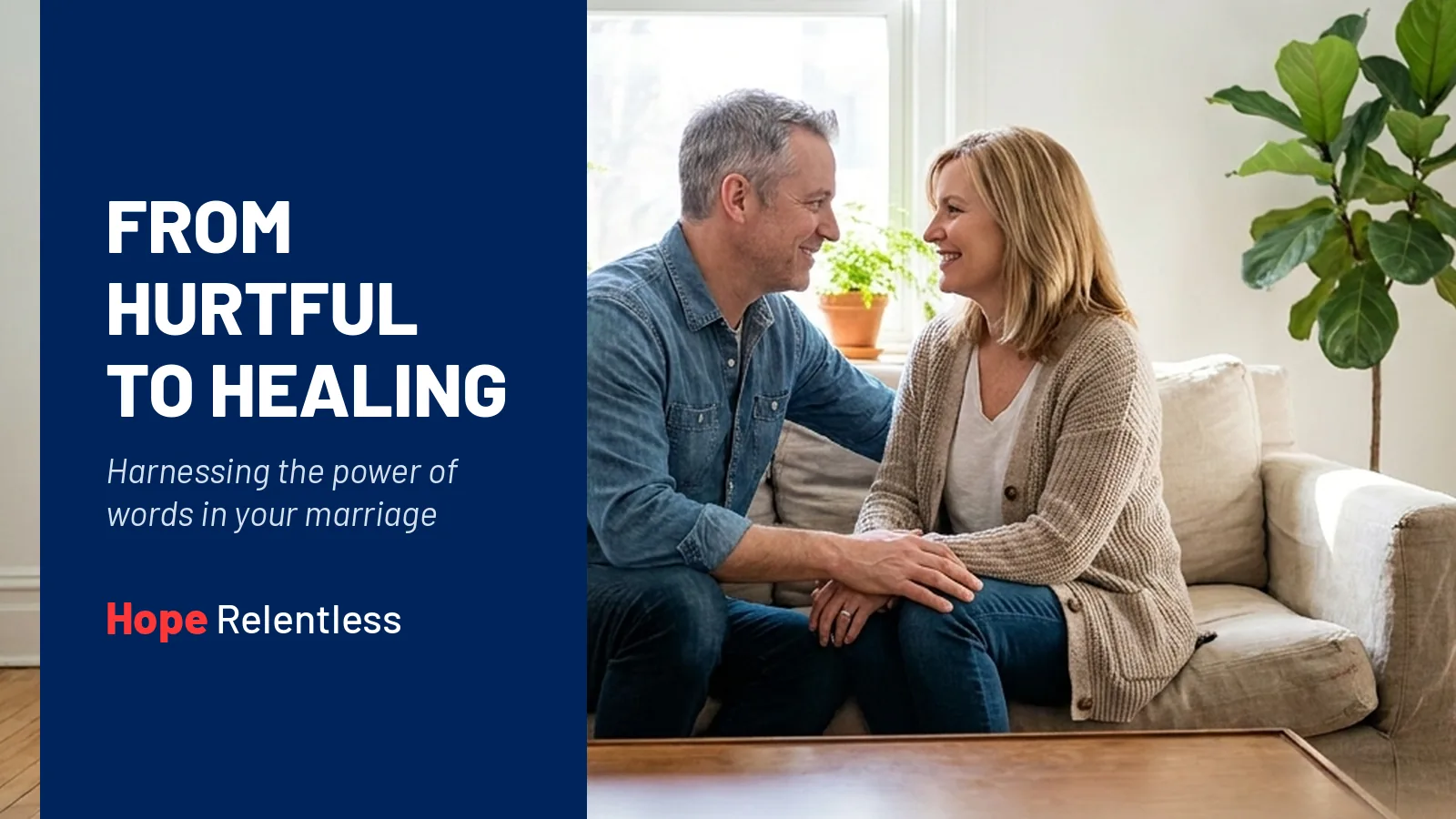
You would never talk to your kids the way you sometimes talk to your spouse.
Most of us wouldn't. We hold our tongue with a child, then turn around and let the sharp words fly with the one person we promised to cherish. The hard truth is that the words we use in our marriage are never neutral. They are building something, or they are quietly tearing it down.
Proverbs says death and life are in the power of the tongue. That is not poetry, it is the daily reality of a marriage. This is about how to move from words that hurt to words that heal, and how to repair it when your words have already done damage.
Prefer to watch or listen? Hit play above, then keep reading.
What this episode is about
We have been teaching couples about making meaningful deposits, the moments of laughter, encouragement, and joy that build the friendship underneath a marriage. This episode zooms in on one of the most powerful deposits or withdrawals you make every single day: your words.
Sarah-Gayle and Chad walk through why words carry so much weight, the magic ratio that keeps a marriage warm, the encouragement exercise that makes couples cry in session, and the simple way to repair things when your words have caused a wound.
Key takeaways
- Your words are never neutral. Every sentence is a deposit or a withdrawal in your marriage.
- Start with your own mouth. It is easy to focus on your spouse's criticism. Personal responsibility starts with the words coming out of you.
- Aim for the 5 to 1 ratio. Five positive interactions for every hard one. Drift, and you land near one to one.
- "Sticks and stones" is a lie. Words can erode a relationship as surely as they can build one.
- Saying sorry is strength. Repentance bridges the gap your words created. It says the relationship matters more than your pride.
- Be the hype man. Don't let someone else be the one to tell your spouse how awesome they are. You be the one.
Why your words carry so much weight
God spoke the world into existence, and the world still responds to words. There is even a book called Words Can Change Your Brain, where a neuroscientist and a communication expert explain that a single word can influence the genes that regulate physical and emotional stress. Your words literally change the chemistry in another person's body. That is how much weight they carry.
So we want to hold ourselves to a higher standard. Most of us already do this with our kids. We use self-control. We don't say the cruelest thing that comes to mind. The question worth sitting with is, why am I more likely to speak to my spouse in a way I would never speak to my child? For those of us who follow Jesus, self-control is a fruit of the Spirit. We have it. The goal is to bring that same restraint to the person we share a bed with.
Your words are never neutral. They build up or they tear down.
Start with your own words, not your spouse's
Almost everything we teach at Hope Relentless starts with personal responsibility, and words are no exception. It is easy to focus on your spouse's words, their criticism, their tone. Growth starts when you focus first on the words coming out of your own mouth. You can only change one person in your marriage, and it is not the one across the table. If you want a deeper look at that mindset, we unpack it in our post on the power of personal responsibility in marriage.
Think about the phrase "I love you." For a lot of couples, they remember exactly when and where they first heard it. Sarah-Gayle still remembers Chad leaning over in the back of a truck on the way to Reno and saying it for the first time. Those are just words. But they carry a life of their own. If words like that can define a relationship, then the words we use on an ordinary Tuesday are shaping it too.
The 5 to 1 ratio
One of the most helpful findings from the research on healthy couples is the magic ratio: five positive interactions for every one negative. Not one to one. Five to one. And here is the catch. If you are not intentional, you will not land at five to one. You will drift toward one to one, where every kind word is canceled out by a sharp one.
This is also where the four horsemen of criticism, contempt, defensiveness, and stonewalling do their damage, and most of that damage is done with words. Name-calling is the one we ask couples to cut first. We tell ourselves it is just teasing, but those little jabs are daggers, and they erode the very relationship we say we want. Learning to spot and replace those patterns is the heart of healthy communication that builds connection.
One more piece on the ratio: what you feed yourself matters. The music you listen to, the books you read, the videos you watch. It is hard to give encouragement you do not carry. If depositing courage feels impossible right now, it may be that there is not much of it being poured into your own life. Fill your own cup, and watch it start to overflow into how you speak to the people around you.
What to do when your words have hurt your spouse
None of us has done this perfectly. So what do you do when you realize your words have wounded the person you love? Two simple moves. First, repent, which just means you decide to turn and do it differently. Second, ask your spouse for forgiveness, and let them know you are genuinely remorseful, that it matters to you that you hurt them.
Saying sorry can feel like weakness. It is actually a place of strength. An apology says, you are more important to me than my pride, and I would rather repair this than win it. Repentance is simply bridging the gap your words created. We have watched a single honest apology open a couple back up after weeks of distance.
What to do when your spouse's words have hurt you
You do not have to attack or belittle your spouse to let them know their words landed hard. You can simply tell them, using an I-statement: "When you said that, I felt sad. Moving forward, I would appreciate encouraging words." That is it. There is vulnerability in it, but vulnerability and authenticity are exactly what help a marriage thrive. More often than not, your spouse had no idea it stung, and the moment you name it gently, something opens up between you.
Want a simple framework for hard conversations?
The Communication Loop is our four-step tool for raising the hard stuff without it turning hurtful. Grab the free guide below and we will send it straight to your inbox.
The encouragement exercise (try this tonight)
Here is one exercise you can do the moment you finish reading. Sit face to face, knees close, and ask each other, "What is something you could use encouragement in?" Maybe one of you says, "Honestly, getting in shape." Then the listener speaks life, and there are two parts to it.
First, remind them who they are. "You are an overcomer. You ran that race two years ago. You have a track record of following through. You are a child of God." Second, assure them they are not alone. "I am with you. Tell me how I can help, because I see you and I want to support you." That is it. Simple, and powerful enough that couples cry doing it in our office, because most of us are starving to be reminded who we are by the person who knows us best.
As Sarah-Gayle says, don't let some other schmuck be the one to tell your spouse how awesome they are. You be the hype man. With genuine, specific words. Sometimes a season of focused help, whether coaching or online marriage counseling, is what helps a couple rebuild that habit of speaking life again.
Key scriptures
"Death and life are in the power of the tongue, and those who love it will eat its fruit."
Proverbs 18:21
This is the anchor for everything. Your tongue carries the power to give life or deal death in your marriage. Use it on purpose.
"Do not let any unwholesome talk come out of your mouths, but only what is helpful for building others up according to their needs."
Ephesians 4:29
A simple test before you speak: will this build my spouse up, or tear them down?
"With the tongue we praise our Lord and Father, and with it we curse human beings, who have been made in God's likeness. This should not be."
James 3:9-10
The same mouth that worships God can wound the image of God sitting across the table. James says it plainly: this should not be.
"Gracious words are a honeycomb, sweet to the soul and healing to the bones."
Proverbs 16:24
Kind words are not just nice. Scripture says they are healing. They mend what harsh words have broken.
Your next step
This week, do the encouragement exercise once with your spouse. Ask the question, then speak life with both parts: remind them who they are, and assure them they are not alone. One intentional, specific deposit. That is how you start moving from hurtful to healing.
Questions to discuss together
- If I am honest, is my word ratio with my spouse closer to five to one, or one to one?
- What is one phrase I use that I know lands as a withdrawal?
- When was the last time I told my spouse, specifically, why I am proud of them?
- Are there words of mine I need to repent of and ask forgiveness for?
- What am I feeding myself, and is it making me easier or harder to live with?
Ready to change the way you talk to each other?
If the words in your home have been doing more harm than good, let's talk. One conversation. 30 minutes. You will know if it is a fit.
Cheering you on,
- Chad & Sarah-Gayle
There's always, always hope.
About the authors
Sarah-Gayle Galbreath, MSMFT holds a Master of Science in Marriage and Family Therapy and coaches Christian couples in communication and connection. She and Chad have been married more than 20 years and co-host the Hope Relentless podcast.
Chad Galbreath is an ordained minister and marriage coach. Alongside Sarah-Gayle, he has spent more than 15 years helping couples move from tension to teamwork through the Hope Relentless method. Chad and Sarah-Gayle are coaches, not licensed therapists.
Read the full episode transcript
Sarah-Gayle: Hello and welcome to the Hope Relentless Marriage Podcast. We are honored that you are tuning in. My name is Sarah-Gayle, and my amazing, incredibly good looking husband, Chad, is joining us. He is a regular on the podcast. We are so happy to have you world changers on, because remember, as you resource your marriage, you are changing the world. Marriages impact families, families impact communities, and communities impact the world. So well done.
Chad: That's right, world changers. It is great to be with you today. We have been talking about the importance of deposits at Hope Relentless. A lot of what we talk about is communication and connection, and deposits are an important part of connection. Even if we become great communicators and minimize those epic, hurtful fights, we still need to enjoy our time together. Deposits are about enjoying the relationship and building the friendship, those moments of laughter and joy. Last week we talked about deposits and looked at thoughts. Today we dive into the power of our words. I want to share a truth from Proverbs 18: death and life are in the power of the tongue, and those who love it will eat its fruit. As we get ready to talk about words, it is a big deal, literally life and death.
Sarah-Gayle: Wow, I feel like he just said Mufasa. For you Lion King people, you know what I mean. This is huge. God spoke the world into existence, so the world responds to words. There is a book called Words Can Change Your Brain, by Dr. Andrew Newberg, a neuroscientist, and Mark Robert Waldman, a communication expert. They say a single word has the power to influence the expression of genes that regulate physical and emotional stress. It literally changes the chemistry of our body. So I want to encourage us to hold ourselves to a higher standard with what we allow out of our mouths. We talk to so many couples who describe a recent argument where everybody was going low, throwing verbal low blows. We are able to have self-control. For those of us who are Christian, it is a fruit of the Spirit. We won't go cuss out our kids, generally, because we make a distinction between what is appropriate and what is not. I want to encourage us to use that same self-control with our spouse, to have a higher standard and a better boundary on what we allow to come out of our mouths.
Chad: That is a good standard, to raise our individual standard. A lot of what we talk about at Hope Relentless starts with personal responsibility, and this is one of those areas. It is easy to focus on our spouse's words, maybe their criticism, but focus first on the words coming out of your own mouth. I think about a phrase that often defines a relationship, the phrase I love you. They are just words, but they give life and encouragement.
Sarah-Gayle: Let me interject, because I remember the first time Chad said I love you to me. We were in the back of a truck, I think going to Reno, shopping or something. He just leaned over and said, I love you. And I whispered, I love you too. I was smitten. So what you are saying is so true, and it is a defining thing.
Chad: For a lot of relationships, they remember when and where they first heard that phrase. That is a high value phrase. Words mean something. We sometimes talk about the four horsemen from Drs. John and Julie Gottman, the incredible work they have done. The four horsemen are criticism, contempt, defensiveness, and stonewalling. A lot of these break down communication, and they are words in the negative. One thing we do with couples, because it falls under contempt, is eliminate name-calling. We tell ourselves we are just teasing, but often it is eroding the relationship, little daggers into our spouse. There is a better option. In James chapter 3, it points out the tension we face: with the tongue we praise our Lord, and with it we curse human beings made in God's likeness. Out of the same mouth come praise and cursing. This should not be. We all heard the saying, sticks and stones may break my bones but words will never hurt me. It is just not true. Study after study shows words can erode a relationship. So before we even get to the takeaways, ask yourself, are my words building the relationship or destroying it? One study talks about the magic ratio of positive to negative being five to one, not one to one.
Chad: If we want to reach five positive deposits with our words for every one harsh or critical moment, we have to be intentional. If we are not, we land somewhere near one to one. We talk about this with our boys, trying to get them to use their words to bring life. And one more thing: what we listen to, read, watch, and talk about matters. If we are having a hard time depositing encouragement, it might be that we do not have much of it in our own life. It is hard to give what we do not have. So get positive encouragement deposited into your own life, and it will start to become a natural outpouring. Let's move toward that five to one ratio and use our words to bring life and hope.
Sarah-Gayle: That five to one ratio stands out to me, because you have to be intentional to even have five positive interactions. A lot of us just go to and fro getting things done, and we do not stop to make eye contact and say the kind thing. I liked how you talked about being intentional, because sometimes we think, if I do not have anything nice to say, I just will not say anything. But over time, if we are not saying anything at all, that is its own kind of negligence, and it will not build the intimacy we want. It is not that we say nothing, it is that we want the things we say to be more positive and life-giving. I know none of us has been perfect at this, myself included. So the question is, what do we do if our words have hurt our spouse? First, repent, recognize you want to turn and do something different that honors God and your spouse. Then ask your spouse for forgiveness. Let them know you are aware of the words coming out of your mouth and that you are truly remorseful, that it matters to you.
Chad: That is bridging the gap, which is what repenting does. Now, what if our spouse's words have hurt us? We let them know in a healthy way, using I-statements. A simple pattern is, when blank happened, I felt blank. Hey, when you said that, I felt sad, and I would appreciate encouraging words. We do not have to attack and belittle our spouse to let them know their words hurt. There is vulnerability there, and also authenticity and trust, which help relationships thrive. Saying sorry can be a place of strength, because it says you are important to me, I recognize I messed up, and my pride is in no way more important than our relationship. Sometimes when we work with couples, a spouse shares something and the other is surprised and says, I did not realize that upset you, and they stop. Just like that, open communication starts to build the life they want together.
Sarah-Gayle: Let me give a few action steps. First, take inventory of what you say to yourself. Do you speak positive phrases, or negative ones, out loud? Some people find scripture for a season of low self-esteem and say it out loud, like I am fearfully and wonderfully made, over and over. There is power when we say it out loud, not just think it. Then, take inventory of how you talk to your spouse. If it is mostly negative, start to transform it into positive, thinking of that five to one ratio. Sometimes when we are working on our marriage, we get focused on everything we are doing wrong, and it becomes tiring. We want to focus on the positive things we are doing to move the relationship forward.
Chad: Those are great. I do not have anything to add to the action items.
Sarah-Gayle: Let me map out one more, the encouragement exercise, because it has been powerful for our couples in session. You ask each other, what is something you could use encouragement in? If someone says, I am having a hard time getting in shape, the spouse listening speaks life. Two components: first, remind them who they are and how awesome they are. Hey, I see an overcomer. You got in shape last year, you ran that marathon, you have a track record of following through, and you are a child of God. Second, assure them you are with them, they are not alone. Let me know if there is anything I can do to help, because I see you and want to support you. We have couples crying at this part, because we are making eye contact, sitting face to face. Try it as soon as you get off this podcast and watch the emotional intimacy that comes from it.
Chad: I love that idea. Imagine being your spouse's number one hype man, with genuine, specific words. When we see couples do it, it is so life-giving. I really hope everybody listening does that exercise and watches the impact on your connection and emotions.
Sarah-Gayle: I tell my couples, don't let some other schmuck be the one to tell your spouse how awesome they are. You be the one, you be the hype man. And speaking of hype, let's move into appreciation time, something we do every podcast and encourage you to do at home daily. Chad, I appreciate that you are a present father. You are involved in our boys' sports, their spiritual growth, basically anything they are involved in, even more than I am sometimes. I do not take it for granted, so thank you.
Chad: Thank you, babe. I appreciate the beauty you bring into our house. Sarah-Gayle and I have two sons, and us three boys have a tendency to bring a lot of things into the house, and beauty is not always one of them. We got back from a recent road trip and there were little flowers in little vases in the bathrooms, and the house smells good, which is a result of your intentional action to overcome our teenage sons. I appreciate the beauty you bring into our family's life.
Sarah-Gayle: Thank you. I only do these podcasts for these moments at the end. Joking. That is what we have for today. I hope you join us for next week. And regardless of whether you are in a high place or a low place, I want you to know that there is always, always hope.