
The Ultimate Guide to Communication in a Christian Marriage

You and your spouse run a good life together. The bills get paid, the kids get where they need to go, the calendar somehow works. From the outside, things look fine. But somewhere along the way the two of you stopped really talking. Not the logistics. The real stuff. The hurts, the hopes, the things that have been sitting under the surface for months.
And it isn't that you don't love each other. You do. It's that the last few times you tried to bring something up, it got worse instead of better. Voices rose. Walls went up. One of you shut down and the other felt alone. So now there's this quiet agreement neither of you ever spoke out loud: don't poke the bear. Keep the peace. Don't make it worse.
If that's where you are, here's the question we hear underneath it all the time: is this it? Is this the most connected we're going to feel? Is this the peak of feeling respected, appreciated, actually known by the person we married? You know couples who have it worse. But you also believe there's more. More friendship. More closeness. More peace. You just can't see the path to get there.
This guide is the path. We're going to give you the whole map: why communication in a Christian marriage carries more weight than most people realize, the heart posture that has to come first, how to name the patterns that keep hijacking your conversations, and the exact four-step tool we walk couples through to have hard conversations without them turning hurtful. None of it is complicated. All of it is learnable. And no matter how stuck things feel right now, there is always, always hope.
Prefer to watch or listen? Here's the podcast episode this guide grew out of.
In that episode, we talk about why so many couples quietly stop communicating. It isn't that they have nothing to say. It's that when they do talk, it tends to make matters worse instead of better, so over time they just stop trying. Toxic patterns take over, and those patterns leave a trail of frustration, hurt, and hopelessness.
The good news is that patterns can be named, and once they're named, they can be replaced. This guide takes everything from that conversation and lays it out as a complete system you can actually use. Let's start with why your words matter more than you think.
Key Takeaways
- Communication is about connection, not winning. If you win the argument but lose the connection, you lost. The goal is to feel like teammates again, not opponents on opposite sides of the table.
- Heart posture comes before tools. Any tool can be weaponized. The same skill that builds connection can be turned into criticism and scorekeeping the moment the heart behind it is off.
- Name your patterns before you try to fix them. Most couples are stuck in a few default unhealthy patterns. You can't change what you won't name.
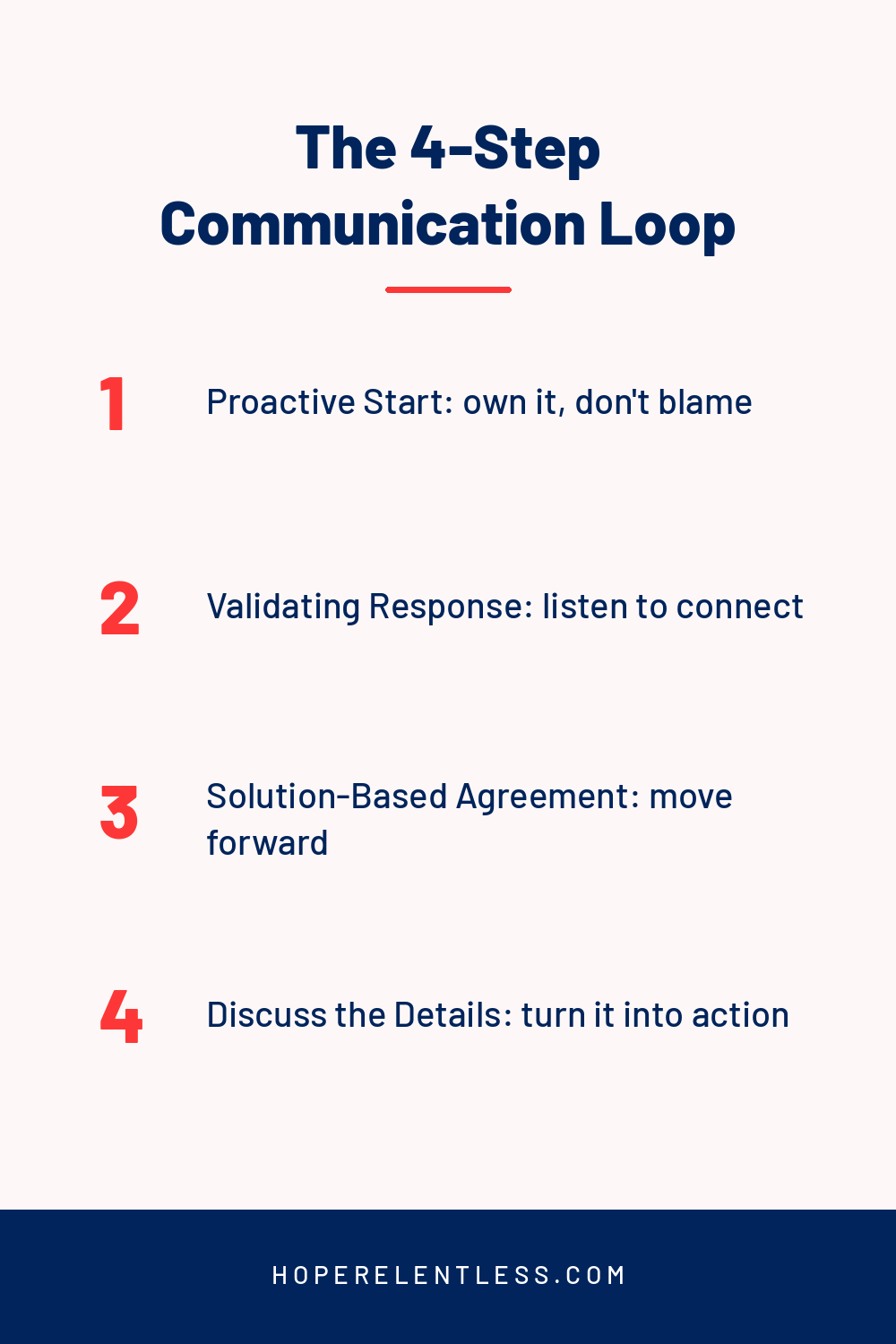
- The Communication Loop is four steps. Proactive Start, Validating Response, Solution-Based Agreement, and Discuss the Details. Used together, they let you talk about almost anything without it turning into a fight.
- Repair is a "when," not an "if." Two real people will step on each other's toes. Healthy couples aren't the ones who never blow it. They're the ones who know how to come back together quickly.
- You can only change yourself. The breakthrough comes when each person stops focusing on what their spouse isn't doing and takes responsibility for how they show up.
Why Communication in a Christian Marriage Feels So Hard
Years ago, Sarah-Gayle and I walked through a brutal season. We had just closed a business and felt like we were starting over. The external pressure was heavy, and on top of that, we were still early enough in our marriage that we hadn't learned how to communicate well yet. So every time we tried to connect, to work through something that mattered, it tended to blow up. We'd both walk away feeling more isolated, more alone, more misunderstood than before we started.
I want to be clear about something. I never wanted a divorce. But there was a stretch in there where, for the first time, I understood how two people who genuinely love each other end up in that place. We loved each other deeply. And we still lacked the skills to connect emotionally and resolve the things we were trying to work through. The goal of every conversation was connection. The result was fight-or-flight. We were trying to get closer, and our patterns kept driving us apart.
That's the gap most couples live in. Put your marriage on a scale of one to ten and a lot of couples land around a six. A solid C. Not a disaster, but not what you hoped for either. You know it could be so much richer. You just feel locked out of the door that leads there, and every attempt to force it open seems to make things worse. So you settle into a C or D marriage, scared to make it worse, with no clear idea how to make it better.
Here's what's underneath that. Most of these conversations turn hurtful not because either spouse is cruel, but because the two people are operating like they're on different teams. Same goal, opposite sides of the table. And when you feel like you're across the table from your spouse instead of next to them, even a small conversation can become a contest. That's the thing we have to change first. Not the topics. The posture.
Your Words Carry Life or Death
For those of us who follow Jesus, communication isn't just a skill set. It's spiritual. There's a line in Proverbs that anchors everything we teach about marriage communication: "Life and death is in the power of the tongue." We see it play out in marriages over and over. Your words are not neutral. They are either depositing life into your marriage or draining it.
So one of the most important questions you can carry into any hard conversation is simple and convicting: are my words creating life in my marriage right now, or are they creating death? That's not a communication technique. That's a heart posture. And it changes how you start, how you listen, and how you respond.
There's a second passage that shapes our whole approach, and it's the picture of marriage in Ephesians 5. Husbands are called to lay down their lives for their wives the way Jesus laid his life down for the church. Wives are called to respect. But here's the part most people miss. Both the husband and the wife are called to do this not in response to what their spouse has earned or deserved, but in response to what Jesus has already done for them.
That one shift changes everything. Because the alternative is a transactional marriage. You do this, so you've earned that. I did this, so now you owe me. The trouble with a transactional relationship is that it puts your marriage in a constant state of debt. One spouse always owes the other, which breeds entitlement on one side and resentment on the other. The way of Jesus is the opposite. We love each other out of the overflow of the grace, mercy, and forgiveness we've already received from him. Which means your spouse's behavior doesn't get to set the ceiling on how you treat them. Jesus already set the example, and we follow him.
It also moves where your trust lives. When your security comes from God instead of from your spouse's performance, you can walk into a hard conversation without needing your spouse to fix you. You can ask, "God, help me start this in a way that brings life and keeps us teammates," whether you're the one raising the issue or the one listening to it. Faith doesn't sit on the sidelines of your communication. It can guide every single step of it, if you invite it in.
Tools Don't Work Without the Right Heart Posture
Before I give you a single tool, I have to tell you about a baseball bat. When I was younger, a good friend of mine went off to college, came back, and we met up for dinner. I noticed a baseball bat sitting in his car. Now, this guy didn't really play ball growing up, so I asked him about it. He said, "Oh, that's for self-defense." When I look at a baseball bat, I think Little League. Home run derby. Summer evenings. He looked at the same bat and saw a weapon. Same tool. Completely different use. The difference wasn't the bat. It was what was in the hand that held it.
That's exactly why heart posture has to come before tools. Because any communication tool I'm about to teach you can be picked up as a weapon. Take Gary Chapman's five love languages, which we love and use with couples all the time. It's a beautiful tool for understanding how your spouse gives and receives love. But I've watched couples weaponize it. My love languages are words of affirmation and physical touch. If my heart posture is off, I can use that knowledge to keep a running tally of every way Sarah-Gayle isn't loving me the way I want. Now I've taken a tool meant to build connection and turned it into a list of grievances.
The right posture flips it. Yes, I should proactively share my love languages with her. But then I spend most of my energy getting curious about hers, learning how she feels loved, and celebrating it when she shows up for me. Same tool. The bat builds a home or it breaks a window, depending entirely on the heart holding it. If you just collect tools without the right heart, you don't get a better marriage. You get a better-armed argument.
So what's the right heart posture? Two convictions hold it up. The first is personal responsibility. You cannot change your spouse. You can only change how you show up. The breakthrough in a marriage almost never comes when both people are waiting on the other one to go first. It comes when each person independently decides to own their part, drop the excuses, and grow.
The second is we are on the same team. Scripture says a husband leaves his father and mother, is joined to his wife, and the two become one. That's covenant language. You are not two individuals negotiating a treaty. You are one team facing the same challenges together. So when a hurt or an obstacle shows up, the move isn't to line up across the table and argue about it. It's to get on the same side of the table and look at the problem together. The enemy was never your spouse. The enemy is the thing the two of you are facing.
Hold onto those two. Personal responsibility and same team. Every tool below only works when it's built on that foundation.
Name Your Patterns Before You Try to Fix Them
Here's a hard truth. If you have an unhealthy communication pattern, then communicating more doesn't help. It actually does more damage. Every hurtful interaction is a major withdrawal from the connection in your marriage, and you can't deposit your way to health while you're hemorrhaging trust out the back door. So the very first move toward better communication isn't adding a new skill. It's reducing the toxic interactions you're already having.
To do that, you have to name the patterns. The clearest framework we've found for this comes from the Gottman Institute, and it's called the Four Horsemen. These are the four communication patterns most likely to predict disconnection, and naming them lets you spot them in real time:
- Criticism: attacking your spouse's character instead of raising a specific issue.
- Contempt: sarcasm, mockery, eye-rolling, treating your spouse as beneath you.
- Defensiveness: deflecting responsibility, counter-attacking, refusing to own your part.
- Stonewalling: shutting down, going silent, walling off and checking out.
Most of us have done all four at some point, but you probably have one or two that are your defaults under stress. Mine is defensiveness, if I'm honest. The goal isn't to diagnose your spouse. It's to catch your own. We go deep on each horseman and its antidote in ourconflict resolution guide, but for now, just learning to recognize them is a huge step.
Here's an exercise we give couples, and the rules matter. Each of you writes down two unhealthy patterns and two healthy patterns that you yourself bring to your communication. Not your spouse's. Yours. Then reflect on two questions: what does my unhealthy pattern cost our connection, and what does my healthy pattern add? Then share them with each other. When you lead with humility about your own part, you create a safe space for your spouse to do the same. Humility tends to be met with humility. And naming your spouse's patterns instead of your own completely misses the point, because you can't change them anyway. You can only change you.
If you want to go further on this, our post on breaking toxic communication patterns walks through how to trade each unhealthy pattern for a life-giving alternative.
The Communication Loop: How to Have Hard Conversations Without Them Turning Hurtful
Once you've started reducing the toxic patterns, you need something to put in their place. That's the Communication Loop. Think of it as the healthy alternative to the Four Horsemen. It's four steps, and like four pieces of a puzzle, you only see the full picture when all four are in place. One quick reminder before we start: this is a guide, not a law. It's a flexible tool to support how you show up, never a script to beat your spouse over the head with.
Step 1. The Proactive Start: Communicate With Ownership, Not Blame
How a conversation begins largely determines where it ends. A Proactive Start is simply an "I" statement with a positive target. The structure looks like this:
"When ______ happens, I feel ______.
Moving forward, I'd appreciate ______."
That simple structure does three things at once. It gives context without accusation. It owns your own emotion instead of assigning blame. And it offers a clear, positive request, which is the key part. The positive target gives your spouse something they can actually hit. For example: "When we go several days without really connecting, I feel lonely. Moving forward, I'd appreciate a short check-in before bed." Compare that to "You never make time for me." One invites your spouse onto the team. The other makes them the opponent before you've said a second sentence. Kill the absolutes, the "always" and "never." They're rarely true, and they always escalate.
Step 2. The Validating Response: Listen to Connect, Not to Correct
This is the listener's job, and it's the step most couples skip. The entire goal here is for your spouse to feel heard. Not for you to agree. Not even for you to fully understand yet. Just for them to feel heard, because that's what creates the safety to keep going. Validation is not the same as agreement. It's acknowledging what your spouse felt and shared.
1. Listen to understand. Put the phone down, turn off the TV, make eye contact, don't interrupt, don't hijack.
2. Reflect back."What I hear you saying is ______. Is that right?"
3. Confirm and validate."That sounds really hard. Thank you for sharing that with me."
The reflect-back step is where the magic is. So often we hear something completely different from what our spouse meant. Reflecting back closes that gap before it turns into a second argument about what you "actually" said. And keep it to one topic at a time. Picture a relay race where only one runner holds the baton. If both of you are talking at once, nobody's really listening, which means nobody feels heard. A few phrases that help: "Can you tell me more about that?" and "When you said ______, what did you mean?" Remember the mindset underneath the whole step: you can win the argument and lose the connection. Don't.
Step 3. The Solution-Based Agreement: Move From Frustration to Teamwork
Once both people feel heard, you move toward a solution. Most unhealthy communication stays stuck on the problem, and the longer you circle the problem, the more likely you are to slide right back into criticism and defensiveness. The shift is to talk about what would actually add value, in the positive.
1. Make a positive request."When we're talking and a phone comes out, I feel dismissed. I'd really appreciate keeping screens down during our conversations."
2. Invite a collaborative response. Your spouse accepts, or counters while staying solution-based: "This weekend's packed, how about Friday next week?"
3. Confirm and commit. Land on something that serves you both.
Notice the focus is on what moves you forward, not "you're the problem, stop doing that." Pursue both/and, not either/or. Either/or makes opponents. Both/and makes a team. When you counter, stay on your spouse's original topic. Don't hijack it into a different complaint or make it about you. And know that not every loop ends with an action item. Sometimes the agreement is simply, "Thank you for letting me share. It felt good to be heard." That's a complete loop. Sometimes there's a clear next step. And sometimes it's a perpetual issue you won't fully solve, where the win is learning to handle it as teammates instead of opponents.
Free Download
Want the whole framework in one place? Grab the free Communication Loop guide: the four steps and a real example of each, in a clean PDF you can keep on the fridge and actually use this week.
Step 4. Discuss the Details: Turn Agreement Into Action
Here's where so many couples fall apart, and it's the step that breaks my heart the most because it's the most fixable. You agree on something, you both feel good, and then the week comes and goes and nothing actually happens. Resentment creeps in, and worse, you start telling yourself a story: "See, it's not even worth communicating, because we never follow through anyway." The problem usually wasn't the agreement. It was the details nobody discussed.
Early in our marriage, Sarah-Gayle and I lived in a tiny one-bedroom apartment in LA. We had agreed that I would take out the trash. Simple, right? Except I emptied the kitchen can on my way out the door each morning. What I didn't realize was that Sarah-Gayle needed it emptied before she cooked, not after. And I never touched the cans in the bathroom or the bedroom, because in my mind "the trash" meant the kitchen. We had a real agreement and a real tension at the same time, and the tension wasn't disobedience. It was undiscussed details.
1. Clarify responsibilities. Who owns each part?
2. Specify timing and logistics. When, where, how often, and what about the kids or the schedule?
3. Confirm and revisit."Just confirming, we're both good on this?" And if a new detail surfaces later, that's just a new Proactive Start. Loop back.
The details are the difference between a nice conversation and a changed marriage. Get the who, what, when, where, and how on the table, and your follow-through will climb dramatically.
Save this for later
Set the Stage First: The Game Plan
The Communication Loop happens inside a conversation. The Game Plan is what you set up outside the conversation, before you ever start. Sarah-Gayle and I both grew up in sports. We met at UCLA, where she played soccer and I ran track. One thing competition teaches you is that teams who walk into a game with a plan can support each other, adjust in real time, and debrief afterward. Healthy communication works the same way. It rarely happens by accident.
A Game Plan covers a few simple things that dramatically raise your odds of success:
- Timing (when): Don't launch a hard conversation late at night when you're both exhausted, or in the morning chaos with little kids underfoot. Pick a time you both have margin.
- Location (where): Where do you both feel safe and present? Public or private? Kids around or not? Decide in advance.
- Who: Who are the trusted voices around your marriage? Scripture says plans fail for lack of counsel. A coach, a pastor, a couple whose marriage you admire. Just agree together on who you bring in, because sharing the wrong thing with the wrong person can break trust faster than the original issue.
- How: Tone and volume matter as much as the topic. And build in a way to call a timeout. Agree on a word or phrase that means "let's pause, let the temperature come down, and come back to this as teammates." A timeout is not abandoning the conversation. It's protecting it.
- Why: Name your goal up front. Are you looking to be heard, or to solve a problem? Mismatched goals are one of the top reasons couples feel misunderstood. A simple question fixes most of it: "Are you looking for a solution right now, or do you just need me to listen?"
We dig into the timeout and the tone in our guide on setting healthy boundaries in communication, which pairs naturally with this.
When You Blow It: The Repair Roadmap
Here's something that takes the pressure off. The goal was never to stop having conflict. Two real people are going to step on each other's toes. It's not if you'll feel disconnected or hurt, it's when. Healthy couples still argue. What makes them healthy is that they take responsibility for how they argue and how quickly they come back together. So you need to know your way home before you're lost. We teach a five-step Repair Roadmap, and these are guides, not laws:
- Proactive. Someone has to go first. Don't wait for your spouse to come to you. Take initiative to close the gap.
- Humble ownership. Lead with an "I" statement and real humility. Humility tends to be met with humility. It softens the walls and invites your spouse to meet you in the middle.
- Reassurance. Reaffirm the relationship. "I know this is hard, but I know we'll work through it together." One of the most destructive things you can do is threaten to leave whenever there's tension. Reassurance is the opposite, and it brings life.
- Apologize, in three layers."I'm sorry" is the start, and the more specific the better. Add remorse , which names the hurt your spouse actually felt, so they know you get it. Then add repentance , which simply means a change of direction. An apology with no plan to do it differently leaves your spouse quietly bracing for the same thing next week.
- Forgiveness. For your spouse, and for yourself. Forgiveness is what keeps resentment from taking root, and unrepaired hurt is the most fertile soil resentment has.
If resentment has already built up over years, start with our guide on dealing with resentment in marriage, then come back to repair. We cover the whole roadmap step by step in ourrepair guide.
The Pitfalls That Keep Couples Stuck
When a marriage isn't where you want it and the path feels unclear, there are a few predictable traps. Watch for them:
- Blaming. Making your spouse the problem. It feels productive and it's pure poison. It keeps you on opposite sides of the table.
- Withdrawing. Shutting down, going quiet, refusing to do the work to grow. Withdrawal feels safer than fighting, but it slowly starves the marriage of the courage and vulnerability it needs.
- Giving up. Throwing in the towel. (To be clear, I'm not talking about situations where someone is genuinely unsafe. If that's you, please get help immediately. I'm talking about the ordinary kind of hard.)
- Not enough self-regulation. If you can't manage your own emotions, every hard conversation will escalate and drag you both into the Four Horsemen. This is where personal growth, and sometimes individual counseling, matters so much. Two healthier, more whole individuals have a far better shot at building a healthy, whole marriage.
And under all of it, remember this: communication is really about connection. The more connected you feel to your spouse, emotionally, spiritually, intellectually, and physically, the more grace and benefit of the doubt you'll naturally extend when a hard conversation comes. The more disconnected you feel, the more you show up guarded, skeptical, with walls up. Building connection and building communication aren't two separate projects. They feed each other.
Key Scriptures for Marriage Communication
Your Next Step This Week
Don't try to do all of this at once. Pick one thing. This week, choose a single recurring tension in your marriage, something low-stakes, and instead of bringing it up the way you usually would, try one Proactive Start. "When ______ happens, I feel ______. Moving forward, I'd appreciate ______." That's it. One sentence, started the healthy way. It will feel a little clunky and awkward the first time. That's normal. Baby steps are still steps, and a step is all anyone can take.
Reading about the Communication Loop and running it under pressure are two different things. Most couples can already name the step where they come apart, and they still end up in the same place the next time it matters. That is not a character flaw. It is a skill neither of you was taught. If you want a coach walking the two of you through these four steps together, start here: how marriage counseling works. The first step is a 30 minute consultation.
If you've been stuck for a long time and you can't seem to get traction on your own, that's not a failure. That's exactly what we do. Through online marriage counseling, we help couples go from recognizing these tools to actually implementing them, so you experience the fruit instead of just reading about it. The path exists. Sometimes you just need someone a little further down the road to walk it with you.
Go Deeper on Each Piece of This
Every section above has a full article behind it. Start wherever your marriage is actually stuck.
- why hard conversations in marriage go sideways, and the ten seconds before the words you remember
- breaking toxic communication patterns and what to replace them with
- keeping the main thing the main thing when a conversation starts to drift
- setting healthy boundaries in communication, the what and the how
- why one spouse always brings things up and what to do about the imbalance
- the power of words in marriage, moving from words that hurt to words that heal
- the mind reading trap, and why "they should just know" keeps failing
- why hiding your struggles is costing you as a Christian couple
Reflection Questions for the Two of You
- On a scale of one to ten, where would each of us put our communication right now? What would moving up just one point look like?
- Which of the Four Horsemen is my personal default under stress? (Answer for yourself, not your spouse.)
- Where in our marriage do we keep agreeing on things and then not following through? What detail have we never actually discussed?
- When we have a hard conversation, am I usually looking to be heard or to solve a problem? Do we check that with each other up front?
- When we hurt each other, how quickly do we repair? What's one thing that would help us come back together faster?
Save this for later

You don't have to figure this out alone.
If you're ready to stop circling the same conversations and start feeling like teammates again, let's talk. One conversation. 30 minutes. You'll know if working together is the right fit.
Schedule a Free ConsultationCheering you on,
- Chad & Sarah-Gayle
There's always, always hope.
Sarah-Gayle Galbreath, MSMFT, holds a Master's in Marriage and Family Therapy and co-hosts the Hope Relentless podcast. Alongside her husband Chad, she coaches Christian couples toward the kind of connection they were made for.
Chad Galbreath is an ordained minister and co-founder of Hope Relentless. Married to Sarah-Gayle for more than 20 years, he has spent 15+ years helping couples build marriages that thrive, not just survive.
Read the full episode transcript
Hello and welcome to the Hope Relentless marriage podcast. We are so happy that you're joining us, and well done on taking the time to prioritize your marriage. That's what you're doing when you're listening to this podcast, reading a book on marriage, going to a seminar on marriage, whatever it is that you're doing. It's amazing, because you are making a difference in your marriage, which means you're making a difference in your family, in the community, and the world. So incredible. We're happy to have you, and we're excited for you to hear what we're going to talk about today.
Yeah, I'm excited today because we are talking about communication. Communication problems, challenges, arguments, fights, whatever it is that couples want to call it, is one of the primary reasons that couples reach out to Hope Relentless. They want help with their communication. And really what we're talking about is the ability to connect. Communication can be powerful. It can help us feel close to our spouse, or it can be a source of frustration. So today we're going to talk about communication patterns: how do we find the patterns that are causing problems in our relationship, and what are the alternatives? How do we make maybe small but significant tweaks and adjustments? That's what we're going to talk about today. I am excited for this.
Yes, because this is a very personal one for us. For some reason we have nothing in common when it comes to how we communicate, really when it comes to life in general. I think initially it was Jesus that brought us together. We both love the Lord, and seemingly we were both athletic. But I don't necessarily like to play a lot of sports other than maybe soccer and basketball, and I don't like to watch them for sure. I like to play, if I'm going to involve myself in sports. And I grew up in the mountains and she grew up in the suburbs of Denver. So I think early on we thought there'd be a lot of interest and overlap, and it's simply not true. The reality is, I am a white male and you are a black female, and in pretty much every area we are as similar, or more likely as different, as the aesthetics suggest. So communication has been a bumpy road for us at times, and sometimes it still is. But big picture, we've learned some things, we continue to grow in this area, and we know that when communication is operating right, it just positions the marriage and the relationship so differently.
Yeah. I was working with a couple recently, and they shared something that really resonated with me. They both want to communicate and share, but oftentimes when they do, the reality is the problem gets worse and not better. I think there's a lot of couples that feel that way. They want to maybe share a dream, or maybe share a frustration, but when they do, the reality is the pattern of communication, the pattern of how they interact with each other, ends up causing more pain than it does clarity and freedom. This is so common, and it doesn't have to be that way. That's why I'm excited about today and what we're going to talk about.
So we're going to use an example in our own marriage, a pattern. We're going to go through and highlight the combative or the toxic pattern, and then we're going to look at what the alternatives are. Hopefully you can look at your own communication patterns, and this can be a guide to help create some clarity and some better options for you and for your spouse.
All right, so let's jump in. I want to go through an example. This is a very real-time example, just for you guys listening. This is something in our marriage that we still have to recognize is happening, because we still can fall into it. But the thing is, we have a plan now. So when it happens, we have a plan of action: hey, this is what I'm responsible for, this is what you're responsible for. If we both show up, then we can have that conversation go differently. So I'm going to lay out what typically happens. Sarah-Gayle, I'm just going to be SG. So SG shares her feelings, because, whoa, my mic drops. Sorry. She shares her feelings, and then Chad will defend himself.
Because I might say, you know, I feel like you're just not listening to me. And then he will defend himself and say something like, "I am listening to you. What are you talking about? How are you going to tell me I'm not listening to you? I literally am looking at you, I'm listening to you." And then if he doesn't acknowledge what I'm saying, then I'm going to push. I'm going to say, "No, but I just feel like you're not listening now." And this happens a lot, actually, because when I've spoken to you of things of the past, I felt like you weren't listening to me then. So then I kind of go a bit global, and really my heart is to try and show him, "Look, this isn't isolated, here's a different example, here's a different example." And then that really just takes him to a different level, and then he will start to attack what I'm saying. Even the different examples I give, he might go into it and say, "That's not even what happened in that example." And then now we're arguing about something that we're not even talking about. And as a result, I just shut down, because I feel like all has been lost. Even talking about this pattern exhausts me.
Yeah, it does. It's both sad and funny, almost. It's funny because we've done it so many times in the wrong way, and now, as we lay it out and we talk about it, it seems so silly. But in the moment, it's a real struggle. We start out with good intentions, but in the moment we end up triggering each other. So let's go back through the pattern, but let's talk about some alternatives. When Sarah-Gayle is sharing and she says "I feel," her desire is to take ownership and to personalize. When she says something like "I feel like you're not listening," I get triggered, because I'm like, "I am listening. Okay, if you feel that way, let me just give you accurate information." And my thought is, it'll change her feelings. And I completely miss it. I completely miss that, at the end of the day, one of Sarah-Gayle's primary desires is to be heard, and to be validated, to have space to be herself. For me, it's to be appreciated. So when she says "I feel" anything negative, and I'm triggered, and I go to defending, because I want to defend my honor, I want to correct, I completely miss the fact that my wife wants to be heard. She wants to be valued, she wants to be recognized for her feelings.
So the negative pattern is, I defend myself. The positive pattern would be to ask questions: "Why do you feel that way?" And what's unique about the alternative options is that at almost every step we both have opportunities to disrupt the negative pattern and to create a better, alternative pattern. One powerful thing is to transition potential complaints into desires. So instead of "I feel you," it's just standing on the "I": "I want to be listened to, I want to be heard." That's an opportunity for her. But even if she doesn't, and she says, "I feel you don't listen," now it's my turn to have an opportunity, to go, "Oh, my wife wants to be heard, she wants to be valued. Let me be curious instead of defensive. Let me ask, why do you feel that way? Or, can you share more about that?" These are the ways that, as we increase awareness and we're committed to the relationship over our own self-preservation, there are all these little opportunities to make small tweaks that translate to significantly different outcomes. What are your thoughts on this so far, babe?
Yeah, I like how you said express the desires. And we can also add, how can you communicate in the affirmative? For example, I can say, "I wish you would take me on more dates," or "we don't ever go on any dates," but really I just would like to go on more dates. So it's finding the affirmative way to say that, where it's not an attack of what our spouses aren't doing, but rather what we would like to see happen. Expressing desires instead of complaints, that came from Resilient Marriage. They have an amazing ministry, doing great work with couples through some intensives. So it's a definite option, saying "I desire" rather than "why don't you." Like Chad pointed out, it's a small tweak, but a lot of times we think we're taking responsibility by saying "I feel," but I'm still coming back to you, and that can trigger someone. Instead, it's saying, "I desire to go on more dates," rather than "I feel like you don't take me on dates." You're saying the same thing, but it sits differently. So what we have to decide is, do we want to communicate so that our spouse knows that they messed up and that they're not serving us in the way that we desire, or do we just want to communicate what we desire? That really does change how we talk to our spouse.
But one thing I want to point out, Chad, that we have to be aware of when we're looking at this pattern, and you listening, I'm sure you can identify a pattern that you guys have in arguments. You go through the same thing. There is one area, when it comes to John Gottman, where he's talking about perpetual problems. We've talked about that in the past, and this podcast isn't for that, so you can look up John Gottman perpetual problems, and there's some growth there that can occur. But there is an element in what we're talking about, where we have to have that time of reflection to know why we are responding the way we're responding, and what we personally can do to respond differently. So for example, when Chad defends, in our pattern it started off with me sharing my feelings. Why do I share my feelings? A lot of times it is rooted in our background, something in our past. When I was growing up, I didn't feel like I had a place to share feelings, so as I got older it's like, I want to be able to share my feelings. And then when Chad defends, I push, because I feel like I'm being shut down, and it's almost as if I'm back in my childhood where there was no voice for me to express feelings. So that makes me upset, and that's why I push. I push because I deserve for my feelings to be heard. So it's me being aware of these past things that are making me show up in my current relationship in a way that I don't really need to. Does that make sense?
Yeah, it makes a lot of sense. This is where we like to look at the past and the family of origin to create context. There are a couple things we can learn from our family of origin. What were the patterns that we witnessed? Oftentimes you'll hear the phrase, kids catch what they see, not what they're told. So oftentimes those are the patterns that we might repeat. Or the alternative is we swing the pendulum way far the other way. An example could be, if parents were super controlling and a young person felt stifled, then when they get older, maybe they don't have a lot of boundaries or rules, they swing the other way. But the context matters. For you, you didn't have a voice and you didn't have a safe space to share your feelings, so now that you're a healthy adult, those are important to you. You want your voice to be heard, and you want the freedom to share your feelings. For me, in my family of origin, emotions were often used to manipulate, or to get what somebody wants. So when you bring feelings and emotions, my first reaction is, "Oh, this is to manipulate the outcome. She's trying to write a blank check, because she feels something so she gets what she wants. No, we're going to rely on accuracy and data and facts." So when we both go to those spaces, without awareness, that conversation is not going to go well.
This is what we see with couples. They're not even aware, because we can get so caught up in the moment. And then I go into my corner and you go into your corner, and now it's like a verbal boxing match. We're sparring, trading comments, trading rebuttals, trading defensiveness and attacks. And at the end of the day, maybe one of us wins and is standing in the corner like, "I'm the champion." Well, at what cost? The cost is our relationship. The cost is our spouse wanting to communicate. The cost is, a couple weeks later, "Ah, should I bring this up? This hasn't gone well. Maybe we're at a B-minus in marital satisfaction, but if I bring it up, we're going to be at a D or an F." So that's why these patterns become so important for us to become aware of, so that we can get better at making a different choice. Making different choices can lead to different results.
Yeah, that's so good. When you were describing how, in your family, emotions and feelings were manipulative, it just shows how important it is for us to track with our spouse, to be compassionate towards them. And I said I wasn't going to talk about Gottman's perpetual problems, but I think it's very relevant, because the thing with perpetual problems, the things that consistently come up, is that they will consistently come up. So how we talk about those things matters. Is our tone of voice still calm? Is our demeanor still kind? All of those things matter. A big reason is that there's a story to the conversation, a story behind the conversation, like you've seen in this example, where Chad's not able to receive my feelings because of how he grew up, and I feel like I need to share my feelings because of how I grew up. Imagine if we're having this conflict, this tug of war, and we're treating each other kind. Eventually we're going to be able to have a conversation about it and actually make progress, because we've left the door open. Because when we're not kind to each other in the midst of that conflict, then, like Chad said, we don't want to have another conversation with that person, or we sweep it under the rug, and even worse, we tell ourselves it's hopeless. And that's how marriages corrode over time. You become roommates, and you're done. Whereas in reality, Chad and I love each other. We might not have a lot in common initially, but what we have in common is what has built our life and our marriage. We have that best-friend friendship, and obviously we're attracted to each other as well, because you want both of those. The point is, we want to keep those conversation lines open, and how we treat each other in the midst of those conversations matters. And remember that you love the person you are arguing with, and oftentimes there's more to the story than what we're just hearing. We have to have the patience to dig deep with ourselves, and also with our spouse, to get to that more.
Yeah. I want to encourage couples, if they find themselves in unhealthy patterns of communication, to get away from the data and the circumstances and become more like investigators. There's a pattern there, and it's not about the subject. Because you and I can repeat this pattern across infinite different things. It could start on who goes to the grocery store, who cooks, who cleans, who picks up the kids. The topics can change, but often the patterns are very, very similar. So when we can take a step back and recognize the patterns: Sarah-Gayle wants to be heard, she wants her voice to matter; I want to be appreciated. It's so powerful, because I want to create wins for my family and for my wife. So when Sarah-Gayle phrases things in the affirmative, I'm literally like, "Oh, I can do that. I'm going to make that happen." And when I take a step back and realize that one of the ways my wife feels connected is by listening, now it changes. Now I want to create space for her to share her feelings, for her to share her voice and feel like her voice matters. And now we create a different pattern that, instead of creating tension, is actually building connection and intimacy and friendship and all of these things that many of us want in our relationship. This is why doing this work is foundational. It can literally redefine a relationship. The very things that used to take a relationship from a B-minus to a D or an F can take it from a B-minus to an A or an A-plus. Same circumstances, but how we handle them builds connection versus destroying connection and intimacy.
Yeah, that's so good. So what do we want you to do? What are some action steps? I would say, identify the pattern. Do you have a pattern that occurs in your conversations? And even if it's not a pattern per se, what is it that you both are constantly saying? If you've been married longer than a couple days, there are some constant things that keep coming up, like "I just want to be heard," "I want to be able to express myself," "I want to be respected," or "I don't like the tone." So once you identify that pattern, then self-reflect, as a couple. Think about, why do you respond the way you're responding? Is there a connection to your past? And then, once you know why you're responding, it's finding out how you can respond to meet your spouse where they are. Because once you realize, okay, this is why they're defensive, then it's asking, "I wonder how I can communicate in a way that you can receive it." You guys get to do this work. It's like a marriage mastermind, is what I say in the sessions that I have. You're constantly thinking, okay, what can I put in there that's going to work, that's going to serve the relationship? And then you try it, and sometimes it doesn't work. You try it and you say, "Oh, I think if you just talk to me more directly, I would understand." And then you get spoken to directly, and you're like, "No, no, no, I don't want you to talk to me directly." And that's okay. So let's go back to the drawing board. Let's not just give up and say, "See, nothing's going to work." Something will work, we just have to keep trying. So as you figure out how your spouse receives what you're trying to say, then you start to do those things. It's going to take some renewing of your mind, because it's not going to be your natural instinct, and that's okay. So write it down, perhaps, and really get it in your heart, as far as how they want to be spoken to, because that's how they can receive it.
So once you have these different alternatives in place, like Chad said at the very beginning, there are probably three exchanges at least in this pattern, where one of you has the opportunity to save the day, to do something different. Because even if both of you start the conversation in your old ways, it still gets to that third level. Someone starts, someone responds, and then at that third level you have another chance to respond differently. That's what we want to pay attention to: taking ownership for how I can respond in a way that my spouse can receive it. And then if it doesn't go as planned, it's still recognizing you can save the day at any point in the conversation. Just do something different, and bam, we're in a new pattern of communication that's not as destructive.
Yeah. And you mentioned Resilient Marriage earlier. There are mentors, Phil and Vicki, and they've taught us the power of a do-over. It's something we've tried to embrace. Maybe you both just drop the ball and screw up at every level. That's where it's like, embrace the do-over. Somebody needs to take ownership, and I challenge the men to lead. Leaders lead. Lead in this area. I bet for a lot of men, if they come to their wife with humility and ownership and just say, "Hey, I messed up, I'd like a do-over. I said something, and reflecting, I don't mean it." I think our words matter, and we can't become casual with our words, but look, we're not perfect as people. We've all communicated something that later we go, "Man, I actually don't agree with that," or "I really wish I hadn't said it." Well, start taking action to repair. Take ownership, ask for a do-over, and then give it another shot. What we've seen is, it isn't that couples implement this right away to perfection. It's simply that the couples who are committed believe, hey, we know there's a better way to communicate, and we're committed to discovering it together. They stumble and fumble, but they're moving forward, and they find something that works for them, and they continue to learn and grow. That's what we want to see. We want couples to get out of the negative, toxic patterns and begin exploring and practicing and discovering, for them, healthier patterns that continue to build that connection we're looking for.
You had me at do-over. Because it's just that ownership, where it's like, "Hey, can we have a do-over?" It's amazing, because we are human, we're imperfect. I think that will go a long, long way in many households. Well, I want to end in appreciation. This is something I do in my sessions, and I want to do it here, and hopefully we can remember to do it moving forward, because it's important to appreciate your spouse consistently, every day, throughout the day, and also in public. Let's create an atmosphere of appreciation. So, Chad, I appreciate how you have taken such ownership, and put such time into growing in your emotional capacity. You're reading books on it, and we have word charts around our house that have emotions, just so we can know, okay, you might feel sad today. So I see it, I know our boys see it, and I really appreciate how you're growing in that area.
Thank you, babe. There are "soul words," soul words I need to literally print out so I can identify them. I was a thinker, and I'm starting to learn more how I feel, and so those help. Thank you, babe, I appreciate that recognition. With today being our son's 13th birthday, it reminds me that you do an incredible job helping us as a family celebrate. If it was up to me, I'd give Micah a hug, tell him I love him and I'm proud of him, and send him on his way. But no, you celebrate with the details, so we feel seen and cared for and loved. So Micah gets up, he's got a homemade breakfast of his favorite things, he's got happy birthday balloons. I just appreciate the details that you execute in demonstrating your care and your love, that allow us as a family to have an environment of celebration and joy. So thank you for that.
Ah, I love it. You're welcome. Well, that's the end of the show. I just hope you guys enjoyed this podcast, and that you can apply it to your own marriage. Regardless of where you are, what season of life you're in, a high place or a low place, I just want you to know that there is help and there is hope. And I want you to remember, even if you feel like there's no up from where you are, hold on to the fact that there is always, always hope.