
Why Marriage Matters: The Power of Family
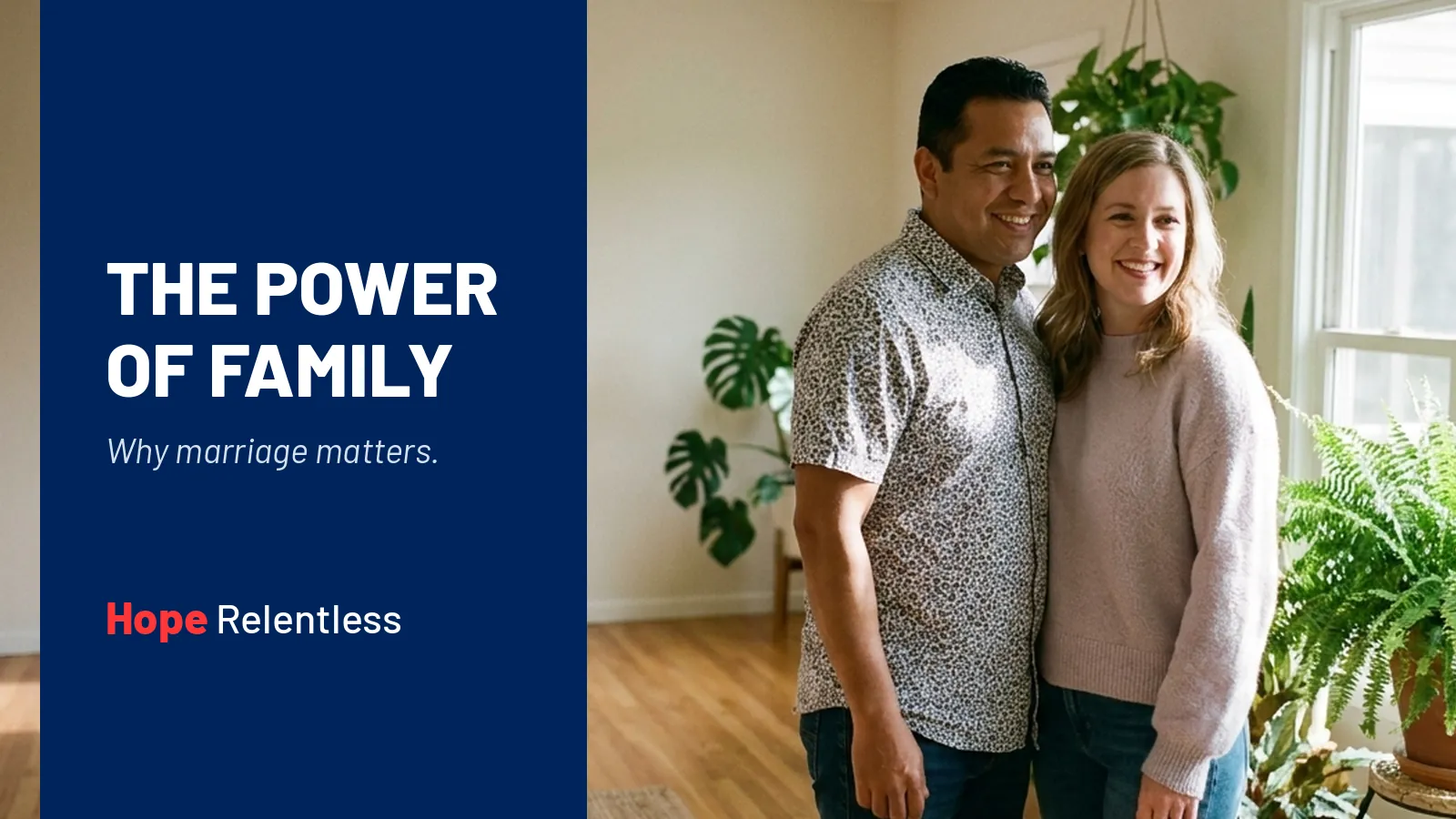
Your kids are watching. Not your lectures. You.
You can give the speech about saying sorry, about being kind, about forgiving. But what they actually absorb is what they see modeled between you and your spouse, day after day, when you think no one is paying attention.
That's both the sobering part and the hopeful part of marriage. This is the second conversation in our "Why Marriage" series, and it builds on the power of partnership. Today we're talking about family, and how the health of your marriage becomes the inheritance you hand your children.
Prefer to watch or listen? Press play on the video, or use the podcast player just above.
Episode summary
Chad and Sarah-Gayle talk about the second sphere of influence God entrusts to a marriage: family. More is caught than taught, so the way a husband and wife treat each other becomes the template their kids carry into their own relationships. They get honest about family-of-origin patterns, share the story of their toddler son and a hard lesson about saying sorry, and make the case for keeping your marriage a priority even in the busy, urgent years of raising kids.
The encouragement is clear. When you invest in your marriage, you are not taking something away from your children. You are giving them a gift that will benefit them for the rest of their lives.
Key takeaways
- More is caught than taught. Kids absorb how you love, forgive, and resolve conflict far more than what you tell them to do.
- Family-of-origin patterns repeat. The patterns you each grew up with show up in your marriage, and then in your kids, unless you address them.
- You don't have to be perfect, just authentic and intentional. Modeling repair matters more than projecting a flawless image.
- Prioritize the marriage, even in the urgent years. When the relationship is strong, the other relationships tend to follow.
- Forgiveness is an inheritance. Learning to ask for and extend it hands your kids a skill for life.
More is caught than taught
Hope Relentless exists to encourage and equip marriages, and one of the biggest reasons why is what happens in the next generation. When I married you, my family extended. When you married me, yours did too. And then came our children.
Here's the thing about kids: they catch more than they're taught. How to handle authority, how to love another person, how to forgive, how to be kind, how to honor. All of it is caught in the everyday atmosphere of your relationship. We've got two teenagers now, and we'll go on what they affectionately call our "rants," and at the end there's a lot of "uh-huh, yeah, okay," and often no change. Because the lecture isn't what forms them. The model is.
When mom and dad love each other well, we hand our kids an example they can copy. Chad & Sarah-Gayle Galbreath
The day a toddler taught us about saying sorry
This story is easy for me to tell, because it's about you.
Our firstborn, Joshua, was a toddler, maybe two. Sarah-Gayle was trying to get him to apologize for something, and he wouldn't say sorry, and she was getting frustrated. Why won't he say sorry? I worked up the courage and said it: "Joshua won't say sorry because you don't say sorry." And the response was, "Yes I do." Then later that same day, a moment came up where it would have been easy to say I'm sorry, and it didn't happen.
It wasn't a character flaw. In Sarah-Gayle's family of origin, taking ownership and apologizing wasn't common. There was a need to project that everything was together, and saying sorry felt like admitting you messed up. She had absorbed that without ever choosing it, and now it was getting reproduced in our two-year-old.
Here's the hopeful part. Today, Sarah-Gayle apologizes and takes ownership all the time. And I've got my own list of patterns I picked up that need addressing so they don't get copied either. A little toddler can hear the principle of forgiveness, but he needs to see it. That is why your marriage matters so much. As you grow as individuals and as a couple, your kids are learning in real time.
Need to get the repair part right?
If saying sorry and rebuilding trust is where things break down in your home, the free Repair Roadmap Guide walks you through how to apologize in a way that actually lands and reconnects, instead of making it worse. Grab it below.
Why the marriage has to stay the priority
When you do this work with couples, you spend a lot of time on family of origin, because those patterns reproduce in the marriage and then in the household. There's a lot at stake, not just with our own children, but with their friends and the broader community.
As life goes on, what's important shifts. When you're young it's about fun. Then responsibilities pile up, money matters, time matters. And here's the trap. When you have young kids or teenagers, there's an urgent pull to pour everything into them, and the marriage quietly gets neglected because parenting feels more urgent. We understand that pull.
But we want to encourage you to prioritize the relationship, and trust that as your marriage grows strong, the other relationships follow. And bigger than all of it, as your relationship with Christ grows, the marriage grows. If you ever have to choose one, choose that one, because everything else grows out of it.
This is also why a date night, an experience, a habit of forgiving and encouraging each other isn't a luxury. It's parenting at the deepest level. The same theme carries forward into how your marriage impacts your whole community.
Little Sarah-Gayle and the pink journal
When I think about why marriage and family, I think about little Sarah-Gayle growing up. My family wasn't perfect, like most families. I had this little pink journal, and I was a thoughtful, pensive kid. I can almost still feel how I felt back then, just wanting more, feeling sad, asking God to one day give me a family that loved him and loved people, because the environment I was in wasn't his best, and somehow I knew it even before I knew him.
That little girl wanted more and didn't have the words for it. That's what's at stake when we look at our own children. There's something in them that knows there's more, and they want it. As a husband and wife, it's our job to be good stewards of what God has given us and to show them the path.
Deuteronomy 6:6-7"These commandments... are to be on your hearts. Impress them on your children. Talk about them when you sit at home and when you walk along the road."
Faith and character are passed down in the ordinary rhythms of home, which is exactly where your marriage is on display.
Joshua 24:15"As for me and my household, we will serve the Lord."
A household takes its direction from the marriage at its center. What you build together, they inherit.
Your next step
This week, let your kids catch you repairing. The next time you get it wrong with your spouse, say sorry out loud, where they can hear it. You won't be showing them a perfect marriage. You'll be showing them a real one that knows how to come back together.
Reflection questions for the two of you
- What did each of us learn about apology and ownership in our family of origin?
- What is one pattern we don't want to pass on to our kids?
- When did our kids last see us repair after conflict, not just argue?
- In this season, is the marriage getting our leftovers or our priority?
- What's one small rhythm (a date night, a check-in) we could protect for our relationship?
Save this for later


Want to build a marriage your kids can inherit?
If the patterns in your home aren't the ones you want to pass on, let's talk it through. One conversation. 30 minutes. You'll know if it's a fit.
Schedule a Free ConsultationCheering you on,
- Chad & Sarah-Gayle
There's always, always hope.
Sarah-Gayle Galbreath, MSMFT holds a Master's in Marriage and Family Therapy and coaches couples toward deeper connection. She and Chad have been married since 2005.
Chad Galbreath is an ordained minister and marriage coach. He and Sarah-Gayle founded Hope Relentless to help couples move from "me vs. you" to "us vs. the problem."
Read the full episode transcript
Hi, Sarah-Gayle and Chad here with Hope Relentless. Last week we talked about why marriage and the first thing being partnership. Today we're talking about why marriage and family. Our mission is to encourage and equip marriages. As Christians we're called to love God and love people, so it makes sense to start with our spouse, the most meaningful and long-standing relationship in our life, the basic unit that creates a family. The health of our relationship matters to God and to our purpose. We won't always get it right, but it's something we keep pursuing.
Family is the next sphere of influence God entrusts to us, our kids, in-laws, siblings, but it stems out of the marriage. When I married you, my family extended; when you married me, yours did. Marriages have the ability to impact the next generation, and that is huge. Kids catch things. More is caught than taught. How to deal with authority, how to love, forgive, be kind, serve, honor, all of it is caught in our relationship. We're not about perfect, because that's false and creates dysfunction. We're about authentic and intentional. When our relationship is intentional and we model saying sorry when we mess up, the kids learn so much.
So often the family of origin creates patterns. The family you grew up in, the family I grew up in, we each brought patterns into our relationship, some good and some not, and we start to reproduce them in our kids. That's why marriage is one of the most significant places we can have a positive impact on the next generation. When our relationship is healthy, our ability to raise healthier kids increases.
I still remember when our firstborn, Joshua, was a toddler, around two. You were trying to get him to say sorry and he wouldn't, and you got upset. I got the courage to say, Joshua won't say sorry because you don't say sorry. And you said, yes I do. Later that day something happened where it would have been easy to say I'm sorry, and it didn't happen. In your family of origin, taking ownership wasn't common; there was a need to project that things were together. You learned it unknowingly, and it was almost reproduced in our son. Now you apologize and take ownership all the time. I've got my own things to address too. A two-year-old can hear the principle of forgiveness, but he needs to see it.
When I see clients we spend a lot of time on upbringing, because it reproduces in the marriage and the household. There's so much at stake with our children and the community. If we speak life in our relationships, that grows something. These aren't just theories, they're powerful concepts in the Bible, often attached to a promise. As we incorporate Scripture and model it, we teach our children character, not just momentary discipline.
As we've experienced more life, what's important has changed. When you're young it's about fun. Then responsibilities, money, time. When you have young kids and teenagers there's an urgent need to be present, and the marriage often gets neglected because of that urgency. But prioritize this relationship, and trust that as it grows strong, the others follow. Even bigger, as our relationship with Christ grows, the marriage grows. If you have to choose one, choose that one.
When I think of why marriage and family, I think of little Sarah-Gayle growing up. My family wasn't perfect. I had a little pink journal, and I was thoughtful and pensive. I still feel how I felt, wanting more, feeling sad, asking God for a family that loved him and loved people, because the environment wasn't his best and I knew it even before I knew him fully. That's what's at stake with our children. There's something in them that knows there's more. It's our job to be good stewards and show them the path.
If you have an opportunity to invest into your marriage, it's always worth it, because the ripple effect is so significant. The power of a date night, of an experience, of forgiveness and encouragement, isn't just about this relationship once there are kids and extended family. People see how we interact, and it can inspire their faith or do the opposite. We enjoy talking about the power of family. Until next time, there is always, always hope.