
Covenant vs Contract in Marriage
Here is a quiet question that changes everything. When something goes wrong in your marriage, do you treat your spouse like a teammate, or like the opposing party?
Most of us slide into contract thinking without ever deciding to. I will do my part as long as you do yours. We keep a running tally. We withhold. And when conflict hits, it starts to feel less like a marriage and more like a courtroom, two sides trying to prove who is right.
This might be the single biggest shift that creates breakthrough: moving from a contract to a covenant.
Prefer to watch or listen? The full episode is right here, notice where you have been keeping score.
In this episode, Sarah-Gayle and I get honest about how often we operated contractually, even early in our own marriage, two former Division I athletes literally competing over who made the bed better. We unpack what a contractual marriage looks like, what a covenant marriage looks like, and how that one shift changes conflict, expectations, and the security of the whole relationship.
Key Takeaways
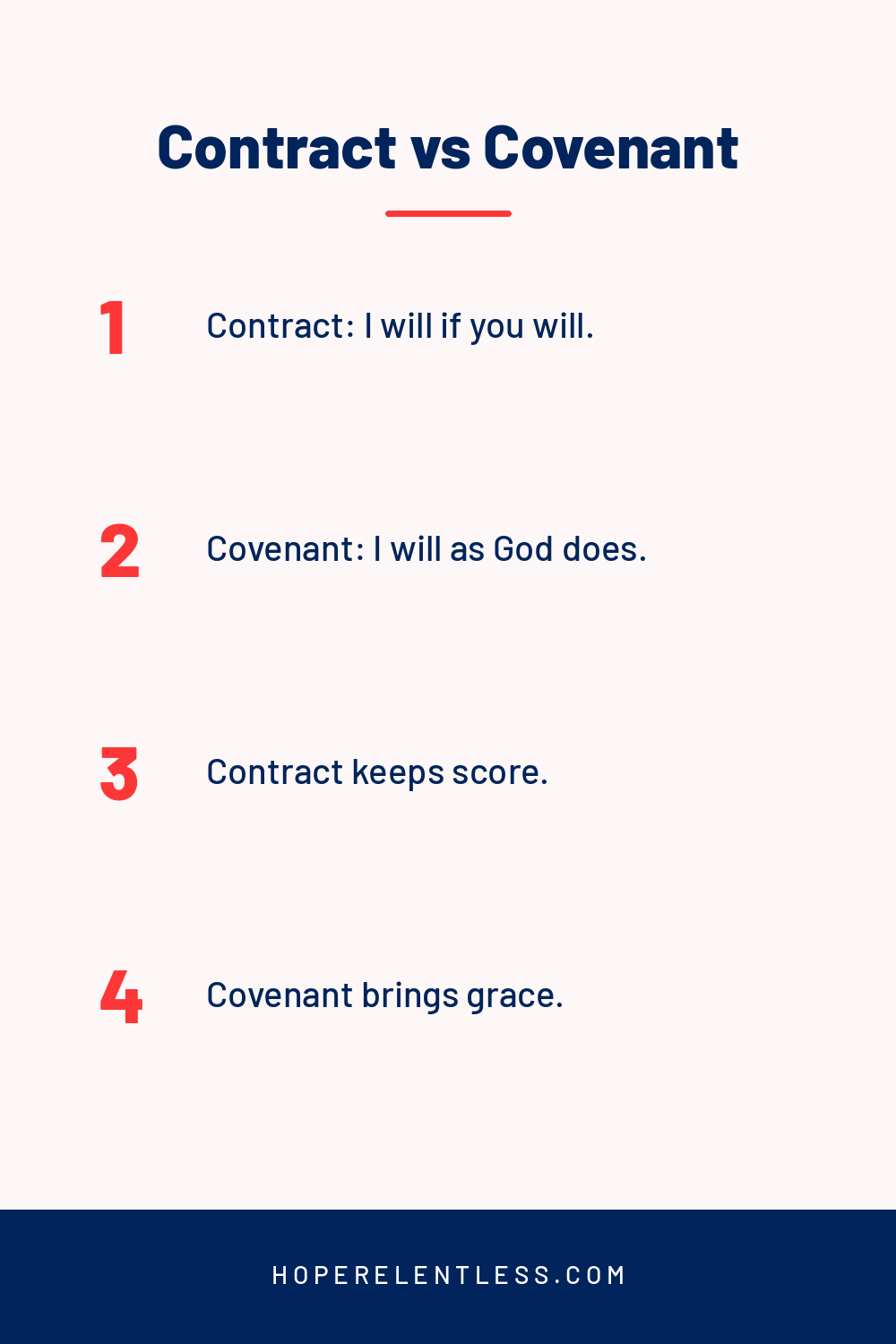
- A contract says, I will if you will. The moment your spouse becomes the opponent when something goes wrong, you have slipped into a contract.
- The courtroom test. If conflict feels like proving your case to a judge, the marriage has gone contractual in that moment.
- A covenant is rooted in God, not feelings. It is a sacred promise, built on faithfulness and commitment, not on whether it is easy or convenient.
- Treat your spouse the way God treats you. Covenant love responds to God's grace, not to what your spouse has earned.
- Covenant is not being a doormat. Choosing obedience to God over your flesh is strength, and God rewards it with peace and restoration.
- Covenant builds emotional safety. When no one is threatening to leave, you can be transparent and actually work toward wholeness.
We are more contractual than we realize
When Sarah-Gayle and I were newly married, we were coming off that athlete, Division I mentality. We were so competitive we raced to see who made the bed better. And honestly that competition went deeper. It started to feel like, am I pulling my weight, are you pulling yours? If I am doing this, are you doing that? That is contract thinking sneaking into a marriage.
Think about where contracts belong. In business, a contract outlines who does what. I will do A as long as you do B. You order a coffee, you pay, you expect a coffee back. If someone breaks the contract, an attorney gets involved, and now you are opponents. So here is the marriage question: when something does not go well, do we start looking at our spouse as the enemy? That is a key sign we have slipped into a contractual arrangement.
In marriage it often looks like keeping a tally. Sarah-Gayle has had couples pull out a literal journal of how many times their spouse did something. It can look like withholding affection or forgiveness, you did not treat me right, so I will not treat you right. It can look like threats of leaving in the middle of conflict, I can not do this anymore. And to be clear, we are not talking about abuse, we have made that disclaimer many times. We are talking about the everyday tension where, if I do not get my way, there are suddenly consequences.

One of the simplest tests is this: in conflict, does it feel like a courtroom? Are you on opposite sides, debating, trying to convince some invisible judge who is right and who is wrong? That feeling is the tell. If conflict has started to feel like two opponents instead of two teammates, the way you come back together matters even more, which is exactly what we cover in the power of repair after a fight.
What a covenant marriage actually is
Scripture gives marriage a different category entirely. Malachi calls your spouse your companion and your wife by covenant. Jesus says what God has joined together, let no one separate. Genesis speaks of two becoming one flesh. And Ephesians 5 frames marriage as a reflection of Christ and the church. So a covenant marriage is rooted in Christ. It is sacred, a promise before God, built on faithfulness and not just feelings. It deals in trusting God's design, anchored in commitment, not ease or convenience.
Here is the heart of it for me. Am I treating Sarah-Gayle based on what she has earned or deserved from my perspective, or based on how God treats me? In a covenant, I am responding to God's grace, His love, His forgiveness, His provision, and in response to how He treats me, that is how I treat her. That is fundamentally different from the transactional version, where I say, well, you did not do your part, so I do not have to do mine.
Sarah-Gayle puts it well: we do everything as unto the Lord, not for human masters. That holds us accountable, because it no longer hinges on how our spouse is showing up. And this is not being a doormat. Choosing obedience to God above our own flesh is not weakness, it is strength, and God rewards it, whether through peace or restoration. All you can do is your part, show up consistently as what God has called you to, and trust your spouse to do what they can.

How covenant changes conflict
Watch what this does to a fight. In a contract, when conflict comes, I am incentivized to highlight all of my wife's shortcomings, the ones from today and the ones from years ago. She is incentivized to do the same, and it is just chaos. In a covenant, in that same moment, I go back to the question, how does God treat me? And from there, how do I show up? Now I show up with grace. With mercy. With a desire for unity and repair. I am looking for healing instead of blaming. And if Sarah-Gayle is showing up that same way, now we have conflict and we are working together to close the gap, instead of pointing fingers.
One honest note: this does not work on willpower. Something supernatural by design requires supernatural power, which is the Holy Spirit working in us. The same Spirit that raised Christ from the dead lives in us, and that is how we actually live this out, depending on God rather than gritting our teeth. Covenant is not a one-time wedding-day idea. It is a framework, a daily way we live and move.
Covenant creates emotional safety
One of the most practical outcomes couples describe after moving toward covenant is stability, resilience, and emotional safety. A big challenge in conflict is when one or both people threaten to end the relationship. The contract has been broken, you did not do your job, so the whole thing is on the table. That undermines everything. What God invites us into is a covenant dynamic that builds security, so we can have conflict and neither of us is worried the other will end it. Now I can be transparent. If something was hurtful or disrespectful, I can name it, and we can work together toward wholeness, instead of wondering whether sharing it will trigger a threat to leave.
If you have been stuck in the courtroom for a long time and you are not sure how to climb out, that is a good place to get some outside help. Working with a coach, or even online marriage counseling, can give you the structure to rebuild that security. It can seem like a small adjustment, but it is massive in how you show up in the hard moments.
Spotting the contract patterns in your own conflict?
Keeping score, withholding, getting defensive, those are the patterns that quietly erode a marriage. The Four Horsemen Guide helps you name them and gives you the antidote for each one. Grab it free below.
Key Scriptures on covenant marriage
Your Next Step
Take an honest look at where you have been operating out of a contract instead of a covenant. Where are you keeping score, withholding, or reaching for the threat to leave when things get tense? Name one of those patterns this week. Then have the conversation with your spouse. A lot of couples hear the word covenant and have no idea what it means, so they never look into it, and they miss applying it. Talking about it together is a significant step toward freedom.
Reflection Questions for the Two of You
- In our conflict, does it tend to feel more like a courtroom or like a team? What does that tell us?
- Where am I keeping a tally, and what would it look like to let it go?
- Am I treating you based on what I think you have earned, or based on how God treats me?
- When have threats of leaving shown up in our conflict, and what did that do to our sense of safety?
- What is one covenant practice we could build into how we handle our next disagreement?
Save this for later

Tired of the courtroom?
If conflict in your marriage keeps feeling like two opponents, we can help you build a covenant dynamic instead. One conversation. 30 minutes. You'll know if it's a fit.
Schedule a Free ConsultationCheering you on,
- Chad & Sarah-Gayle
There's always, always hope.
Sarah-Gayle Galbreath holds a Master's in Marriage & Family Therapy and co-leads Hope Relentless, coaching Christian couples in communication and connection.
Chad Galbreath is an ordained minister and co-founder of Hope Relentless. He and Sarah-Gayle have been married over 20 years and have coached couples since 2010.
Read the full episode transcript
Chad: Today we are talking about the difference between a contract and a covenant. Oftentimes this can be the single biggest change to create breakthrough in our marriages. Last podcast we talked about should I stay or should I go, the temptation to wonder if the grass is greener somewhere else, and we talked about understanding our why. For us, the word covenant comes back into play. So we want to talk about the difference between a contract and a covenant as it relates to our marriage.
Sarah-Gayle: I think we will be surprised at how often we operate in a contractual way. When Chad and I were newly married, coming off that athlete, Division I mentality, we were even competing against each other when we made our beds. I think I won most of the time.
Chad: It was not a competition, because that requires, you know, being a child.
Sarah-Gayle: Exactly. We were a mess. And that competition went deeper, because it started to feel like, am I pulling my weight, and are you pulling yours? So let's dig into what a contractual relationship is.
Chad: Think about a contract in a business sense. Contracts outline who does what. There is an agreement: I will do A as long as you do B. We have these everywhere. You go to your coffee shop, order a coffee, pay for it, and expect a coffee back. If that does not happen, we are competing. If somebody breaks a contract, an attorney gets involved, and now we are opponents. So what does it look like to have a contract in our marriage? When something does not go well, do we start looking at our spouse as the enemy or an opponent? That is a key sign we are in a contractual arrangement in that season.
Sarah-Gayle: In marriage it can look like tallies, keeping track. In some of my sessions, couples bring out their journal and say, I have been keeping track of how many times he or she said this. And they want me to go down that path with them.
Chad: When one spouse pulls out a quote of the other, it is usually a sign.
Sarah-Gayle: It can also look like withholding affection or forgiveness, you did not treat me right, so I am not going to treat you right. And threats of leaving during conflict, I can not do this anymore, I am going to leave. We are not talking about abuse. We have made many disclaimers about that. We are talking about the idea that if it does not go my way, there will be consequences.
Chad: One of the simplest illustrations: in conflict, does it feel like a courtroom? Are you on opposite sides, debating against each other, trying to convince a judge or jury who is right and who is wrong? That is a key sign the marriage has become contractual in that setting.
Sarah-Gayle: Even talking about that makes me feel tight, proving this and that. It does not feel good. So what does a covenant relationship look like? I want to start in Malachi 2:14, she is your companion and your wife by covenant. And there are verses that speak to the permanence God has in mind for marriage. Matthew 19:6, what God has brought together let no man separate. Genesis 2:24, two becoming one flesh.
Chad: We have Matthew 19:6 engraved. When we first got it engraved, they did the verse wrong, and I told the engraver, that is not right. They said, it is a Bible verse, it is the same thing. That is a different story for a different podcast.
Sarah-Gayle: I forget about that. Another scripture is Ephesians 5, where it talks about Christ and the church, and how marriage is a reflection of that covenant. So a covenant relationship is rooted in Christ, sacred, a promise before God, rooted in faithfulness and not just feelings. It deals with trusting God's plan and design, based on commitment, not ease or convenience.
Chad: One of the biggest things: am I treating Sarah-Gayle based on what she has earned or deserved from my perspective, or based on how God treats me? A covenant marriage is, I am responding to God's grace, love, forgiveness, and provision, and in response to how He treats me, that is how I treat her. That is fundamentally different than a transactional relationship where I say, you did not do your part, so I do not need to do mine.
Sarah-Gayle: I think of a couple of scriptures. Do everything as unto the Lord, not for human masters. That holds us accountable, because it does not matter how my spouse is showing up. We treat our spouse as unto the Lord. There is pleasure in that, because we are being obedient to God. Sometimes we think, well, I do not want to be a doormat. But we are not being a doormat when we choose obedience to God above our own flesh, and God rewards us, whether in peace or restoration. And James says, if you know the good you are to do and do not do it, it is sin. God holds us to a standard not dependent on circumstance. All you can do in your marriage is what you can do, show up consistently as what God has called you to, and trust that your spouse will do what they can.
Chad: Let's look at a couple of practical things. First, conflict. Marriages have conflict, we are different people with different personalities and dreams. In a contract, I am going to highlight, well, you did not do your part. I am incentivized to highlight all of my wife's shortcomings, present and past. She is incentivized to do the same, and it is chaos. In a covenant, in conflict, I go back to, how does God treat me? And from that, how do I show up? Now I show up with grace, with mercy, with a desire to bring unity and repair. I am looking for healing instead of blaming. Imagine if Sarah-Gayle shows up the same way. Now there is conflict, and we are working together to close the gap.
Sarah-Gayle: It is an entirely different framework or lens. When it comes to covenant marriage, we see things differently, even roles and expectations. It starts with, what has God laid out in His word, and am I honoring God in how I honor my spouse? And this does not really work with willpower. Something supernatural in nature requires supernatural power, which is the Holy Spirit working in us. The same Spirit that raised Christ from the dead resides in us. So we live this covenant out as we depend on the power of God. Covenant relationship is meant to be in our day to day. It is a framework, a new way that we live.
Chad: A practical outcome couples share from moving into covenant is stability, resilience, and emotional safety. A big challenge is when, in conflict, one or both people threaten to end the relationship. The contract is broken, you did not do your job. That undermines the entire relationship. What God invites us into is a covenant dynamic that builds emotional stability and security, so we can have conflict and neither of us is worried about the other ending it. Now I can be transparent. If something was hurtful or disrespectful, I can share it, and we can work together to bring wholeness, instead of wondering if sharing will make them threaten to leave. It can seem like a small adjustment, but it is massive in how we show up.
Sarah-Gayle: Some action steps. First, think about where you have been operating out of a contractual relationship rather than a covenant. Second, share this with your spouse, and with people it would be impactful for, because having this conversation is significant. A lot of times we hear, it is a covenant relationship, and we have no idea what it means, so we never look into it, and we miss applying it. When we apply this teaching and recognize there is more, that God has a greater design for us, we experience freedom and God's best. We are excited for the freedom that comes from this awareness. God's plan is good. Let's trust it, and we are cheering you on.