
The Power of Repair After a Fight
You said the thing. He said the thing back. Now it is quiet, and the quiet is doing the talking. A day goes by. Maybe two. You are still under the same roof, still passing the same kitchen, still raising the same kids, and you are pretending the gap is not there.
If that is the cycle in your house right now, you are not broken and your marriage is not over. You just never learned how to come back together on purpose.
One of my favorite things to say when we work with couples is this: it is not if you fight, it is when. Every real marriage has tension. The question that decides everything is what happens next.
Prefer to watch or listen? The full episode is right here, take it on a walk.
In this episode, Sarah-Gayle and I open up our own pattern from earlier in our marriage. I would get defensive, she would get critical, and we would drift to separate corners and just wait for the storm to pass. We never actually closed the gap. We just got good at acting like the fight never happened, until it happened again.
Then we walk you through the five moves that changed everything for us, the same five we now teach couples as the Repair Roadmap. None of them require your spouse to go first. Every one of them is something you can own today.
Key Takeaways
- Repair is a skill, not luck. Couples who come back together quickly are not lucky. They have a roadmap, and they run it on purpose.
- The goal is not zero conflict. Healthy couples still argue. The win is closing the gap in hours instead of weeks.
- Somebody has to go first, and it can be you. A proactive move toward your spouse is step one, and it does not require them to deserve it.
- A real apology has remorse and repentance."I'm sorry you felt that way" closes nothing. Naming what you did and what you will do instead changes the room.
- Forgiveness is given, not earned. We forgive the way we have been forgiven, and we stop making our spouse climb a mountain to get there.
- Regulate before you repair. You cannot have a tender conversation with your heart rate off the charts. Breathe, walk, call a timeout, then come back.
It is not if you fight, it is when
For years, Sarah-Gayle and I ran the same loop. She would bring something up, and honestly she still does not love the word, but it would come across as criticism. What he did not do. What he got wrong. And I would do what a lot of husbands do. I got defensive. I had explanations, excuses, justifications. I felt misunderstood and underappreciated, so I defended.
Then we would separate. She did not feel heard, so she decided I did not care. I felt attacked, so I pulled back. A day or two would pass where we were just existing, chit-chatting the surface stuff because we had kids and a life to run. Eventually something would nudge us back together and we would quietly start over, as if the disconnect had never happened.
Here is what we missed. We were not actually repairing. We were waiting. Criticism, defensiveness, disconnect, pretend it did not happen, wait for the next one. That was our pattern, and the pattern itself was creating the gap. We did not know how to fix the pattern, so we never created repair that lasted.
Maybe you know that loop. If conflict in your home still feels like two opponents in a courtroom, that is worth understanding, and we unpack it more in covenant versus contract in marriage. The first step out is naming the cycle honestly, without making your spouse the villain in it.

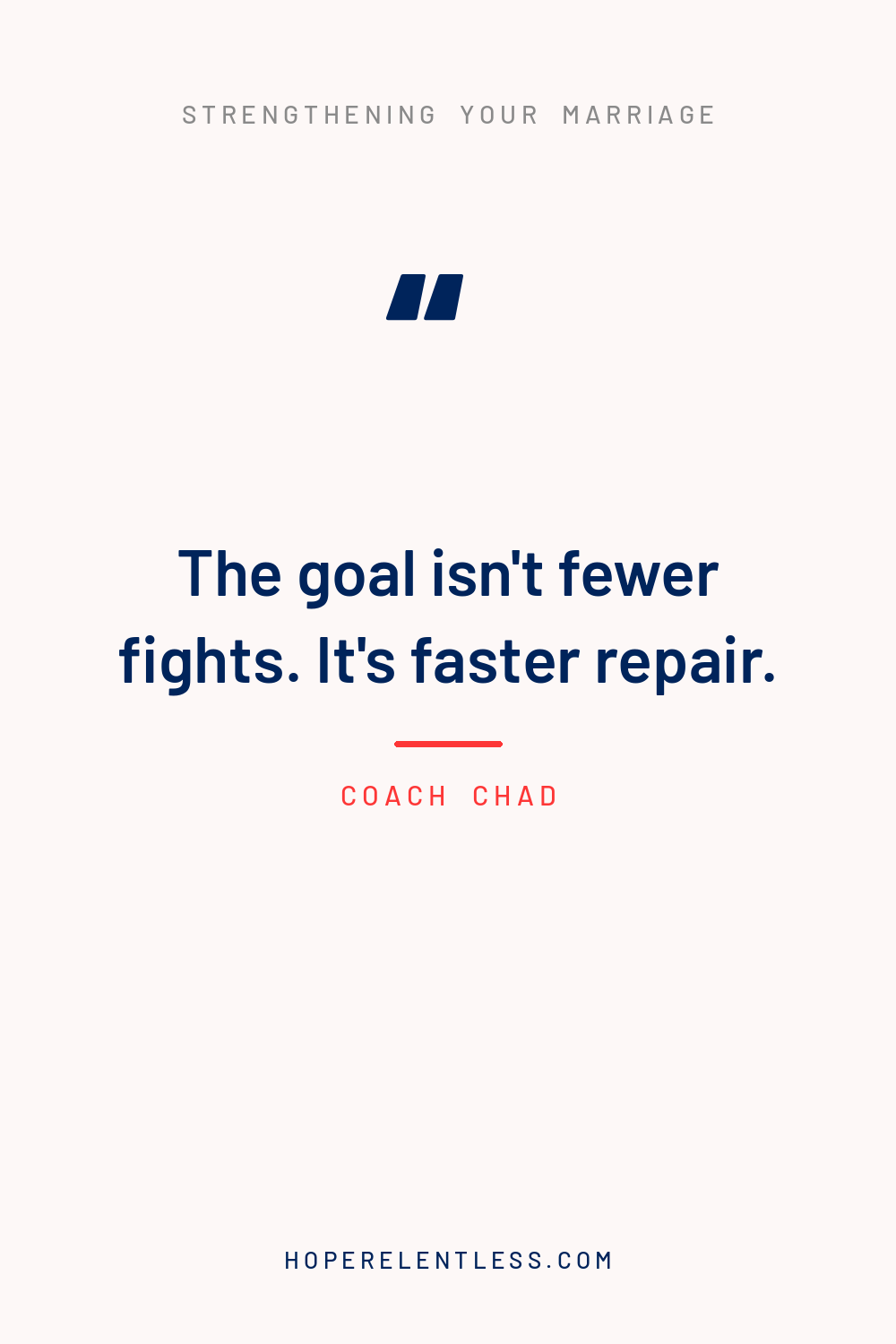
The goal is not fewer fights. It is faster repair.
When we say repair, we mean coming back together. And the goal is not to believe you should never disagree. That is not realistic, and honestly, if you never have a difference of opinion, I would wonder whether you are talking about anything real. You are two different people.
The goal is that when you do hit a tense moment, you close the gap quicker. If it used to take a week and now it takes a day, celebrate that. You are closing the gap. Ideally it does not even take days. You have the disagreement, it does not go how you planned, and you are still on the same team. You can still go on a date that night, because there are no hateful words to carry and nothing was done that makes it hard to even look at each other.
That is the shift. From me versus you, to us versus the problem. Faster repair is growth. Under stress, what is in us comes out of us, so the work is taking responsibility for how we argue and how quickly we come back.
The Repair Roadmap: 5 ways to come back together
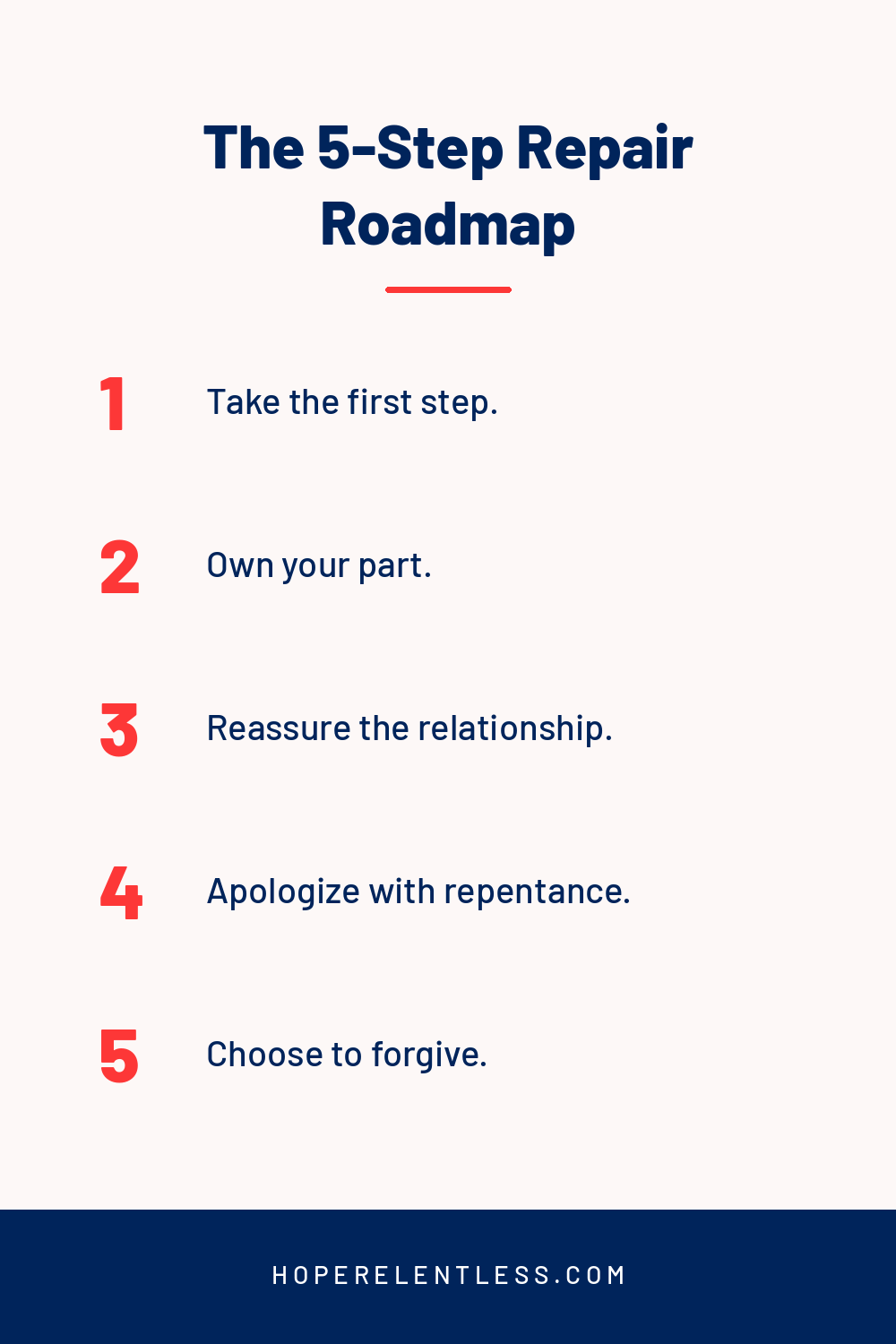
These five are not all-encompassing, but they are the ones that helped us and have helped a lot of couples close the gap. Run them in order.
1. Make the proactive move
Somebody has to initiate. In our marriage, we both want to own that it is going to be me. If it is going to be anyone, it is going to be me to close the gap. I think of the verse that says do not give the devil a foothold. When a separation sits between us, my mind fills the space with assumptions and narratives about what he must be thinking. So instead of waiting, I take the initiative, I go toward, and I start the conversation.
I once worked with a couple who showed up to their consultation having not spoken in three and a half weeks, with three little kids in the house. The reason was simple. They had no repair strategy. Both were hurt, both were frustrated, and neither would take the first step. Their whole relationship was waiting on somebody to go first.
2. Take humble ownership
Whatever you say when you go back matters. Humble ownership is finding an I-statement and speaking with accountability. If I walk in blaming, well you did this, well you did that, we are right back in the argument. But humility is often met with humility. When I come to Sarah-Gayle and say, I am sorry for the way I reacted, I am sorry for my tone, I am sorry for the words I spoke, the more specific the better, that is a powerful step. A generic "I'm sorry you felt that way" rarely closes the gap.
3. Reassure the relationship
Studies show healthy relationships in conflict carry reassurance, appreciation, and moments of respect. Say Sarah-Gayle and I argue over the budget. When I come back I can say, I am sorry for my tone, and I am committed to working through this together. I know this is a hard topic, but I know we can figure it out. That puts us back on the same team. One of the fastest ways to destabilize a marriage is threatening to end it in conflict. Threats of divorce, threats of separation, "I can't do this anymore," all strip away security. Replace separating with reassurance and you come back together faster. To be clear, we are not talking about abuse or domestic violence here. We are talking about the normal tension and frustration that every couple navigates.
4. Apologize like you mean it
An apology is more than the words "I'm sorry." The most impactful apologies carry repentance, a turning from what was done. I know I did this, that is the ownership. Here is what I am going to do instead next time. That assures your spouse you are not just sorry, you are changing. It is worth checking your own heart too: do I actually have remorse? When we do not feel the weight of what happened, we are slow to do anything different. Real remorse sounds like, my heart breaks for what I did and for how it landed on you, whether I meant it or not. Let me bridge that gap.

5. Choose to forgive
Jesus set the standard. The disciples asked how many times, seven? And He said seventy times seven. Basically, as many as it takes. In marriage that can be hard. I like to ask couples one question: do you believe forgiveness is earned, or given? Biblically it is given. Christ forgave us not because we earned it, but out of grace. That is the standard we are after. And while forgiveness is a gift the offended person gives, the one who blew it can make it easier or harder. When I take the first four steps, I am actually supporting Sarah-Gayle in forgiving me. So do not add obstacles and then tell your spouse they "should" forgive you. Each of us owns our own part.
Regulate before you repair
You can know all five steps and still blow the conversation if your body is not ready for it. Repair takes some self-regulation. We cannot go into these moments with our heart rate off the charts. Physiologically, that state makes a calm conversation almost impossible. So take the breaths, do the work, go on a walk and calm down before you talk.
And do not be afraid to call a timeout. If you are mid-conversation and it is heating up, separate for a few minutes, regain composure, then come back. Healthy couples, even in conflict, stay respectful. Eye contact. Inviting body language. I-statements. That is the aim. Because God opposes the proud but gives grace to the humble, and pride, left unchecked, will quietly destroy a marriage. You can be right and still lose the relationship.
Want the Repair Roadmap as a guide you can actually use?
We turned these five steps into a simple, printable guide so the next time you blow it, you are not guessing. Grab The Repair Roadmap and keep it where you will find it when you need it most.
Key Scriptures on repair and forgiveness
Your Next Step
Pick one of the five steps and ask yourself two questions. Which step would mean the most to me if my spouse did it? And which one is hardest for me to do? Often the step that means the most to your spouse is the one that is hardest for you. This week, take a baby step on the hard one. Just one move toward your spouse. That is how repair gets rebuilt.
Reflection Questions for the Two of You
- What is our usual pattern after a fight? Who tends to pull away, and who tends to push?
- When we last disconnected, how long did the gap stay open, and what finally closed it?
- Of the five steps, which one means the most to you when I do it?
- Which step is hardest for me to take, and why do you think that is?
- What is one thing I could say next time that would help you feel reassured we are still on the same team?
Save this for later
The gap does not have to stay open
If the same fight keeps cycling and you are tired of waiting for it to pass, let's talk. One conversation. 30 minutes. You'll know if it's a fit.
Schedule a Free ConsultationCheering you on,
- Chad & Sarah-Gayle
There's always, always hope.
Sarah-Gayle Galbreath holds a Master's in Marriage & Family Therapy and co-leads Hope Relentless, coaching Christian couples in communication and connection.
Chad Galbreath is an ordained minister and co-founder of Hope Relentless. He and Sarah-Gayle have been married over 20 years and have coached couples since 2010.
Read the full episode transcript
Chad: In today's podcast, we are going to talk about what to do after a fight. The basic question: how do we come back together? When working with couples, one of my favorite things to say is, it is not if you fight, it is when. There are healthier ways and really unhealthy ways to fight. I am just using that word to mean there is a gap, a disconnect between you and your spouse. Now what? How do you come back? That is what we want to talk about today.
Sarah-Gayle: I want to tell you our pattern. We do what we do because we know how it feels to hit a wall again and again, and we love helping couples experience something different, because that is what we have been blessed to experience ourselves. Marriage is not meant to be a ball and chain you endure. Let's learn what we need to learn, do the healing we need to do, and have the marriage God has called us to. Back to our pattern. I would be critical. I do not love that word, because I called it sharing my feelings, I just wanted him to know how I felt, but it came off as criticism and blame, what he did not do. And then what would you do when I was critical?
Chad: I would be defensive. I would have explanations or excuses or justification, or I would feel misunderstood and underappreciated. But I was defensive.
Sarah-Gayle: Yes. And then we would separate. He was defensive, I was critical. I did not feel heard. I thought, he does not even care. Then we make judgments about the person. The sad thing I tell couples is, the only reason I brought something up was because I wanted to connect with my husband. But how I did it created a wedge. And he wants to connect with me too. Men, you want to give your wife the world and be the man God has called you to be. So we would miss each other completely, even though the heart posture on both sides was, we want the best for each other. Some days would go by where we are just existing, chit-chatting the surface talk.
Chad: A day or two would go by disconnected, then something would bring us back together and we would start over. But big picture, we acted like the disconnect never happened. We were not coming back together because we had actually resolved the first hurt. The pattern was creating the disconnect, and we did not know how to fix the pattern. So we never created effective, long-lasting repair. Criticism meets defensiveness meets disconnect meets act like it did not happen, and wait until it happens again. That was our cycle for years.
Chad: There is a better way. We have experienced it and we have coached couples through experiencing it. That is what we want to share today.
Sarah-Gayle: When we talk about repair, coming back together, the goal is not to think we should never have an argument or disagreement. That is not realistic. You are different people. The goal is, when you do have tense moments, can you come back together quicker and not let a day or two go by? Let's celebrate if it only took a day when it used to take a week. Ideally it does not even take days. You have a disagreement, it did not go how you planned, but you are still on the same team. You can still go on a date that night. Part of that comes from how we talk to each other. If we are not throwing hurtful words, it is easier to come back, because I am not carrying negative words in my heart. So we want to take you through five areas of repair. The first is a proactive attempt to close the gap. We take personal responsibility that, if it is going to be anyone, it is going to be me. I think of the scripture, do not give the devil a foothold. When that separation exists, I start assuming and building narratives about what he thinks. So instead of waiting, I take initiative and start the conversation.
Chad: We did not have a roadmap, so we did not have skills. Sometimes we would repair, but looking back, we just got lucky instead of having a proven path. A quick story. A couple showed up to their consultation having not talked in three and a half weeks, with three little kids in the house. The reason was, they had no repair strategy. Both were hurt and frustrated, but nobody would take the first step. So step two is humble ownership, my ability to find an I-statement and speak with accountability. If I blame, well you did this, we are back in the argument. But humility is often met with humility. Hey babe, I am sorry for the way I reacted, or for my tone, or for the words I spoke. The more specific the better. A generic, I am sorry you felt that way, probably will not close the gap. And then step three is reassurance.
Chad: Studies show healthy relationships in conflict have reassurance, appreciation, and respect. Say we argued over the budget. I can say, I am sorry for my tone, and I am committed to working through this together. I know this is hard, but I know we can figure it out. That is reassurance, putting us back on the same team. One of the things that disrupts stability is threatening to end the relationship. Threatening divorce or separation strips away security. Classic disclaimer, I am not talking about abuse or domestic violence. I am talking about typical tension. Anytime we replace separating with reassurance, it is powerful.
Sarah-Gayle: It does require some regulation, physiologically self-soothing. We cannot go into these conversations with our heart rate off the charts. Take the breaths, go on a walk, calm down first. And do not be afraid to call a timeout mid-conversation, separate, regain composure, and come back, because we want to treat each other with respect. Healthy couples in conflict are respectful, they use eye statements, they make eye contact, their body language is inviting. One more thing: God opposes the proud but gives grace to the humble. Humble ownership is hard. It is dying to ourselves, dying to pride, and pride will destroy your marriage. You could be right, but lose the relationship.
Sarah-Gayle: Communication is about connection. Chad covered the first three. Number four is the apology. An apology is more than I am sorry. The most impactful apologies have repentance, a turning from what was done. I know I did this, that is ownership. What I am going to do instead next time is this. It assures your partner you will do something different. And ask yourself, do I have remorse? When we do not have remorse, we are not urgent to change, because we are not understanding the gravity. Remorse is humbling: my heart breaks for what I have done and how it impacted you, whether or not it was my intention.
Chad: To drive it home, go back to the budget example. I go toward her with humble ownership: I am sorry for the way I talked with you earlier, my tone was rude and harsh. There is the reassurance: I know this is difficult, but I am committed to figuring it out together. Then the apology with remorse and repentance: I recognize my tone shuts you down and I am sorry. I am committed to owning my tone and creating a safe space where both our voices are valued. That is a different apology than, I am sorry you felt that way. And then the last thing is forgiveness. Jesus set the standard. The disciples asked, how many times, seven? And Jesus said seventy times seven, as many as it takes. I ask couples, do you believe forgiveness is earned or given? Biblically it is given. Christ gave us forgiveness not because we earned it, but because of grace. While forgiveness is given, let's not make it as hard as possible. If I do the first four steps, I am supporting my spouse in forgiving me. Let's not add obstacles and then tell our spouse, well, you should forgive me. We each take ownership of our own part.
Sarah-Gayle: Those are the five steps that help with repair and coming back together quickly, because you are on the same team. We are going to have highs and lows, that is part of being married to someone different from you. Think about which of the five steps is most meaningful for you. What step would your spouse do that would mean so much? Reassurance is the most meaningful for me.
Chad: For me it is proactive and humble ownership.
Sarah-Gayle: And sometimes the step that is most meaningful for your spouse is the one that is most difficult for you to do. For me, humble ownership, because I do not always think I did anything, it was not my intention. So that is one I can grow in. Think about which step is most meaningful for you, and which step you can grow in.
Chad: As we close, I just want to encourage you. This is a process of growth. You will not get it right right away. But keep practicing, keep discussing. If you are looking for help, this is what we do with couples. We help them learn to repair, communicate, and connect effectively. You are worth it, and your marriage is worth it.
Sarah-Gayle: All right. Cheering you on.