
Marriage Coaching in Chandler, AZ
Fewer repeat arguments. A faster way back after one. Decisions you both actually agreed to, instead of one of you quietly giving in. That is what coaching is built to change, and we teach it to the two of you together, at our Chandler office or online.
One conversation. 30 minutes. No cost, and no obligation to book anything.
What's on this page
- What changes at home
- Coaching and counseling: the difference
- What couples say
- What coaching is, and what it isn't
- Coaching or therapy: which do you need?
- What no diagnosis actually means
- If your spouse won't see a therapist
- When we send you somewhere else
- Which format fits you
- Where we meet in Chandler
- Frequently asked questions
What Changes at Home
The same fight stops repeating
Most couples are not having twenty arguments. They are having two or three, over and over, in different clothes. You learn to run those conversations a different way, and the loop breaks.
You get back to each other faster
Conflict does not disappear, in any marriage. What changes is the recovery time. Days of cold distance become a repair you can both do on purpose, usually the same night. That is what conflict resolution for couples actually looks like in practice.
You start deciding as a team
Money, the kids, in-laws, how you spend a Saturday. You leave with agreements you both had a hand in, which is the difference between a decision that holds and one that gets relitigated.
None of that comes from being handed insight about yourselves. It comes from practicing a specific process on your own real issues, with somebody correcting you while you do it. That is the difference between being told what is wrong and being taught what to do, and it is the reason this page is about coaching rather than counseling. The backbone of it is the set of communication skills for couples we teach in every format.
Coaching and Counseling: The Difference
The two words get used interchangeably, and the marketing does not help. Here is the actual difference, without the spin.
- What the hour is for. Counseling works on understanding and healing, which often means going back through history and each person's mental health. Coaching works on skill. We hand you a process, you use it on a real issue in front of us, and we correct you in the moment.
- Who provides it. Counseling is delivered by licensed clinicians who can diagnose and treat. Coaching is not licensed care. We do not diagnose, and there is no clinical record.
- How it gets paid for. Counseling is often billed to insurance, and insurance requires a diagnosis on file to pay a claim. Coaching is private pay. Nothing is submitted anywhere.
- How long it runs. Counseling is frequently open-ended, and that is appropriate for what it does. Our coaching has a defined start and a defined finish, and you know both on day one.
- What happens between sessions. Coaching assumes practice at home. The session is where you learn the move; the week is where it becomes yours.
Plenty of couples do both, sometimes at the same time. If what you need is treatment rather than teaching, we will say so and point you to it. That is covered further down in when we send you somewhere else.
What Couples Say
What Coaching Is, and What It Isn't
Hope Relentless is a coaching practice. We are not licensed therapists, we do not diagnose, and we do not treat mental health conditions. That is not a disclaimer buried at the bottom of the page. It is the whole shape of what we do.
Coaching is teaching and practice. We hand you a process for having a hard conversation, we watch you use it on your own real issues, and we correct you in the moment. You are learning a skill, the way you would learn anything else, with somebody in the room who has taught it a few thousand times.
That is the whole job. We are not trying to be a lighter version of therapy, and we are not trying to replace it. When someone needs clinical care, nothing else substitutes for it.

One thing that never changes here: we work with couples only. Both partners in the room, every session, every format. We do not do individual sessions, and we do not have a version of this for one spouse who wants to bring it home to the other.
Which one do you need
Coaching or Therapy?
Read both columns honestly. If the right one is therapy, we would rather you find that out here than three sessions into working with us.
Coaching fits when
You are both stable, nothing clinical is going on, and the problem is that you cannot talk about the hard things without it turning into a fight or into silence. You want tools and a finish line.
Therapy fits when
Depression, anxiety, trauma, or another condition is in the room and needs treatment. Something in one person's history is driving the pattern and needs real clinical work before skills will hold.
Coaching looks forward
We spend the hour on what you are going to do differently this week. The past comes up when it explains the pattern, and then we get back to what changes.
Therapy can go deep and long
Working through what happened to you takes as long as it takes, and it should. That is a feature of therapy, not a flaw, and it is exactly what some people need.
Coaching has an end
Every format we run has a defined length. You know going in how many sessions it is and what you walk away with.
Some couples need both
These are not rivals. Plenty of couples do individual therapy while doing couples coaching with us, and the two support each other well.
The simplest test: is the problem something one of you is carrying, or something the two of you are doing? Carrying usually points to therapy. Doing usually points to coaching. If you cannot tell, that is a completely normal place to be and it is what the consultation is for.
What No Diagnosis Actually Means
This one rarely gets said out loud, and for some couples it is the entire reason they choose coaching.
To bill insurance, a therapist has to give somebody a diagnosis. That is how the system works, it is legitimate, and the resulting record is protected. But it is a record, attached to a person, in a file.
Coaching does not produce one. We are private pay only. We do not bill insurance, we do not submit claims, there is no billing code and no diagnosis, because there is nothing here to diagnose. You are not a patient. Nothing about your marriage becomes part of a medical history.
No clinical record
No diagnosis, no billing code, no claim submitted anywhere. What happens in the room is between the three of you.
Why it matters to some people
Pastors, teachers, people in ministry, anyone holding a clearance, anyone who simply does not want a mental health record. This is a real reason and we do not think it needs defending.
The tradeoff, stated plainly
No insurance also means no reimbursement. You pay for coaching yourself. If cost is the deciding factor and your plan covers therapy, therapy may genuinely be the better call.
If Your Spouse Won't See a Therapist
This is the most common reason one person ends up on this page alone at eleven at night, and it deserves a straight answer.
A lot of people who refuse counseling are not refusing help. They are refusing a specific picture in their head: sitting on a couch, being analyzed, hearing a list of everything they do wrong while their spouse nods along. That picture is not what happens here, and it is worth telling them so.
What we actually do is teach. Both of you learn the same process, both of you practice it, both of you get the same homework. Nobody is the patient and nobody is the problem. For a spouse who has been dreading being put on trial, that reframe is often the whole difference.
A workshop is usually the easiest yes. Two hours, a room with other couples, nobody asked to share anything. It costs less than dinner out and it lets a hesitant spouse see how we teach before agreeing to anything longer.
Here is the honest limit. If your spouse will not participate at all, we do not have something for you on your own. Every service we run has both partners in the room. That is a real boundary and I would rather name it than take your money.
When We Send You Somewhere Else
We turn couples away. Not often, but we do, and you should know what triggers it before you book.
- Violence, intimidation, coercive control, or fear for anyone's safety at home.
- Addiction that is active and untreated.
- A mental health condition that needs clinical evaluation or treatment first.
- One partner unwilling to participate at all.
- An affair that is still happening, or was discovered days ago and is still raw.
If there is violence or fear in your home, the National Domestic Violence Hotline has guidance written specifically about couples work and abuse, and it is worth reading before you decide anything. If someone is in crisis or thinking about self-harm, call or text 988.
None of that means the marriage is over. It means the order matters. Get the urgent thing handled, then come back and learn the skills. We will still be here.
Which Format Fits You
Same frameworks in all three. The difference is depth and how much of your calendar it asks for.
A workshop
Two hours, one topic, one tool, at our Chandler office with other couples. The smallest possible first step and the easiest thing to say yes to.
The 12-Week Couples Reset
Twelve weekly sessions, both of you in the room, building the habit through repetition. This is the main event for most couples.
A two-day intensive
The same ground compressed into two days with both Chad and Sarah-Gayle, for couples whose calendar will not hold twelve weeks.
Couples who finish the twelve weeks can keep meeting with us afterward on a lighter rhythm, more like a check-up than a program. That option exists once you have been through it, not as a way to start.
How this starts
Schedule a consultation
A 30-minute conversation, no cost and no obligation. We ask what has been going on, you ask us anything you want.
We tell you the truth
Whether coaching fits, which format we would put you in, or whether you need a therapist instead. Sometimes the answer is a therapist.
You decide, not us
Nobody signs anything on that call. You get an honest read and the information, and you take it from there.
Or call (623) 343-4764 if you would rather talk to a person first.
Where We Meet
Coaching in Chandler, or Online
We are just off Ray Road near the 101, a short drive from anywhere in Chandler and the surrounding East Valley. Parking is free and steps from the door.
Hope Relentless Marriage & Relationship Center
3075 W Ray Rd #200
Chandler, AZ 85226
(623) 343-4764
Get directions
Online works just as well for the weekly formats, and plenty of couples do a mix, coming in when the topic is heavy and meeting by video when the week is full. Workshops and intensives happen in person.
Who You'll Be Working With
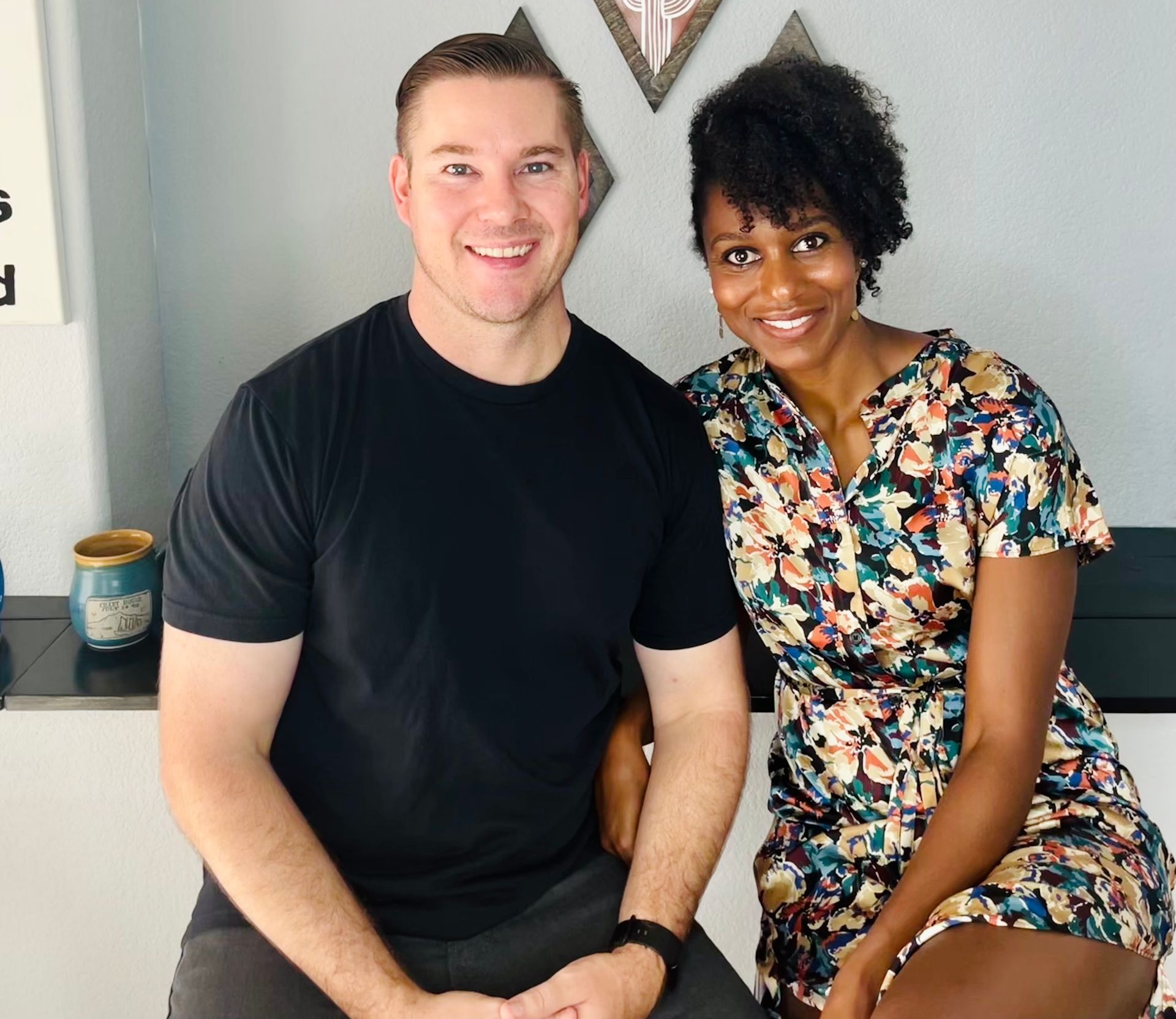
We have been married since 2005 and coaching couples since 2010. Most couples work with one of us. Working with both of us together is an option on some formats, not the standard.
Chad Galbreath
Ordained Minister
I spent about ten years as an executive pastor before Sarah-Gayle and I built Hope Relentless. I used to fight to be right. My wife jokes that I should have been an attorney. I would win the argument and lose the connection every time. The shift was not a better comeback. It was realizing we were on the same team.
Sarah-Gayle Galbreath
M.A. in Clinical Psychology, Marriage and Family Therapy
Sarah-Gayle holds a Master of Arts in Clinical Psychology with an emphasis in Marriage and Family Therapy from Azusa Pacific University, and she works here as a coach rather than a clinician. She hears the thing underneath what a couple actually said, which is most of the job.
Hope Relentless is a coaching practice, not a clinical one. We are coaches, not licensed therapists, and we do not provide therapy, diagnosis, or treatment. If your situation calls for licensed clinical care, we will tell you and help you find it.
Frequently Asked Questions
What is the difference between marriage coaching and marriage counseling?
Counseling and therapy are clinical care. A licensed therapist can diagnose and treat conditions like depression, anxiety, and trauma, and often works with the past to do it. Coaching is teaching and practice. We hand you a process for having a hard conversation, watch you use it on your own real issues, and correct you in the moment. Neither is more serious than the other. The difference is what the hour is for, and if the right answer for you is therapy, we will say so.
Are you licensed therapists?
No. Hope Relentless is a coaching practice. We do not diagnose, we do not treat mental health conditions, and we do not provide therapy. Sarah-Gayle holds a Master of Arts in Clinical Psychology with an emphasis in Marriage and Family Therapy and works here as a coach rather than a clinician, and Chad is an ordained minister. If your situation calls for licensed clinical care, we will tell you and help you find it.
Does insurance cover marriage coaching?
No, and we do not submit anything to insurers. Coaching is private pay only. There is no diagnosis, no billing code, and no claim, which means nothing about your marriage becomes part of a medical record. For some couples that privacy is the main reason they choose coaching. The tradeoff is real though: no insurance also means no reimbursement, so if cost is the deciding factor and your plan covers therapy, therapy may be the better call.
My spouse refuses counseling. Would they do coaching?
Often, yes. Most people who refuse counseling are refusing a picture in their head: sitting on a couch being analyzed while their spouse nods along. Coaching is teaching. You both learn the same process, you both practice it, you both get the same homework, and nobody is the patient. A two-hour workshop is usually the easiest first yes. That said, if your spouse will not participate at all, we do not have something for you alone, because every service we run has both partners in the room.
How long does marriage coaching take?
Every format has a defined length, which is part of the point. A workshop is two hours. The 12-Week Couples Reset is twelve weekly sessions. An intensive is two days. You know going in how long it is and what you walk away with, rather than an appointment that runs indefinitely. Couples who finish the twelve weeks can keep meeting with us afterward on a lighter rhythm if they want to.
Can we do coaching and therapy at the same time?
Yes, and plenty of couples do. One or both partners see a therapist individually while the two of you do couples coaching with us. These are not competing approaches. Individual therapy handles what one person is carrying, coaching handles what the two of you are doing, and they tend to support each other well.
When would you tell us coaching is not right for us?
When there is violence, intimidation, or fear for safety at home. When addiction is active and untreated. When a mental health condition needs clinical evaluation first. When one partner will not participate. And when an affair is still happening or was discovered days ago and everything is still raw. None of that means the marriage is over. It means the order matters, and we would rather tell you that on a free call than three sessions in.
We think coaching is right for us. What is the next step?
Schedule a consultation. It is 30 minutes, no cost and no obligation, and nobody signs anything on it. We ask what has been going on, you ask us anything, and we give you an honest read on whether coaching fits and which format we would put you in. You can book online any time, or call (623) 343-4764 if you would rather talk to a person first.
Not Sure Which One You Need?
That is the most common reason people book this call, and it is a good reason. Thirty minutes, no cost, and an honest answer even when the honest answer is that you need somebody else.
Schedule a ConsultationChandler office or online · (623) 343-4764
Cheering you on,
Chad & Sarah-Gayle
There's always, always hope.