
Conquering Loneliness Together: How to Build Deeper Connection in Your Marriage

You can be married, share a home, raise kids, even go on regular date nights, and still feel lonely. If that's you, you're not broken, and you're not the only one.
This episode actually came from one of you. After we talked about how to affair-proof your marriage, a listener wrote in. We'd mentioned that loneliness is one of the things that makes a marriage vulnerable, and he asked a simple, courageous question: could we do an episode on how to fight loneliness inside your marriage? So we did.
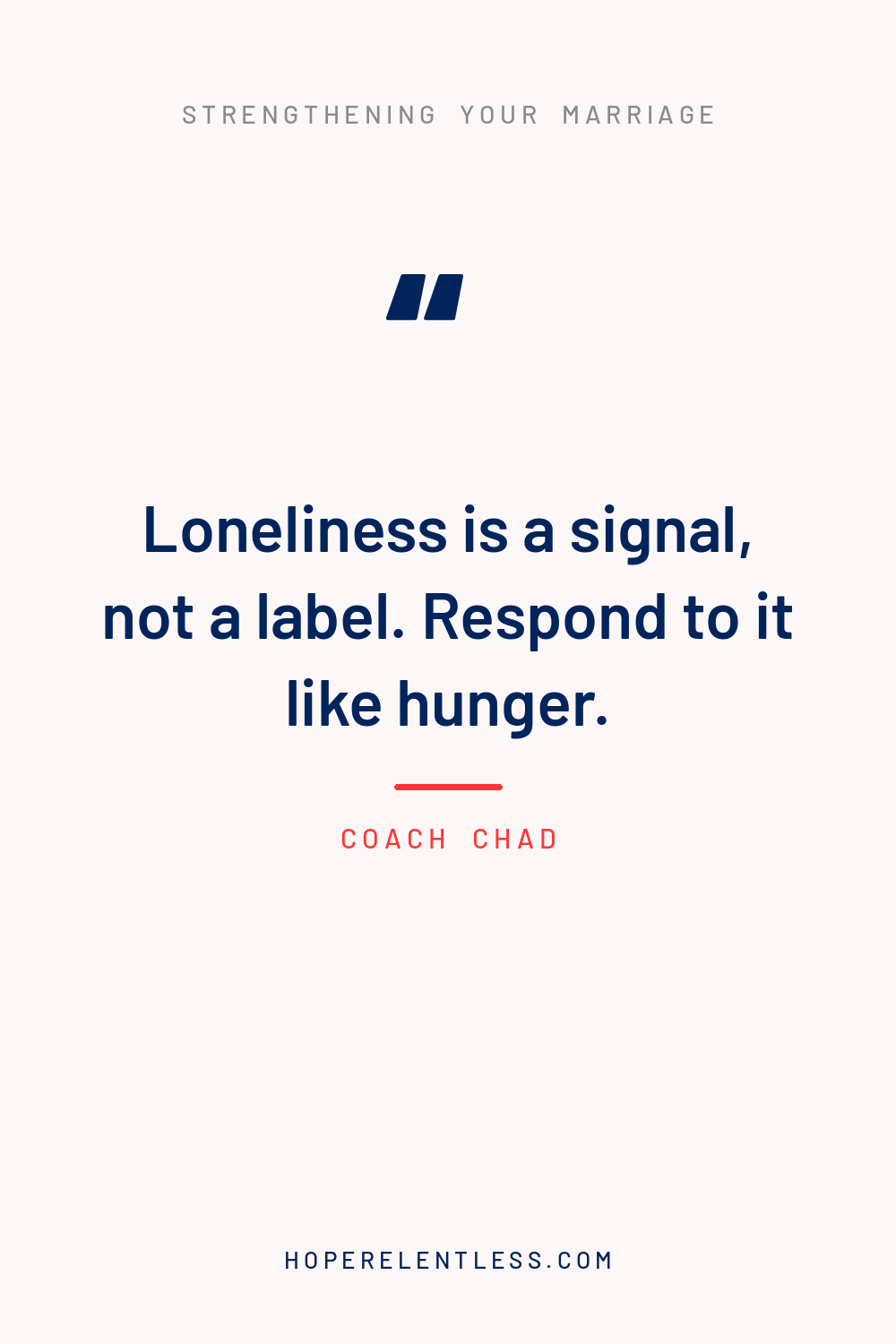
Here's the reframe we want you to carry through this whole post: loneliness isn't a verdict on your marriage. It's a signal. And a signal is something you can actually respond to.
Prefer to watch or listen? Press play above, or use the podcast player below.
We walked through loneliness in two directions, what you can do personally and what you can do together as a couple, and across three seasons: before it hits, while you're in it, and how to keep it from coming back.
Key Takeaways
- Loneliness is a signal, not a label. Treat it like hunger. It's an alarm telling you to connect, not proof that something is wrong with you.
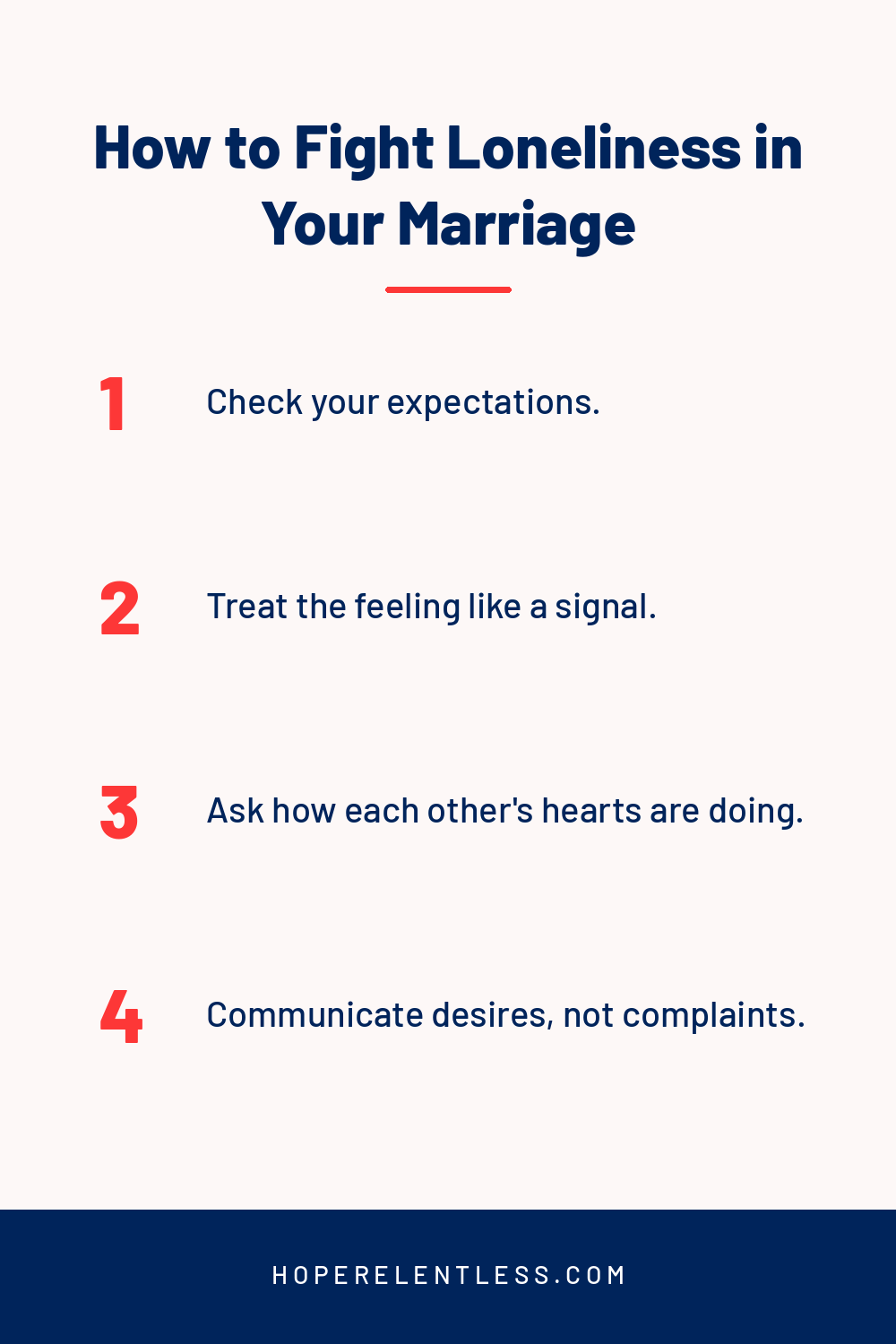
- Check your expectations. Comparing your marriage to a TV show or a "should" breeds discontent. A realistic perspective shrinks a lot of loneliness on its own.
- Different isn't rejection. One spouse may love doing everything together while the other recharges alone. That's a difference to understand, not a sign you're unloved.
- Journal for awareness. A couple of minutes naming your highs, lows, and worries surfaces patterns before they become crises.
- You're worth the work. Some growth is yours to do, including your mental health. Your spouse can't convince you of your own worth.
- Dates aren't enough without intentional questions. Shared activity isn't the same as heart connection. Ask how each other's hearts are really doing.
- Your spouse is not the enemy. You're on the same team. The resources to grow your connection are already on the team you're on.
- Communicate desires, not complaints."I'd love to reconnect on our date" opens a door. "You never spend time with me" invites defensiveness.
Before Loneliness Hits: Expectations, Comparison, and Self-Awareness
A lot of loneliness starts before we ever feel it, in our expectations. Watch the word "should." Whenever we say our marriage should look a certain way, or our spouse should talk to us like a character on our favorite show, we set up an unrealistic ideal that breeds disappointment. So the first question is honest: am I comparing my real marriage to some fantasy? A more realistic perspective can quietly dissolve a surprising amount of loneliness.
The second piece is self-awareness. Some personalities are simply more predisposed to loneliness. In our marriage, Chad is more independent and content doing things solo. Sarah-Gayle wants to do everything together, so when we're not, she's more susceptible to feeling lonely. Naming that is powerful, because it stops the false story. His need for space doesn't mean he's rejecting her. We're just different. And knowing your own wiring lets you build a plan that actually fits your life.
In the Middle of It: Treat the Signal Like Hunger
When I get hungry, I don't spiral. I don't think something's wrong with me or the world is ending. My body sent an alarm, so I eat, and ideally I eat something that actually fuels me. Loneliness can work the same way. The feeling shows up, and instead of piling on condemnation ("why do I always do this?"), I can read it as a signal: I need to connect. With my spouse. And if you're a person of faith, with God, the One who reminds me I'm loved and made for a purpose.
One of the most practical tools here, for anyone, is journaling. Our phones are built to numb and distract us from the very questions we need to sit with: How am I doing? How is my spouse doing? You don't need 45 minutes. A couple of minutes naming a highlight, a lowlight, something you're excited about and something you're worried about will start to reveal trends. And trends tell you where to build a plan so the next wave doesn't catch you off guard.
Some of this is personal growth work, and that includes your mental health. If you notice patterns and attitudes that need attention, getting professional help isn't weakness. It's worth it, because you're worth it. Your spouse genuinely can't fix what you don't believe about yourself. For me, two simple daily habits change everything: reading five to ten pages and going for a walk. When I was sick last week and dropped both, I felt it. The day I picked them back up, my energy and perspective came right back.
Save this for later
Conquering It Together: Connection Is the Antidote
Loneliness is the feeling of isolation, so the antidote is connection. And connection between spouses almost always starts with one thing: communication. Simply saying it out loud, "I've been feeling lonely the last few days," gets it into the light. It doesn't dump a burden onto your spouse. It opens a door. Because in good seasons, your spouse loves you and wants to see you thrive. Most of the time, they just didn't know.
A few things have helped us specifically. Praying together is huge, you learn what's really on your spouse's heart by listening to what they pray for. And here's a humbling one: you can go on great dates and still not feel close. We did a whole month of Mexican-restaurant date nights, rated them all, had a blast, and Sarah-Gayle still didn't feel emotionally connected, because we weren't asking intentional questions. Couples can be married for decades and never know the deep yearnings of each other's hearts, simply because they never ask. So we weave in small check-ins, at dinner, in the car, "What was your high? Your low? Anything you're anxious about?" None of it takes hours.
Then watch for patterns versus exceptions. One lonely day is probably just a day, the same way one pack of Skittles isn't a crisis. But Skittles every meal is an issue. If you're feeling lonely or anxious consistently , that's a wake-up sign to be more intentional, together. It's so much easier to address something in week one than after months or years of letting it harden.
Your Spouse Is Not the Enemy
Please hear this one. When loneliness sets in, it's tempting to frame your spouse as the problem, and that's exactly the thinking that makes a marriage vulnerable to looking elsewhere. But you and your spouse are teammates. When you look outside the marriage, you're playing for a different team, when the resources to grow the team you're already on are right there. You can tackle this together. (This is the same shift we unpack in our episode on why you and your spouse are on the same team, and it's the heart of how to affair-proof your marriage.)
Don't sweep loneliness under the rug, either. All that does is create bumpy rugs. The longer it goes, the more the heart hardens, and the more numb and susceptible we become. If you feel that hardening starting, get help early. Sometimes a coach or counselor is exactly what helps a couple find the next step when they feel like there isn't one.
Get the free Communication Loop Guide
Turn complaints into desires and start connecting instead of defending. Drop your name and email below and we'll send the four-step guide right over.
The Shift That Changes Everything: Desires, Not Complaints
Our marriage mentors taught us something we're still growing in: learn to communicate as desires, not complaints. If I say, "I'm lonely because you don't spend time with me," that lands as a complaint, and complaints invite defense. (I'll be honest, I'm a pro at defending myself. And as good as I am at it, I'm not sure it has ever once helped.) Flip it: "I've been feeling lonely. I wonder if on our date we could talk about why." Same topic. Completely different door. One puts your spouse on defense, the other invites them onto your team.
And if your spouse is the one complaining, can you bring enough maturity to get curious and ask a question instead of defending? That single move can unlock a new level of communication. (We go deeper on turning these reactions around in how to break toxic communication patterns and find healthy alternatives.)
One last word for the spouse who's already tried. If you've reached out and felt like your partner just wasn't able to meet you there, first check how you're starting those conversations, are you accusing, or offering a safe space and owning how you feel? And if they still aren't ready, go back to the personal work: your growth, your mental health, your prayers. You can't change your spouse. They have to do that themselves. But you can change your perspective, and often, as we pray, our own hearts begin to soften first. You're worth it. Your marriage is worth it. And you never know, today could be the day of breakthrough.
Key Scriptures
Your Next Step This Week
Tonight, ask your spouse one intentional question and actually listen to the answer: "How's your heart really doing right now?" No fixing, no defending. Just one honest question and a chance to be heard. That single question, asked consistently, is how connection rebuilds.
Reflection Questions for Couples
- Where am I comparing our marriage to a "should" or a fantasy, and what would change if I let that go?
- Am I more wired for togetherness or for independent recharge, and does my spouse know that about me?
- When was the last time we asked each other how our hearts were really doing, not just how the day went?
- Is there a complaint I keep repeating that I could re-say as a desire? What would that sound like?
- When my spouse brings me a frustration, do I get curious or get defensive? What is defensiveness actually costing us?
Save this for later
You don't have to wait until the distance feels permanent.
The couples who reach out earliest get the best outcomes. If you're feeling the drift, let's talk about what's really going on and whether we're a fit to help.
Schedule a Free ConsultationOne conversation. 30 minutes. You'll know if it's a fit.
Cheering you on,
- Chad & Sarah-Gayle
There's always, always hope.
Sarah-Gayle Galbreath, MSMFT holds a Master's in Marriage and Family Therapy and co-leads Hope Relentless with her husband, Chad. She's passionate about helping couples move from roommates to teammates.
Chad Galbreath is an ordained minister and marriage coach. Married 21 years, he and Sarah-Gayle have spent 15+ years helping couples build marriages that thrive. They host the Hope Relentless Christian Marriage Podcast.
Read the full episode transcript
hey Chad and Sarah-Gayle here with the Hope Relentless marriage podcast and we are so happy that you're joining us and I just want to congratulate you on changing the world because that's what you're doing when you invest in your marriage you are doing your part to change the world because remember marriage is impact families families impact communities and communities impact the world so well done so good excited to be here today we're actually doing a podcast in response to a viewer who wrote in with I think a great question so a couple weeks ago we were talking about how to Affair proof your marriage and
Studies have shown that one of the things that put makes us vulnerable to an affair is loneliness so babe why don't you go ahead go ahead and read the question that came in and then we will talk about loneliness and what we can do around that okay they're amazing amazing so much and then he says thank you so much and then next he says can I ask for some additional information when you do your next podcast on how to Affair proof your marriage you guys brought up the greatest point of being lonely and loneliness could you do a podcast on how to fight being lonely
in your marriage well we certainly can and we certainly are so that is exactly what this podcast is about Chad do you want to start us off yeah so I'll maybe introduce kind of the kind of an overview of some of the things that we're going to talk about and then we'll jump into the details of loneliness so when I think about kind of any area of my life as it relates to marriage there's kind of two Dynamics what can I do personally what does it look like for me to take ownership over a certain area of my life and then can I begin to
do that but then what you talked about we are in a relationship with another person our marriage so whatever I am or am not dealing with impacts my spouse so the first part is what can I do personally and then the second part is what can we do together so that's kind of the two different paths that we're going to talk about as it relates to loneliness but then I also want to create kind of this new structure for how we can formulate things and that is like pre-during and post so kind of this Dynamic of taking ownership and personal responsibility but what can I
do before I'm feeling loneliness then how can I strategize or put together a plan that in the midst of feeling lonely what can I do and then after loneliness so these are kind of some of the different just overview of how we're going to look at this particular topic of loneliness because this is a great question you know if you hear how to Affair proof your marriage and I think in that particular episode we're talking about the importance of boundaries in relationship boundaries with people said people of the opposite sex but if loneliness makes us more vulnerable well then how do we what do we
do around that so I'm excited for this question and so let's go ahead and jump in and start talking about it all right so I like your format there and I want to start with the pre area that you were talking about because I think before we become lonely there are some things that sometimes can lead us to loneliness and so one of those things is expectations when it comes to our expectations of how we should be feeling of how our marriage should be going and I I do this should I do air quotes if any can't see me but air quotes should whenever we
use the word should it creates just an unrealistic ideal of whatever that whatever is on the other end of the should and it also can create condemnation and disappointment and discouragement and so when it comes to expectations about what our marriage should look like how we should be enjoying ourselves it's something to be aware of and that's that awareness because if we are living our day-to-day with our spouse and we're thinking that we should be living you know in a way that our favorite TV show is we're thinking that our spouse should be talking to us the way one of our favorite TV show characters
talks and and they should look the way they look then that's going to really set us up to feel disconnected from our spouse and feel discontent yeah so that that's good so I think one of the things is looking at is there comparison that is generating the loneliness are we comparing our current situation to some fantasy some mythical circumstance or situation uh because having a more realistic expectations or perspective might minimize some of the loneliness by itself I think the other thing is kind of in this pre is self-awareness certain personalities are going to be more predisposed to battling with loneliness than other personalities and
so if if somebody's like hey that that's me loneliness is something that I experience on a regular basis then that awareness alone is great it allows you to identify a situation that you're going to to have to manage and be prepared for and so then as we put together a plan you know you're putting together a plan that is Meaningful and is going to add value specifically to your life and so just that self-awareness can be an incredibly powerful you know I think as people in general we will all experience moments of loneliness and I think sometimes we can put labels on ourself or condemnation
beyond what an initial moment is so loneliness is simply like an alarm or a siren it's almost like a timer going off it's a warning of hey you have these feelings and then it's more about how do we respond can we respond in a way that helps us feel connected reminds us that we are not lonely or that we are not isolated ways that we can remind that we are loved and valued and so if we can view the loneliness more as a signal of hey let's be intentional about connecting then right there that it can kind of shift once again that expectation or that
perspective as opposed to oh there's something wrong with me I'm struggling with loneliness again why do I do this that doesn't help right yeah and I was just thinking Chad when you were talking about certain personalities might be more predisposed to loneliness I think that that makes a lot of sense even thinking of our marriage your personality is more of an independent one and so you are fine just being by yourself doing things you know whereas I want to be I want to do things together I want to do everything together and when we're not doing things together then I can feel more susceptible to
to feeling lonely and so I think like you said that awareness as far as hey you know this is what I I acclimate towards is I like acclimating towards uh my husband I like having him involved in everything and just because he's not does not mean that he's rejecting me it just means that we're different and I talk about this with my couples as far as you're two different people and I think sometimes the perception that we have of our spouse also influences the the feeling of of loneliness because because we might think they don't want to be with us or they don't love me
as much as I love them where that's just not true they're different and and that is the thing that I want to encourage us to recognize and so just kind of going into the during you know when when we are lonely and you mentioned that I think you hit on that as far as the siren like so there's a siren that goes off and you you hopefully you recognize okay I am lonely and so I think when you're in a season of loneliness it is recognizing it but it's not sweeping it under the rug it's not having this this mentality of woe is me there's
nothing I can do about it and this this defeated mentality it's not about that I think it's important when you're feeling loneliness that yes you're aware that you're feeling it but then you figure out okay well so what what are my next steps forward I'm feeling this way I I acknowledge that but how am I going to get out of this and part of that is what is actually causing the loneliness be because there are many different things that can be causing the loneliness so it's getting that awareness of what yeah and so this is kind of where like almost the pre-loneliness in the midst
of loneliness overlap right as we talk about that awareness I think one of the things that can be super practical for all people regardless of our personality and whether loneliness or maybe other feelings and emotions are things that we that we deal with is journaling I think one of the challenges that we face in today's culture is our phones and the ability of our phones to distract us to numb us and to uh you know instead of dealing and processing and really being aware of how are we doing how is my spouse doing if we're moms or dads how are my kids doing we can
go to the phone we can go to the TV we can go to the computer and we can kind of numb out with entertainment so journaling doesn't have to be something that we spend 30 or 45 minutes it can be something we just do a couple minutes either in the morning or in the evening or both that helps us just increase our awareness with little questions how am I doing what was a highlight what was a low light what am I excited about what am I concerned about and when we start to identify trends then it lets us know oh here's an area that I
need to put together a plan so that when these things happen I'm not caught off guard basic thoughts when I get hungry I don't freak out I know what that means I need food right my body sends an alarm you're hungry I don't go there's something wrong with me the world is ending I don't know what to do no I have normalized that feeling and be like okay I'm going to prepare something to eat and when I'm taking care of my body I'll even have better guidelines in terms of what kind of food do I eat vegetables greens things that give me energy that make
me feel healthy and fit and so coming to this idea of loneliness we might feel loneliness and then it's like okay yeah it just means I need to connect with my spouse maybe if you're a person of Faith hey I need to reconnect with God and spend some quiet time with him reminding myself that I am created for a purpose reminding myself that I am loved by God whatever that is then we can take normal steps to um to support or to to meet that particular need of loneliness which is connection does that make sense yeah it does and I think the journaling is key
because it really helps us to realize you know what we're actually feeling it it gives us time to reflect which we don't spend a lot of time on ourselves reflecting and what I want to say to you listening is you're worth it you're worth taking the time to reflect and figure out what's really going on what are you wanting to grow and change in your life because sometimes I think we can have this attitude and I already alluded to this but it's I I feel like I wanna I wanna say it again um because I feel like we have this attitude that there's nothing we
can do we feel lonely and we also feel hopeless and I don't think that we need to stay in that space it's just getting that awareness from journaling and not sweeping it under the rug but actually like Chad said making a plan as to okay so what are the things that I want to do to move forward and so one of those things and this kind of goes into the the person and all the personal awareness and the personal action steps I guess if you're lonely also so we're kind of interweaving um between these things but a personal thing is mental health you know your
own personal your own personal mental health so when it comes to you you're one wanting to make a plan and you recognize wow there's some things that are going on in my mind um there's some attitudes that I'm having there's some patterns like Chad talked about before and so then it's addressing that getting professional help because you're worth it and and tackling it that tackling it that way because your spouse won't be able to help that area of you you know if you don't believe that you're worth it your spouse cannot convince you of that there's certain things that we need to grow in ourselves
and get the help um the professional help for yeah and I think as as we're doing those things and we're trying sometimes we'll try something and it won't make a difference and that's okay we just have to keep trying and so I think getting professional help is really beneficial for me I've noticed there's kind of two like daily habits that if they don't happen every day if they happen more often than not I notice for myself I'm in a better mental and emotional space and they're simple it's going for a walk and reading so if I read five to ten Pages a day and at
some point go for a walk it just allows me to think it allows me to pray and I love I feel like a better version of myself when I am learning or growing and so those are things for me I've noticed last week I was sick I wasn't feeling well so I wasn't reading and I wasn't walking because I felt like crap and just the last couple days I got back to reading and got back to walking in the morning and it just it changes my energy and so for somebody who's dealing with loneliness there might be some simple daily things that take five ten
minutes that just kind of change the perspective and get the energy going get the connection going get get the motivation and build momentum but it takes some exploration and that's where it takes personal responsibility and intentionality if I'm dealing with loneliness what can I do to learn and to grow and to explore and then I think maybe making the transition to what how do we manage this with our spouse and I think the first thing is communication right is maybe one spouse identifying hey you know I've realized through my journaling or just I was thinking the other day I've been dealing with loneliness just by
sharing stuff and getting stuff out in the open we got we have to remember for the most part in Good Times our spouse cares about us our spouse loves us our spouse wants to see us Thrive wants to see us grow wants to encourage us and so when we get stuff out into the light it just helps everything in the dynamic of hey you know what man I've been feeling I've been feeling lonely the last couple days or whatever it might be by just sharing we immediately open up connection it doesn't shift the burden to our spouse but it opens up connection what are your
thoughts around how do spouses manage loneliness together or what role can a spouse play yeah I think for our marriage Chad when we have been consistent praying together I think that is huge because it's amazing what I learn from your prayer requests you know if if I'm saying okay how can I pray for you or maybe we just start praying and then the things that you pray I realize oh those are on his heart those are top of mind and so I think that's an incredible way to kind of you know get some of the insight into how your spouse is really doing is to
listen to their prayers and listen to their prayer request but another thing is it's interesting because you can be married and you can go on dates and I was feeling this also recently I I did a post on Instagram if you don't follow me on Instagram follow me on Instagram uh but I did a post on Instagram about all the dates the amazing dates we've been going on and just for those of you who are listening and who are who are interested in some date ideas I know I'm digressing but it's okay because this is relevant so we did a whole month of a themed
date idea and we did a whole month of Mexican restaurants and so we tried a different one every week and then at the end we kind of rated rated them according to our favorites and it was so much fun and so but I found myself in the midst of that kind of taking it for granted like we'd go on the dates and then we would just be experiencing the atmosphere but I personally didn't feel like we were asking intentional questions so even though it just was seemingly so much fun at the end of the day I didn't feel closer emotionally to Chad and I Chad
I think I told you this a little bit um and I don't know if you were like what in the world I spent all this money on you and like scratch this whole idea but yeah so I didn't feel as emotionally connected and I think it is is relevant because we can be doing things together we can be watching movies together but if we're not intentional about the the questions and just kind of the heart connection then it's not going to happen people are married for a very long time and never know the Deep yearnings of their spouse's Hearts because they never ask I mean
think about it we have we have kids we have all these things when is their time for me to really ask Chad how's your heart doing how are you really doing what are you anxious about what are you excited about that doesn't happen if we're not intentional to ask those specific questions yeah I think that intentionality and the questions are just such good ideas and things to implement I think you know when our family is operating at its best we like to eat dinners together as often as possible and as the boys have gotten older uh and with counseling schedules and sports schedules that has
gotten harder but just simple questions around what was your high or what was your low or what were you what are you excited about is there anything you're nervous or anxious about you mentioned the praying you know sometimes the kids pray for something or you pray for something and I had no idea and all of a sudden in a prayer it lets you know what somebody's excited about what they're nervous or anxious about and so these are other things that as couples if we weave these into our day-to-day life then we will become more aware that our our spouse is feeling lonely or that we
are feeling lonely because they're these little check-ins or these little reflection moments that don't need to take hours they just can be a simple question while enjoying a meal together that can highlight and then that's where I'm a big fan of patterns and Trends right exceptions I don't think we need to worry about right my kid wants periodically to enjoy a whole pack of Skittles probably not a big deal they start wanting Skittles every meal well now we've got an issue right and so if one day I'm kind of feeling lonely and it becomes an exception it might not be something to to spend too
much energy about but if I start finding that I'm nervous or anxious or I'm feeling lonely consistently that's a that's a a wake-up sign of hey this is a bigger issue this is becoming a pattern or a trend I need to be more intentional and how I'm going to address this or as a couple we need to be more intentional in checking in around this particular topic and praying for each other encouraging each other connecting around this particular issue um you know and so I think some of those things will help minimize how long we go right it's so much easier to address something in
the early stages than when something has been going on for weeks or for months or for years that's a much bigger thing to try and address right one thing I want you guys to remember when it comes to loneliness your spouse is not the enemy and especially if we're thinking okay I feel lonely because my marriage isn't what it is and I mean when we're talking about infidelity that's kind of what what we're saying there we're like oh you know it's not going well in the marriage and so I'm gonna go look elsewhere and the reality is you and your spouse are teammates you're on
the same team so literally when you look elsewhere you're playing for a different team and and really you have the resources available to grow your team that you're already on so you and your spouse can tackle this together and and not an obvious one but I think an important way to do that would be counseling sometimes we don't know what what we want to do what we need to do we just feel like there's there's nothing to do we feel hopeless and so then I think that's where we get to this point where we're just numbing ourselves and we just don't even care anymore and
so then that's when we become very susceptible and I think we want to make sure that we are being aware right we're checking our expectations and we're doing all these things before we get to that point because when we get to that point A lot of times our heart is hardened because this has gone on for so long and so this is why we're having this conversation now with you guys and I'm hope I'm hopeful that if you're starting to feel any of that semblance of loneliness and hardening that you seek help immediately because it's gonna get worse if you don't address it if you
sweep it under the rug this is what I say it just creates bumpy rugs so that's what I want to encourage you to do see your spouse as not your enemy you're on the same team and then one thing that is would be helpful when we like let's move into action steps here Chad uh one thing I think would be helpful if it is regarding your spouse you know you've kind of done the awareness you've journaled and you recognize you know I just wish that I could be I could feel more connected to my spouse it would be an action step would be having the
conversation and it's having the conversation in a way where you're not blaming them for anything but I think it's helpful to have the conversation with some thoughts as to what your plan might be come to them with a solution hey I'm wondering if we can start to go on a weekly date night or I'm wondering if we can ask these intentional questions daily it just takes five minutes let's ask these intentional questions like what are we excited about what are we worried about whatever it may be but coming to your spouse with a plan and having that conversation yeah yeah so my action steps I
was thinking about our marriage mentors and a conversation we had with them and they talked about this is something we're still growing and learning ourselves but learning to communicate as desires and not complaints it's good yeah I think if we're feeling lonely how can I communicate that as a desire with my spouse and not a complaint and I think as we grow in those areas of awareness communicating our desires can you give an example of that Chad yeah I mean I think like like if I were to say you know I'm lonely because you don't spend time with me or I'm lonely because you don't
come to bed when I come to bed or I've been dealing with loneliness and you don't even care like um for us it actually goes it flips it goes the other way where you're trying to communicate a desire but if it comes across as a complaint my initial response is defensiveness so it's like what do you mean I don't care what do you mean I don't well I'm I didn't go to bed when you went to bed because I was doing this or that and we just miss each other so the opposite could be you know I've been feeling lonely I wonder if on our
date we can talk about why right now that's a desire it's not a complaint and it might sound similar but I think we will find our spouse's response will be different when we get better at communicating desires and not phrasing them as complaints and then on the flip side if your spouse is complaining can you be the person to have more maturity to be curious and ask questions and sort of jump into defensiveness I am the I am I am a semi-pro at defending myself like I'm I don't even I think I meant I'm a pro I am so good at defending myself and as
good as I am at defending myself I'm not sure it's ever helped right and so the dynamic of when I jump to defend myself if I can think oh no that's you've been down that path thousands of times and it's almost never helped so that so I think that would be my action step of communicate in terms of desires and not complaints and when your spouse complains can you try and be more Curious to ask questions and I think that can unlock a new level of communication and I think that can lead couples directly towards connection which is the opposite of isolation and loneliness which
can go a really long way in protecting our marriages and creating an affair proof marriage awesome and I know we're wrapping up but I don't want to wrap up without recognizing that I know there are some couples out there or some people listening where you feel like I've tried that like I've tried to have a communication or have a conversation with my spouse and it seems like they just don't care they're not willing to meet me halfway or whatnot and I think changing the complaints to a desire I think that's something you could try most of us will say a complaint or we'll we'll think
we're you know asking for support in an area but really it is coming off as blame so it's really thinking about how are you starting these conversations are you accusing of of something or are you offering a um a safe atmosphere for a conversation to happen and it's just expressing your desires taking ownership for how you are feeling so I think that's one thing but another thing is you know if your spouse isn't in a place where they're able to hear you uh then I would just recommend going going back to the initial things we talked about you know that self growth that that checking
your own mental health and you know growing in areas that you can grow in praying praying if they're not going to pray with you pray for them pray that you can have that marriage that you can feel emotionally connected with your spouse on and a lot of times even when we're praying our hearts start to change our perspectives our mindset starts to change because at the end of the day we can change this scenario or situation which in this case you know where we can't change our spouse they need to do that for themselves or we can change our perspective on it and our mentality
and look at it a different way and so that's what I want to encourage you in I know it's hard but it's one of those things where you're worth it and also your marriage is worth it and there's always hope for breakthrough you never know today could be the day of breakthrough you never know so um just hang on to that hope yeah I think that's really good I think um you know hopefully that can guide people down this path a little bit more of exploring loneliness and being proactive and intentional and protecting and growing their marriage because like you always say it is worth
it their marriage is worth it all right well we're with you guys and uh if you have any feedback for us if you have a question that you'd like us to talk about on the podcast please write in you can email me my email is Sarah with an H Gail g-a-y-l-e at hope relentless.com we would love to hear what you would like us to talk about and until next time remember there is always always hope