Marriage Myths That Ruin Relationships (And How to Avoid Them)
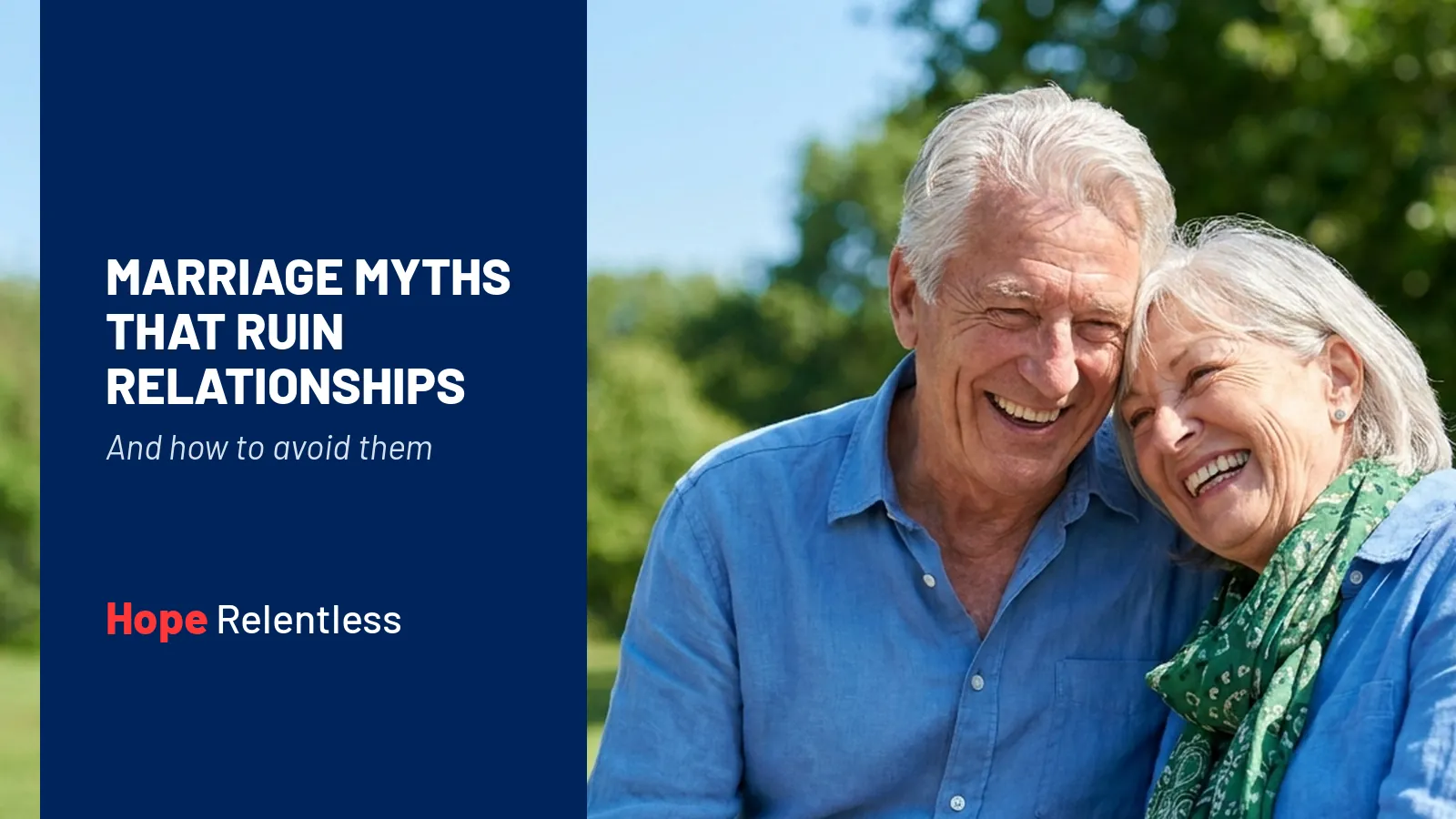
After years of working with couples every day, you start to notice the same questions coming up again and again. And underneath a lot of them are quiet myths, beliefs that sound romantic but slowly do real damage to a marriage.
Today we're tackling three of the most common ones we hear, from listeners and from the couples we coach. None of them seem dangerous on the surface. That's exactly why they're worth busting.
Prefer to watch or listen? Press play above, or use the podcast player below.
Here's the thread running through all three: a marriage left to chance drifts. A marriage you take ownership of can grow for decades. Let's get into it.
Key Takeaways
- Myth 1: True love shouldn't take work. Early attraction feels effortless, but lasting love takes intentionality. Healthy relationships are not the result of accidents.
- The work is worthwhile. Find any area of life with extended health and strength, and you'll find effort, patterns, and purpose behind it.
- Myth 2: You fall in and out of love. Love is a choice followed by actions, a decision you make and then manage, not a feeling that sweeps you in and back out.
- "Grew apart" is often a story we tell to disengage. Believe the myth and your mind will confirm it. Take ownership and you'll find solutions instead of excuses.
- "I love you, but I don't like you right now" is human. Choosing to build your future together doesn't require liking every moment.
- Myth 3: Counseling is for messed-up couples. It's like the medical field, you go when you're hurting and when you're healthy. The healthy season is often the best time to grow.
- Words matter. You're not "damaged," you're healing. Speak life over your marriage as a statement of faith about where you're headed.
Myth 1: "If It's True Love, It Shouldn't Take Work"
Does true love take work? Yes. It does.
The myth is that if you're truly in love, it should just happen, butterflies and goosebumps the whole way through, and if it doesn't feel effortless, maybe it wasn't real. Part of that is even true at the start. Early on there's a unique attraction and connection that genuinely doesn't feel like work. But when we're talking about the health and strength of a relationship for the long haul, that's where intentionality and purpose come in.
Think about it this way: in what area of life do you find extended growth, health, and strength without some level of effort behind it? Pick any industry and look at who's successful long-term, there are almost always patterns, habits, and intentional effort underneath. Marriage is two whole lives coming together. Once the initial butterflies settle, there's learning, growing, and stretching required for the relationship to thrive.
One of the biggest disservices in marriage is how little we prepare for it. You go to driving school and pass a test before you operate a car. Marriage is far more powerful and far more impactful, and most of us were never sat down and told the truth: this will take intentionality, not just for the first couple of years, but for life. If we heard that early, our expectations would shift, and a hard season would feel like a normal part of the work instead of proof something's broken. (That's a big reason we believe so deeply in premarital counseling, getting prepared before you say "I do.")
Myth 2: "You Can Fall In and Out of Love"
We use this language all the time. "I fell hard." "We just fell out of love." It even shows up in divorce filings as irreconcilable differences. But notice what the phrase itself implies: if you can fall into something, you can fall right back out, like stepping into a puddle. It frames love as passive, accidental, and fragile.
We see it differently. Love, in its best form, is a choice followed by actions. You make the decision to love this person, and then you manage that decision, you don't re-vote on it every morning. And how do you manage it? By working on it and investing in it.
Now, can you fall in and out of love? The honest answer is a question: is that what you want? If you're passive, just an observer swept up in early romance and then disappointed as it fades, then yes, that will probably be your experience. But relationships that last not weeks or years but decades aren't passive. Those couples didn't simply never fall out of love. They made intentional choices to sow into their marriage, year after year.
Here's why this myth is so dangerous: when a dry season comes, and they come, believing you can "fall out of love" hands you a reason to disengage. "Maybe we just grew apart." Your mind is powerful. Look for evidence that you're not in love anymore and you'll find it in every word and glance. But decide from the start that love is a commitment you've made, and when the hard times come, you'll dig deep and look for options, because falling out of love isn't one of them. (This is the same ownership mindset we unpack in growth that lasts.)
And let's be human about it: there are seasons where I can honestly say, "I love you, but I don't like you right now." That's real. Choosing to build your life and future with someone doesn't mean you love how they talked to you this afternoon. Ownership finds solutions. A lack of ownership finds excuses to let us off the hook.
Save this for later
Myth 3: "Counseling Is for Messed-Up Couples"
Yes, counseling is for couples who need help. And also, no, it is not only for them.
Think of the medical field. Do you see a doctor when you're sick or injured? Yes. But do you also go when you're healthy, for an annual physical, for preventative checkups as you get older? Best practice says yes. Counseling and coaching work the same way. The myth quietly suggests that if your marriage is flourishing, you'd have no reason to go, and that's just not true. A flourishing season is often the best time, because you're building on a strong foundation and taking things to the next level.
Couples often wait around seven years before they reach out for help. Seven years. So yes, if you're hurting, counseling is for you, and there's every reason for hope: get good counsel, learn, apply things differently than before, and it's completely reasonable to expect different results. We see it constantly, relationships full of pain and disconnection that start to grow once a couple gets the right guidance. (Want to go deeper on this? See our episode on the importance of wise counsel.)
Nobody says coaches are only for messed-up athletes. Coaches are for teams and athletes who want to become the best version of themselves. We have our own marriage mentors, and we meet with them both when things are going great and when we've hit a wall we couldn't solve on our own. Our hope is that couples would start getting guidance earlier, in premarital season, early in marriage, just to make it a habit. (Our online marriage coaching makes that possible from anywhere.)
One more thing, because the word "messed up" kept catching us. We worked with a couple walking through infidelity, and they'd quietly accepted that one spouse was "damaged" by what she was going through. They didn't mean it harshly, but words matter. She's not damaged. She's in a season of healing. The couples who reach out aren't messed up either, they're just in a season where they could use some support. Speak life. Even when you don't feel it yet, that's not being inauthentic, it's faith about the direction you're going.
And that's the quiet power of getting counsel: often, before a single circumstance changes, the hope and the perspective change. A couple starts to believe they're learning, growing, and finally getting tools to handle the same old problems differently. That shift alone is worth it.
Not sure where to start? Take the free Connection Pulse
A 10-minute assessment that shows you where your marriage is strong and where it's drifting, plus your number one next step. Clear, judgment-free, no crisis required.
Take the Free AssessmentKey Scriptures
Your Next Step This Week
Pick the one myth you've quietly believed, that love should be easy, that you might be falling out of it, or that you'd only get help if things were bad, and say it out loud to your spouse. Then name one small, intentional action you'll take this week that the myth would have told you wasn't necessary.
The Other Myths Worth Naming
Three myths is only the start. Each of these takes one apart on its own terms.
- does true love take work, the myth that trips up good couples
- can you fall out of love, and why love is a choice before it is a feeling
- is counseling only for messed up couples, and what that myth costs
- should your spouse meet all your needs, and why that weight is too heavy for one person
- should you have a backup plan for marriage, and how a plan B quietly undermines plan A
- does marriage take work, or should it just be easy
- should I stay or should I go, when you are honestly not sure anymore
Reflection Questions for Couples
- Which of these three myths have we believed, even a little? How has it shaped how we show up?
- Where in our marriage have we been waiting for it to feel "natural" instead of being intentional?
- When a dry season hits, what story do we tend to tell ourselves? Is it true?
- What would it look like to see counseling or coaching as preventative, not just a last resort?
- Are there words we use about ourselves or our marriage that we'd be better off replacing with words that speak life?
Save this for later
A fresh perspective can change your marriage before your circumstances do.
If one of these myths has been quietly steering your relationship, let's talk. One honest conversation is often where the hope comes back.
Schedule a Free ConsultationOne conversation. 30 minutes. You'll know if it's a fit.
Cheering you on,
- Chad & Sarah-Gayle
There's always, always hope.
Sarah-Gayle Galbreath, MSMFT holds a Master's in Marriage and Family Therapy and co-leads Hope Relentless with her husband, Chad. She's passionate about helping couples move from roommates to teammates.
Chad Galbreath is an ordained minister and marriage coach. Married 21 years, he and Sarah-Gayle have spent 15+ years helping couples build marriages that thrive. They host the Hope Relentless Christian Marriage Podcast.
Read the full episode transcript
hello and welcome to the Hope Relentless marriage podcast Chad and Sarah-Gayle here and we are honored that you are tuning in to listen I want to remind you that you are making a difference in the world right now because you are investing in your relationship we know that our marriage impacts our day-to-day personally and we also know that our marriages impact our families families impact communities and communities impact the world so well done on changing the world yeah and so thank you for listening to the podcast our Dream our desire is to continue to add value into your life and into your relationships and today's
podcast we're going to be looking at some of the most common questions that we get asked this could be either from people who listen to the podcast or just common themes that come up when we are working with couples and marriages in counseling so every day Sarah-Gayle and I and our team we work with couples and one of the benefits is we start to recognize and see patterns and themes and these are some of the questions that are consistently coming up that Sarah-Gayle and I want to just shed some of our thoughts some of our opinions and some of our perspective on so bab can
you share what is the first question that we're going to talk about today yes I'm happy to share I feel like I should have a sharing voice like I think I'm going to go deep when I say the question and then I'll go back to my voice when I answer the question the first question is does true love take work all right well glad you you asked that question does true love take work yes it does I think the myth of this is that if we are in love with someone it should just work we should just feel how we feel it should just be
natural and we should have the butterflies goosebumps throughout the entire time because if we don't then perhaps it wasn't true love and when it comes to the work that True Love Takes I think that it also matters as far as the connotation of the word work a lot of times when we say work people think of or at least at least I think of you know working out in the in the hot sun of Arizona doing construction I have my my little Hammer thing trying to to dig and that is some work and so I think of that a lot of times but the work
of marriage is very worthwhile and it's actually very rewarding yeah it's funny your definition of work is something you've never done before so that's amazing you've never had a shovel or a or a pick out in the Arizona desert but um yeah I mean I think this is something that I think the word myth you know somewhere in our social expectations we feel like true love should be natural and should be easy and I think there are some Dynamics to myths that are true right there's dynamics that when we first meet somebody there can be an attraction there can be a desire there can be
a connection that is unique and different than how people interact with other people and those early stages don't feel like work it feels natural right but when we're talking about the the health and the strength of a relationship for the long term well then there becomes a level of intentionality and a level of purpose that is required for that love to continue and so you I think this concept of do true love take work I would kind of be like in what area of Life do we have extended growth extended health extended strength where there isn't some area of intentionality or work involved and there
isn't find a different industry and think about how somebody would define success or successful and there's likely individuals who are putting in effort that are building patterns and habits there's a reason that they had extended success extended you know in this capacity and so I think that idea of does true love take work the reality is if you want it to last for a long time yeah you know you're two lives coming together and once you get past some of the initial butterflies there's going to be some intentionality there's going to be some learning there's going to be some growing and some stretching that takes
place in order for that relationship to thrive in the long term yeah and the last thing I'll say on this is I think one of the greatest dis Services when it comes to marriage is the lack of preparation that we put into it you know to get your driver's license for example you you go to driving school you have to take a test and there's things you you do to prepare to drive uh such a powerful machine as as a car and so in marriage oh my goodness all the more in the sense of what the impact is for marriage and what the possibilities are
for marriage all the more reason to really invest in it and prepare yourself so that's speaking to premarital but I think the disservice is that we aren't told at least I wasn't I don't know if those listening were I wasn't told and sat down and and and and led to understand that yes it it's going to take intentionality it's going to take work and it's not just going to take work for the first couple years it's the rest of your life as you say yes as you say I do you are committing to in investing in your marriage working in your marriage until time until
the end of time and so I think if we were told that early on our expectations can be shifted a bit and then when we are in the midst of it and it's hard and we're thinking oh it's just not feeling awesome we're not thinking oh it just should we're thinking oh I that I expect that because I haven't been investing what I need to invest in my relationship so that's ask do you have anything else yeah just the last thing I'll say is healthy relationships are not the result of accidents it's good that's good there's there's a level of purpose and intentionality so if
that's translated into work then true love requires work yeah so all these questions I'm realizing they kind of flow into each other so that's cool how this is working out because the next question let me get my question voice is can you fall in and out of love that's a good question because I think that we use that word oh I I I fell hard I fell in love or a lot of times when marriages are dissolving it's irreconcilable differences but really we fell out of love and I think from the from the F from the start of this phrase to fall into something to
me it tells me you can fall out of something if you can fall into something it it kind of has this precarious feel to it it's like just emotion it's just naive I fell into it just like oh I fell into a puddle and then it implies that you can fall out of it just as easy and so when it comes to Falling In and Out of Love I believe that love is a choice is an ultimately a decision that you make and once you make the decision that you're going to love this P person you manage the decision that you've made you don't keep
making the decision again it's something that's to be managed and kind of like what we just were talking about how we manage that is we are working on it we are investing in it yeah I mean I think that question can you fall in and out of love um it's almost met with another question is that what you want and if the answer is yes then I would say yeah you can fall in and out of love but I think big picture I don't know that that's what we want and I think it goes a little bit back to does true love take work and
the answer is yes if somebody is reactive to the relationships in their life they're just almost like an observer um a passive you know person then you could fall in and then fall out of love and likely that will be your experience kind of swept up in the romance or the excitement or the anticipation that is common early in relationships and then disappointed where as that starts to fade and Wayne but I think what we see is in relationships that survive not weeks and months and years but decades it it's not a passive Dynamic right there's once again there's a level of intentionality and a
level of action I love that you said I think in its best form that love is a choice followed by actions and so in that capacity this idea of just being Swept Away by by Gravity by love gravity is less what we see in relationships that are thriving 10 20 30 50 60 years down the road it wasn't that they just never fell out of love it's that they made choices to intentionally sew into their marriage sew into their relationship and realize that it was actions and choices is that allowed the relationship to hopefully not just survive time but to continue to grow and flourish
year after year decade after decade yeah that's good that's a that's an interesting thought that different perspective in a sense that you kind of shared where it's like yeah if that's what you want sure and I think that it's it's one of those things when you've been married for a long time you don't always feel feel loving you know you don't always feel like oh I'm in love you don't always feel those butterflies and so I think what happens when we ask this question and we think that it is something that actually is is valid then in those Seasons those dry seasons if you will
it almost gives us a reason to disengage because then we start to think oh well maybe we're just not in love anymore maybe we've just Grown Apart and that's kind of a very defeating attitude whereas if we decide from the get-go like this is what we're doing this is my decision this is what I'm going to sew into this is what I'm going to invest in then in those dry seasons we're able to to recognize okay well I can have the relationship that I want to have we can have the relationship we want to have it just takes that intentionality because our mind is so
powerful so if we're thinking oh maybe we just grew apart maybe we're not in love anymore then guess what we're gonna we're going to confirm that over and over again in the things we're looking for in the words we're saying but if we think oh you know it's not a that's not even a real thing this is a decision a commitment that I've made then when we have those Hard Times we're going to start to dig deep we're going to start to look at different options uh because falling out of love is not one of them yeah I mean I think perspective and ownership is
so powerful and so if we see it as this Whimsical thing that we can't control then when our relationship starts to drift we just accept it whereas when we take ownership and see love and relationships as a choice as actions as something that we can have a positive impact on well then when we start to drift we take different actions to resolve the issues maybe it's personal growth maybe it's communication maybe whatever it is will take action as opposed to like oh just I don't know what happened I'm just it we fell out of love and often times that might be a sign of yeah
we're we're we feel defeated or I feel defeated and so I'm not willing to put in the work to try and resolve and and I get while people will have have gotten to that place you know the reality is and this might be kind of a a a very simplistic statement but there are times in our relationship where I think I could say I love you but I don't like you right now what what are you talking about and I imagine that you have moments too where you're making a choice of no I love Chad I'm GNA I'm choosing to build my life and my
future with him but right now I didn't like the way he talked to me I didn't like the way he treated me I didn't you know like that's that's realistic that's that's people that's Humanity um and so I think part of it is what do people want I feel like when we take ownership when we identify what we want and we take ownership of it then we find solutions to move in that direction when we don't take ownership then we find excuses to let ourselves off the hook and I think that is kind of what this falling in and falling out of love is we're
looking for a reason to kind of bail that realistically isn't our fault somebody else's or some Whimsical thing all right well we'll move on to the last question the last question is is counseling for messed up couples yes I I love how that's worded that phrase that that it's phrased like that like it's counseling for messed up couples because I think that's honestly what we think sometimes even when we are ourselves going to counseling it's like we're messed up we're a mess and that you know that hashtag bless this mess it's like I don't want to bless this mess I want to get healthy and
so and and obviously healthy is not Perfection it's a it's a different thing alt together but counseling yes it's for couples who need assistance who need help but I think what it's what this implies a little bit to me at least is that if you are a couple who is in a season that is good in a you're flourishing as a couple it kind of implies that you wouldn't be one to go to counseling and I don't think that that's true I think that a lot of times when we're flourishing that's the best time to go to counseling because it's continuing to build on what
is already there it's continuing to add the things that you want to make your relationship go to the next level there's always growth that can occur and it's it's always significant to have a another voice that's speaking into your relationship that's encouraging it and that's helping you guys to do the things that you want to do yeah I mean I think counseling can be a lot like the medical field right do I go to a doctor when I'm sick or injured yes but do I also go to a doctor at least best practices when I'm healthy yes do I maybe go as often when I'm
healthy maybe not as often annual physicals different checkups as you get older you might go ahead of time because it's preventative I think about when we work with couples you know you share this stat and I think it's I think it's initially from gotman but that couple often wait seven years before they seek counsel or get help and so yeah is counseling for messed up couples absolutely but do messed up couples still have reason to have hope absolutely if you get counsel and you start to learn and apply things differently than what you did in the past then it is totally reasonable to anticipate different
results moving forward and so hope Relentless every day we have tons of reviews counselors have tons of reviews where relationships were causing pain they were disconnected there was lack of communication they get counsel and guess what they start to see growth and Improvement in these areas but what I would also say is counseling is also for couples who in this season aren't messed up and one of the best ways to avoid some of the more painful seasons of relationships or life is to make it a habit to consistently learn and grow and get counsel get wisdom get practical advice in every area of our life
especially relationships you know when our relationship is messed up when we're struggling when we're disconnected when we're uh fighting whatever that may be it impacts every other area of my life it impacts uh how I interact with the kids it impacts how I show up at church or at work or in different areas yes and so yeah it makes sense to to get counsel this is one of the reasons for us that we have um essentially our own marriage mentors and we meet with them both when things are going well but also when things when we hit a wall it's like yeah of course we
want to get help we've hit a wall that we've tried to solve on our own and we haven't been able to so we're getting we're getting counsel we're getting advice and I think my heart and my desire is I would love for couple to start getting guidance and counsel earlier premarital yeah early in marage just to make it a habit and a pattern um I mean you think about in business in sports people have coaches people have mentors nobody's like ah coaches are only for messed up athletes it's like no that's funny I like well put yeah coaches are for teams and for athletes who
want to become the best versions of themsel and so yeah when you're hurt do you need some guidance absolutely but when you're healthy and you want to experience another level that's also a time to get counsel and I think that's an area that we're starting to see some growth and progress but there's a ton of opportunity um that is there for us as individuals to see counsel and counseling different yeah so just on that as far as for healthy couples seeking counseling so I have one couple right now that I'm working with and they are phenomenal they are high capacity individuals running businesses like phenomenal
and I'm just like can can you counsel me can can I learn from you guys and it's kind of like on the surface there's there's nothing really to talk about there's not anything really deep that they're going through that's uh detrimental or anything but they are growing and they are sharpening they're sharpening the the skills their communication skills they are being reminded of the things that they love about each other and reminded of their priorities and how they want to continue to grow together and so for them it looks a bit different than a couple that's in crisis and it's absolutely amazing because they're growing
just as much as a couple that would be in crisis just in different ways and so you never know what you don't know right like we don't know what we don't know and so when you expose yourself to counselors to mentors people who can speak into that those areas then there's amazing opportunity for growth and then the last thing I want to say on this because how the question was phrased I thought was interesting and I get I keep getting triggered when I'm hearing this phrase as far as messed up messed up you know and I was working with another couple where they were dealing
with infidelity and the one of the they just kind of acknowledged or they accepted that the one of the spouses was damaged because of what she was going through so now she's damaged and they didn't mean it in a negative way but I caught it and I'm just like you're not damaged no like on the contrary and also these couples that that are reaching out in this question the messed up couples they're not messed up they're just in a season where they could use some help some support the the wife is not damaged she's in a season where she's healing how we say the words
that we say are significant and we don't want to put ourselves in a box that we don't want to be in we want to make sure that we are speaking life and and that's a that's a statement of faith even if we don't feel it we're speaking it and it's not being inauthentic it's it's a statement of faith that this is where we're headed so I just wanted to point that out because I was triggered every time we kept saying messed up I'm like yeah I mean I think I know we're going to wrap this up I think it highlights the power of perspective and
once again it highlights the growth that can take place by seeking counseling often times when we first start working with couples not a lot has changed in their actual circumstances but a lot has changed in terms of their hope and their perspective they now believe that we're learning and that we're growing and the problems that we've been um struggling with we're now getting the tools to manage differently and that's one of the powerful things about getting counseling in our lives and our relationships so that we can have that hope and that fresh perspective of growth and progress okay well let end in some appreciation some
public appreciation and Chad one thing that I appreciate about you is the way you think and I know that's surprising because that's created a lot of contention for us in the past because we are so different but goodness I feel like we make such a great team because I will think about something in one way and then you have a completely different way of thinking about it but it's necessary and it makes what I'm saying that much Fuller and complete because it's it's a different side of it so I really appreciate about appreciate that about you I think one of the things I appreciate about
you is the way that you feel I am as you just suggested a thinker so even when I'm asked how I feel I default to how I think and the reality is our emotions and our feelings are valuable and important and so so you're such a healthy reminder to be aware of that not just for me but also for our sons for our household to recognize our emotions and our feelings and to validate them and really to get a better understanding of what they are so I appreciate that you help all of us become a more holistic individuals that are more attuned with how we
feel a I feel very tender about that appreciation so thank you well we're going to be ending and there's no way to do it Grace gracefully so I want to end you with this that no matter what you are going through no matter what season of life you are in that there is always always hope